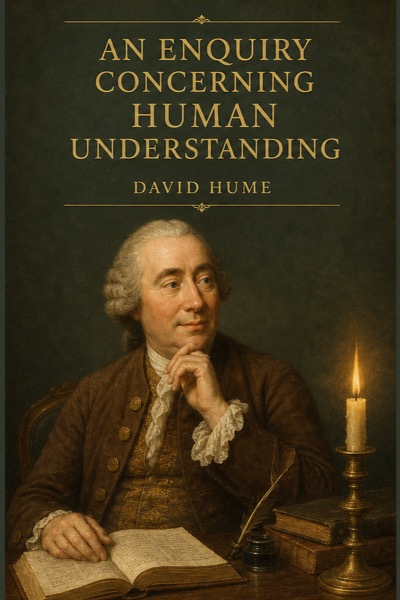

David Hume's exploration unveils the intricacies of human understanding, challenging the foundations of knowledge and belief
Read full overviewShow less›
In 'An Enquiry Concerning Human Understanding,' David Hume delves into the nature of human cognition, questioning the reliability of our perceptions and the principles guiding our reasoning. By dissecting the distinction between impressions and ideas, he offers a profound examination of how we form beliefs and make judgments about the world. Hume's insights extend into the realms of morality, causation, and the limits of human understanding, inviting readers to reconsider the foundations of their own knowledge. This exploration not only serves as a philosophical inquiry but also as a guide to navigating the complexities of human thought and behavior. Engaging with Hume's work equips readers with the tools to critically assess their beliefs and the nature of reality itself.
Hume's 'An Enquiry Concerning Human Understanding' serves as a profound exploration of the nature of human cognition, challenging readers to reconsider the foundations of their beliefs and the limits of their understanding. By dissecting the distinctions between impressions and ideas, the principles of association, and the nature of causation, Hume invites a critical examination of how we navigate the world. His emphasis on scepticism and the importance of questioning dogmatic beliefs encourages a more nuanced approach to philosophy and knowledge. Ultimately, Hume's insights remain relevant, providing a framework for understanding the complexities of human thought and the interplay between experience, belief, and reason.
- 1Two Approaches to Philosophy
- 2Impressions vs. Ideas
- 3The Association of Ideas
- 4Relations of Ideas vs. Matters of Fact
- 5Causation and Experience
A glimpse inside

Hume delineates two distinct approaches to philosophy: one that emphasizes moral philosophy and human action, and another that prioritizes the rational examination of hum… Read moreHume delineates two distinct approaches to philosophy: one that emphasizes moral philosophy and human action, and another that prioritizes the rational examination of human nature. The former seeks to inspire virtue through emotional engagement, using vivid examples and eloquent rhetoric to evoke the sentiments of morality in the reader. In contrast, the latter approach focuses on the rigorous analysis of the principles governing human understanding, aiming to establish a solid foundation for moral reasoning and critical thought. Hume believes that both approaches have merit, contributing to the entertainment and enlightenment of mankind. The balance between action-oriented philosophy and speculative reasoning is crucial for a comprehensive understanding of human nature. Show less
One of Hume's fundamental distinctions lies between 'impressions' and 'ideas.' Impressions are the raw, vivid experiences we encounter through our senses, such as the pai… Read moreOne of Hume's fundamental distinctions lies between 'impressions' and 'ideas.' Impressions are the raw, vivid experiences we encounter through our senses, such as the pain of heat or the pleasure of warmth. These experiences are immediate and forceful, shaping our understanding of the world. Ideas, on the other hand, are the faint copies of these impressions, recalled by the mind in a less vivid form. Hume asserts that while we can think about our sensations and reflect on our emotions, the strength of these thoughts can never match the intensity of the original impressions. This distinction is crucial for understanding how humans process information and form beliefs, as it highlights the limitations of our cognitive faculties in replicating the richness of direct experience. Show less
Read the full text — free
About the author
David Hume has 2 works free to read on Lumina, including A Treatise of Human Nature
All 2 books by David Hume →