The Jungle Book · Rudyard Kipling
Part 9
Chapter 9 of 15 · 14 min read
That nearly broke his heart, and he headed round the Horn back to his own beaches; and on his way north he hauled out on an island full of green trees, where he found an old, old seal who was dying, and Kotick caught fish for him and told him all his sorrows. “Now,” said Kotick, “I am going back to Novastoshnah, and if I am driven to the killing-pens with the holluschickie I shall not care.”
The old seal said, “Try once more. I am the last of the Lost Rookery of Masafuera, and in the days when men killed us by the hundred thousand there was a story on the beaches that some day a white seal would come out of the North and lead the seal people to a quiet place. I am old, and I shall never live to see that day, but others will. Try once more.”
And Kotick curled up his mustache (it was a beauty) and said, “I am the only white seal that has ever been born on the beaches, and I am the only seal, black or white, who ever thought of looking for new islands.”
This cheered him immensely; and when he came back to Novastoshnah that summer, Matkah, his mother, begged him to marry and settle down, for he was no longer a holluschick but a full-grown sea-catch, with a curly white mane on his shoulders, as heavy, as big, and as fierce as his father. “Give me another season,” he said. “Remember, Mother, it is always the seventh wave that goes farthest up the beach.”
Curiously enough, there was another seal who thought that she would put off marrying till the next year, and Kotick danced the Fire-dance with her all down Lukannon Beach the night before he set off on his last exploration. This time he went westward, because he had fallen on the trail of a great shoal of halibut, and he needed at least one hundred pounds of fish a day to keep him in good condition. He chased them till he was tired, and then he curled himself up and went to sleep on the hollows of the ground swell that sets in to Copper Island. He knew the coast perfectly well, so about midnight, when he felt himself gently bumped on a weed-bed, he said, “Hm, tide’s running strong tonight,” and turning over under water opened his eyes slowly and stretched. Then he jumped like a cat, for he saw huge things nosing about in the shoal water and browsing on the heavy fringes of the weeds.
“By the Great Combers of Magellan!” he said, beneath his mustache. “Who in the Deep Sea are these people?”
They were like no walrus, sea lion, seal, bear, whale, shark, fish, squid, or scallop that Kotick had ever seen before. They were between twenty and thirty feet long, and they had no hind flippers, but a shovel-like tail that looked as if it had been whittled out of wet leather. Their heads were the most foolish-looking things you ever saw, and they balanced on the ends of their tails in deep water when they weren’t grazing, bowing solemnly to each other and waving their front flippers as a fat man waves his arm.
“Ahem!” said Kotick. “Good sport, gentlemen?” The big things answered by bowing and waving their flippers like the Frog Footman. When they began feeding again Kotick saw that their upper lip was split into two pieces that they could twitch apart about a foot and bring together again with a whole bushel of seaweed between the splits. They tucked the stuff into their mouths and chumped solemnly.
“Messy style of feeding, that,” said Kotick. They bowed again, and Kotick began to lose his temper. “Very good,” he said. “If you do happen to have an extra joint in your front flipper you needn’t show off so. I see you bow gracefully, but I should like to know your names.” The split lips moved and twitched; and the glassy green eyes stared, but they did not speak.
“Well!” said Kotick. “You’re the only people I’ve ever met uglier than Sea Vitch—and with worse manners.”
Then he remembered in a flash what the Burgomaster gull had screamed to him when he was a little yearling at Walrus Islet, and he tumbled backward in the water, for he knew that he had found Sea Cow at last.
The sea cows went on schlooping and grazing and chumping in the weed, and Kotick asked them questions in every language that he had picked up in his travels; and the Sea People talk nearly as many languages as human beings. But the sea cows did not answer because Sea Cow cannot talk. He has only six bones in his neck where he ought to have seven, and they say under the sea that that prevents him from speaking even to his companions. But, as you know, he has an extra joint in his foreflipper, and by waving it up and down and about he makes what answers to a sort of clumsy telegraphic code.
By daylight Kotick’s mane was standing on end and his temper was gone where the dead crabs go. Then the Sea Cow began to travel northward very slowly, stopping to hold absurd bowing councils from time to time, and Kotick followed them, saying to himself, “People who are such idiots as these are would have been killed long ago if they hadn’t found out some safe island. And what is good enough for the Sea Cow is good enough for the Sea Catch. All the same, I wish they’d hurry.”
It was weary work for Kotick. The herd never went more than forty or fifty miles a day, and stopped to feed at night, and kept close to the shore all the time; while Kotick swam round them, and over them, and under them, but he could not hurry them up one-half mile. As they went farther north they held a bowing council every few hours, and Kotick nearly bit off his mustache with impatience till he saw that they were following up a warm current of water, and then he respected them more.
One night they sank through the shiny water—sank like stones—and for the first time since he had known them began to swim quickly. Kotick followed, and the pace astonished him, for he never dreamed that Sea Cow was anything of a swimmer. They headed for a cliff by the shore—a cliff that ran down into deep water, and plunged into a dark hole at the foot of it, twenty fathoms under the sea. It was a long, long swim, and Kotick badly wanted fresh air before he was out of the dark tunnel they led him through.
“My wig!” he said, when he rose, gasping and puffing, into open water at the farther end. “It was a long dive, but it was worth it.”
The sea cows had separated and were browsing lazily along the edges of the finest beaches that Kotick had ever seen. There were long stretches of smooth-worn rock running for miles, exactly fitted to make seal-nurseries, and there were play-grounds of hard sand sloping inland behind them, and there were rollers for seals to dance in, and long grass to roll in, and sand dunes to climb up and down, and, best of all, Kotick knew by the feel of the water, which never deceives a true sea catch, that no men had ever come there.
The first thing he did was to assure himself that the fishing was good, and then he swam along the beaches and counted up the delightful low sandy islands half hidden in the beautiful rolling fog. Away to the northward, out to sea, ran a line of bars and shoals and rocks that would never let a ship come within six miles of the beach, and between the islands and the mainland was a stretch of deep water that ran up to the perpendicular cliffs, and somewhere below the cliffs was the mouth of the tunnel.
“It’s Novastoshnah over again, but ten times better,” said Kotick. “Sea Cow must be wiser than I thought. Men can’t come down the cliffs, even if there were any men; and the shoals to seaward would knock a ship to splinters. If any place in the sea is safe, this is it.”
He began to think of the seal he had left behind him, but though he was in a hurry to go back to Novastoshnah, he thoroughly explored the new country, so that he would be able to answer all questions.
Then he dived and made sure of the mouth of the tunnel, and raced through to the southward. No one but a sea cow or a seal would have dreamed of there being such a place, and when he looked back at the cliffs even Kotick could hardly believe that he had been under them.
He was six days going home, though he was not swimming slowly; and when he hauled out just above Sea Lion’s Neck the first person he met was the seal who had been waiting for him, and she saw by the look in his eyes that he had found his island at last.
But the holluschickie and Sea Catch, his father, and all the other seals laughed at him when he told them what he had discovered, and a young seal about his own age said, “This is all very well, Kotick, but you can’t come from no one knows where and order us off like this. Remember we’ve been fighting for our nurseries, and that’s a thing you never did. You preferred prowling about in the sea.”
The other seals laughed at this, and the young seal began twisting his head from side to side. He had just married that year, and was making a great fuss about it.
“I’ve no nursery to fight for,” said Kotick. “I only want to show you all a place where you will be safe. What’s the use of fighting?”
“Oh, if you’re trying to back out, of course I’ve no more to say,” said the young seal with an ugly chuckle.
“Will you come with me if I win?” said Kotick. And a green light came into his eye, for he was very angry at having to fight at all.
“Very good,” said the young seal carelessly. “If you win, I’ll come.”
He had no time to change his mind, for Kotick’s head was out and his teeth sunk in the blubber of the young seal’s neck. Then he threw himself back on his haunches and hauled his enemy down the beach, shook him, and knocked him over. Then Kotick roared to the seals: “I’ve done my best for you these five seasons past. I’ve found you the island where you’ll be safe, but unless your heads are dragged off your silly necks you won’t believe. I’m going to teach you now. Look out for yourselves!”
Limmershin told me that never in his life—and Limmershin sees ten thousand big seals fighting every year—never in all his little life did he see anything like Kotick’s charge into the nurseries. He flung himself at the biggest sea catch he could find, caught him by the throat, choked him and bumped him and banged him till he grunted for mercy, and then threw him aside and attacked the next. You see, Kotick had never fasted for four months as the big seals did every year, and his deep-sea swimming trips kept him in perfect condition, and, best of all, he had never fought before. His curly white mane stood up with rage, and his eyes flamed, and his big dog teeth glistened, and he was splendid to look at. Old Sea Catch, his father, saw him tearing past, hauling the grizzled old seals about as though they had been halibut, and upsetting the young bachelors in all directions; and Sea Catch gave a roar and shouted: “He may be a fool, but he is the best fighter on the beaches! Don’t tackle your father, my son! He’s with you!”
Kotick roared in answer, and old Sea Catch waddled in with his mustache on end, blowing like a locomotive, while Matkah and the seal that was going to marry Kotick cowered down and admired their men-folk. It was a gorgeous fight, for the two fought as long as there was a seal that dared lift up his head, and when there were none they paraded grandly up and down the beach side by side, bellowing.
At night, just as the Northern Lights were winking and flashing through the fog, Kotick climbed a bare rock and looked down on the scattered nurseries and the torn and bleeding seals. “Now,” he said, “I’ve taught you your lesson.”
“My wig!” said old Sea Catch, boosting himself up stiffly, for he was fearfully mauled. “The Killer Whale himself could not have cut them up worse. Son, I’m proud of you, and what’s more, I’ll come with you to your island—if there is such a place.”
“Hear you, fat pigs of the sea. Who comes with me to the Sea Cow’s tunnel? Answer, or I shall teach you again,” roared Kotick.
There was a murmur like the ripple of the tide all up and down the beaches. “We will come,” said thousands of tired voices. “We will follow Kotick, the White Seal.”
Then Kotick dropped his head between his shoulders and shut his eyes proudly. He was not a white seal any more, but red from head to tail. All the same he would have scorned to look at or touch one of his wounds.
A week later he and his army (nearly ten thousand holluschickie and old seals) went away north to the Sea Cow’s tunnel, Kotick leading them, and the seals that stayed at Novastoshnah called them idiots. But next spring, when they all met off the fishing banks of the Pacific, Kotick’s seals told such tales of the new beaches beyond Sea Cow’s tunnel that more and more seals left Novastoshnah. Of course it was not all done at once, for the seals are not very clever, and they need a long time to turn things over in their minds, but year after year more seals went away from Novastoshnah, and Lukannon, and the other nurseries, to the quiet, sheltered beaches where Kotick sits all the summer through, getting bigger and fatter and stronger each year, while the holluschickie play around him, in that sea where no man comes.
Lukannon
This is the great deep-sea song that all the St. Paul seals sing when they are heading back to their beaches in the summer. It is a sort of very sad seal National Anthem.
I met my mates in the morning (and, oh, but I am old!) Where roaring on the ledges the summer ground-swell rolled; I heard them lift the chorus that drowned the breakers’ song— The Beaches of Lukannon—two million voices strong.
The song of pleasant stations beside the salt lagoons, The song of blowing squadrons that shuffled down the dunes, The song of midnight dances that churned the sea to flame— The Beaches of Lukannon—before the sealers came!
I met my mates in the morning (I’ll never meet them more!); They came and went in legions that darkened all the shore. And o’er the foam-flecked offing as far as voice could reach We hailed the landing-parties and we sang them up the beach.
The Beaches of Lukannon—the winter wheat so tall— The dripping, crinkled lichens, and the sea-fog drenching all! The platforms of our playground, all shining smooth and worn! The Beaches of Lukannon—the home where we were born!
I met my mates in the morning, a broken, scattered band. Men shoot us in the water and club us on the land; Men drive us to the Salt House like silly sheep and tame, And still we sing Lukannon—before the sealers came.
Wheel down, wheel down to southward; oh, Gooverooska, go! And tell the Deep-Sea Viceroys the story of our woe; Ere, empty as the shark’s egg the tempest flings ashore, The Beaches of Lukannon shall know their sons no more!
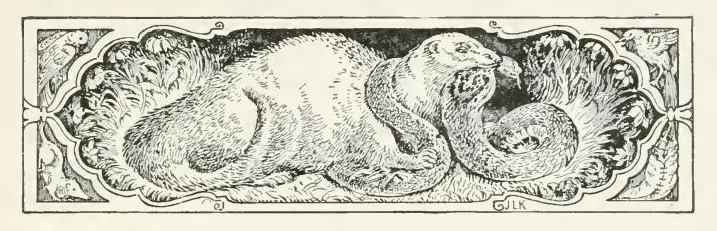
“Rikki-Tikki-Tavi”
At the hole where he went in Red-Eye called to Wrinkle-Skin. Hear what little Red-Eye saith: “Nag, come up and dance with death!”
Eye to eye and head to head, (Keep the measure, Nag.) This shall end when one is dead; (At thy pleasure, Nag.) Turn for turn and twist for twist— (Run and hide thee, Nag.) Hah! The hooded Death has missed! (Woe betide thee, Nag!)
This is the story of the great war that Rikki-tikki-tavi fought single-handed, through the bath-rooms of the big bungalow in Segowlee cantonment. Darzee, the Tailorbird, helped him, and Chuchundra, the muskrat, who never comes out into the middle of the floor, but always creeps round by the wall, gave him advice, but Rikki-tikki did the real fighting.
He was a mongoose, rather like a little cat in his fur and his tail, but quite like a weasel in his head and his habits. His eyes and the end of his restless nose were pink. He could scratch himself anywhere he pleased with any leg, front or back, that he chose to use. He could fluff up his tail till it looked like a bottle brush, and his war cry as he scuttled through the long grass was: “Rikk-tikk-tikki-tikki-tchk!”
One day, a high summer flood washed him out of the burrow where he lived with his father and mother, and carried him, kicking and clucking, down a roadside ditch. He found a little wisp of grass floating there, and clung to it till he lost his senses. When he revived, he was lying in the hot sun on the middle of a garden path, very draggled indeed, and a small boy was saying, “Here’s a dead mongoose. Let’s have a funeral.”
“No,” said his mother, “let’s take him in and dry him. Perhaps he isn’t really dead.”
They took him into the house, and a big man picked him up between his finger and thumb and said he was not dead but half choked. So they wrapped him in cotton wool, and warmed him over a little fire, and he opened his eyes and sneezed.
“Now,” said the big man (he was an Englishman who had just moved into the bungalow), “don’t frighten him, and we’ll see what he’ll do.”
It is the hardest thing in the world to frighten a mongoose, because he is eaten up from nose to tail with curiosity. The motto of all the mongoose family is “Run and find out,” and Rikki-tikki was a true mongoose. He looked at the cotton wool, decided that it was not good to eat, ran all round the table, sat up and put his fur in order, scratched himself, and jumped on the small boy’s shoulder.
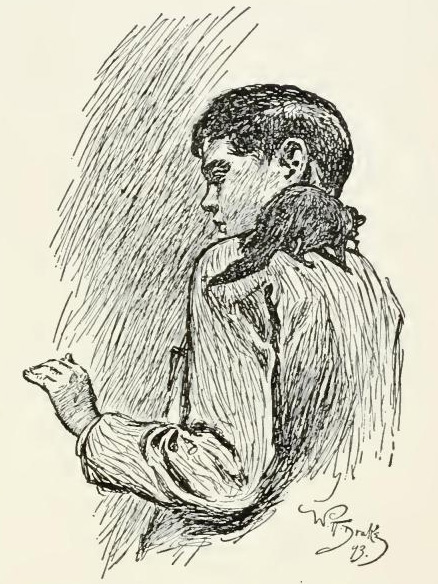
“Don’t be frightened, Teddy,” said his father. “That’s his way of making friends.”
“Ouch! He’s tickling under my chin,” said Teddy.
Rikki-tikki looked down between the boy’s collar and neck, snuffed at his ear, and climbed down to the floor, where he sat rubbing his nose.
“Good gracious,” said Teddy’s mother, “and that’s a wild creature! I suppose he’s so tame because we’ve been kind to him.”
“All mongooses are like that,” said her husband. “If Teddy doesn’t pick him up by the tail, or try to put him in a cage, he’ll run in and out of the house all day long. Let’s give him something to eat.”
They gave him a little piece of raw meat. Rikki-tikki liked it immensely, and when it was finished he went out into the veranda and sat in the sunshine and fluffed up his fur to make it dry to the roots. Then he felt better.
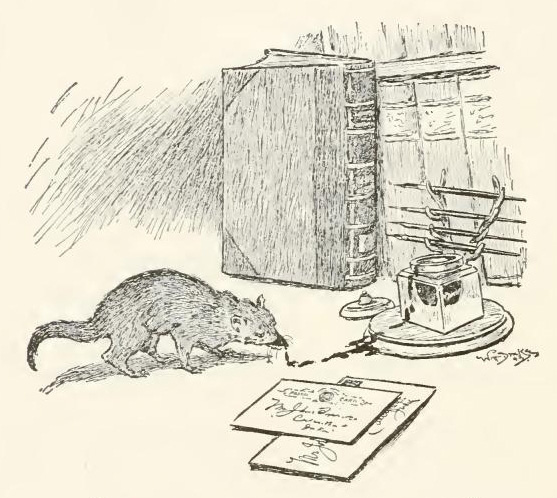
“There are more things to find out about in this house,” he said to himself, “than all my family could find out in all their lives. I shall certainly stay and find out.”
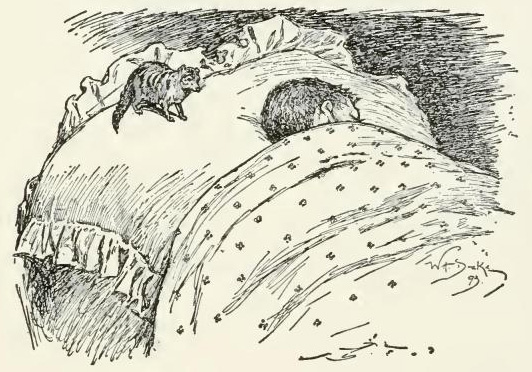
He spent all that day roaming over the house. He nearly drowned himself in the bath-tubs, put his nose into the ink on a writing table, and burned it on the end of the big man’s cigar, for he climbed up in the big man’s lap to see how writing was done. At nightfall he ran into Teddy’s nursery to watch how kerosene lamps were lighted, and when Teddy went to bed Rikki-tikki climbed up too. But he was a restless companion, because he had to get up and attend to every noise all through the night, and find out what made it. Teddy’s mother and father came in, the last thing, to look at their boy, and Rikki-tikki was awake on the pillow. “I don’t like that,” said Teddy’s mother. “He may bite the child.” “He’ll do no such thing,” said the father. “Teddy’s safer with that little beast than if he had a bloodhound to watch him. If a snake came into the nursery now—”