
History · Information science · Information society
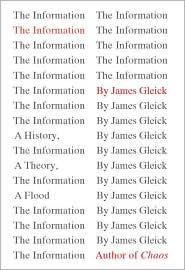
The Information: A History, a Theory, a Flood by James Gleick — Summary, Key Ideas & Quotes
2011526 pages✦ 3-min Big ideas★ 4.0 (21)
Rate it
The Information: A History, a Theory, a Flood begins with the tale of colonial European explorers and their fascination with African talking drums and their observed use to send complex and widely understood messages back and forth between villages far apart, and over even longer distances by relay. The book then covers informational implications of technologies from drum signaling to the long distance telephone. Starting with symbolic written language, The Information examines the history of intellectual insights central to the development of information theory, detailing key figures responsible such as Claude Shannon, Charles Babbage (1791-1871), Ada Byron, Samuel Morse, Alan Turing, Stephen Hawking, Richard Dawkins and John Archibald Wheeler.

Gleick argues that information is not just a byproduct of communication, but a fundamental force shaping the modern world. He traces how the concept evolved from simple messages—like those sent by African talking drums—to the abstract, mathematical formulations of information theory. This shift redefined how we understand everything from language and genetics to physics and consciousness, positioning information as a core element of reality.
The book spotlights Claude Shannon, whose work in the mid-20th century gave rise to information theory. Shannon’s insight—that information could be quantified, transmitted, and manipulated mathematically—laid the groundwork for digital communication, computing, and the Internet. Gleick explains how this theory revolutionized technology and made possible the compression, storage, and transmission of vast amounts of data.
“When information is cheap, attention becomes expensive.”
“We have sought, in vain, for a universal language; and we have found, instead, a universal machine.”
