
The deep dive
Good Energy
by Casey Means with Calley Means
18 min read · Original commentary by Lumina, written with AI
Good Energy asks readers to connect what medicine often separates: symptoms, daily habits, and the work happening inside cells. Its metabolic framework offers a way to rethink chronic health. Reading it critically means distinguishing a useful organizing idea from a proven explanation—and personal agency from responsibility for every outcome.
Prefer the quick version? Read the main learnings →♫ AI-generated voice · press play below to listen and read along; tap any passage to jump to it
01
A Health Book That Changes the Unit of Attention
Good Energy is nonfiction that combines health explanation, medical criticism, personal narrative, and practical guidance. Its main move is to shift attention from individual organs toward the conditions that help cells function. Food, sleep, movement, light, stress, and environmental exposures become parts of one health picture rather than separate lifestyle topics.
Casey Means writes from experiences in surgical training and a later turn toward nutrition and cellular health. The narrator’s frustration concerns recurring illness: treating a local problem can help, yet leave broader patterns unexplored. The book acknowledges medicine’s achievements, especially in emergencies, while questioning how well chronic care addresses prevention.
Readers should expect more than advice about eating and exercise. The argument reaches into laboratory testing, glucose monitoring, household choices, emotional well-being, and cooking. That reach is both its attraction and its central challenge. A framework broad enough to connect many problems must still show where its explanations hold.
Lumina’s reading is that the book works best as an invitation to investigate connections, not as a master diagnosis. Its intellectual question is demanding: how much can shared cellular processes explain, and how should that explanation change decisions without erasing differences between illnesses or people?

Illustrated key idea
Tracking is meant to reveal patterns, not replace judgment02
What Gets Missed When Every Problem Has Its Own Specialist?
The book’s central question is not simply whether healthy habits matter. It asks whether the organization of care can hide relationships among problems. A person may receive help for migraines, high blood pressure, digestive trouble, and disrupted sleep without anyone asking what these conditions might share.
Sarah’s experience gives this concern a concrete form. The book describes disabling migraines alongside several chronic conditions, despite extensive specialist care. Her case motivates the narrator’s search for shared contributors. It does not establish that specialization caused her suffering or that a metabolic approach would resolve every problem. It shows why the narrator finds separate treatment plans insufficient as an overall explanation.
The proposed alternative begins with energy production. Cells need usable energy to repair damage, move materials, communicate, and regulate their internal conditions. The book argues that trouble with this work can appear differently across tissues. From that premise, it connects chronic illness with mitochondrial dysfunction, persistent inflammation, and oxidative stress.
There are two kinds of stakes here. One is biological: a warning may deserve attention before it crosses a disease threshold. The other concerns who gets to ask questions. Patients are encouraged to notice patterns, examine recommendations, and participate in decisions rather than merely receive separate labels.
Lumina sees an important distinction between a better question and a complete answer. Asking about shared causes can improve inquiry even when the proposed shared cause remains uncertain. Conversely, a compelling explanation can become restrictive if every new symptom is forced into it.
The strongest version of the book’s project therefore keeps both levels in view. It asks what connects a person’s problems while preserving the need to understand each problem on its own terms. Integration should add context, not replace one narrow view with another.
03
Cellular Energy Is a Lens, Not a Universal Verdict
The book’s first major claim is that many chronic conditions involve problems with the cell’s energy supply. Cells perform much of their work using ATP, which mitochondria make by processing nutrients. In the book’s model, disrupted energy production becomes entangled with ongoing inflammation and oxidative stress. The latter occurs when chemically reactive substances cause more harm than protective systems can contain.
The important point is that these problems can feed one another. The model is not just a straight line from one bad meal to one disease. Poor fuel handling may increase cellular strain; inflammation may then make normal functioning harder. Daily conditions enter this picture as repeated influences on a system, not merely isolated choices.
Insulin resistance makes the argument easier to follow. Insulin helps signal glucose entry into cells. In the book’s account, overloaded cells become less responsive, initially limiting further fuel entry. The body may compensate by producing more insulin. Glucose can therefore appear normal while the underlying pattern is changing. A reassuring glucose reading does not, within this framework, answer every metabolic question.
This reasoning explains why the book gives weight to combinations of measurements. Its starting set is five accessible readings—waist circumference, blood pressure, fasting glucose, HDL cholesterol, and triglycerides—and each supplies a different clue. None provides a direct view inside every cell. Their combined pattern, read together rather than result by result, is meant to guide further investigation.
Lumina’s interpretation is that the framework’s real strength lies in changing what counts as relevant. Persistent fatigue, for example, need not be dismissed simply because it lacks a clear disease label. It can prompt questions about sleep, food, stress, and other possible contributors. Yet the symptom remains a clue, not a metabolic diagnosis.
The boundary becomes sharper as the book extends its model across skin, reproductive, neurological, immune, and cardiovascular conditions. Shared involvement in a biological process does not mean that process explains each condition equally well. Nor does identifying a plausible pathway establish that changing it will produce a particular clinical result.
The supplied account describes several kinds of support: associations, proposed mechanisms, animal experiments, and patient experiences. These do different jobs. A mechanism explains how something might happen. An association shows that things occur together. A patient account shows a particular course of experience. None automatically answers all the questions the others leave open.
The implication is neither dismissal nor surrender. Readers can use the energy framework to organize questions while asking how strong the evidence is for each application. That approach preserves the book’s connecting insight without treating its widest claims as settled facts.
04
Daily Life Becomes a Set of Interacting Signals
Once cellular conditions become the focus, health advice changes shape. Food is no longer only a source of calories. Sleep is not merely time away from work. Movement is not confined to workouts. The book treats these activities as signals that help organize how the body uses resources.
Its food argument has three parts. Food supplies fuel, provides materials for cellular structures, and affects biological activity. The discussion includes gut microbes, appetite regulation, and compounds involved in inflammatory and antioxidant processes. This supports the book’s preference for nutrient-rich whole foods over allegiance to one named diet.
That flexibility has limits. The book accepts that different dietary patterns can support metabolic health, but it also makes firm exclusions. Three categories are to be eliminated outright: industrially refined vegetable and seed oils, refined grains, and sugars that are both refined and added. Whole grains receive a softer verdict—the book grants their advantages over refined grains yet still discourages them. Readers should notice the difference between its broad principle of meeting cellular needs and its more specific rules. Agreement with the principle does not settle every disputed food choice.
Timing adds another layer. The book presents light and meals as signals for internal clocks. Morning and daytime light, consistent sleep, and earlier meals are meant to support coordinated rhythms. It also describes a two-way relationship between poor sleep and metabolic difficulty: each can worsen the other. This makes sleep part of the metabolic argument rather than an optional extra.
Movement provides a second useful example. The book explains that muscle contraction offers a route for drawing glucose from the blood that does not require insulin’s signal. It therefore distinguishes exercise from activity spread across the day. A workout and repeated breaks from sitting do not serve exactly the same purpose in its account. The emphasis shifts from earning a completed exercise session to changing the conditions of an otherwise inactive day.
Stress extends the same logic into emotional life. The book explains that stress hormones mobilize fuel for immediate action. Repeated activation may keep that response going when there is no immediate physical task to perform. Supportive relationships and psychological safety therefore belong inside its health model, not outside biology.
Lumina reads these links as a challenge to single-variable thinking. Changing food while ignoring severe sleep disruption may miss an important part of the picture. But interconnectedness also makes results harder to interpret. If several habits change together, improvement cannot easily be assigned to one cause.
The practical implication is to seek workable combinations rather than a perfect isolated intervention. The boundary is equally important: the book’s many proposed inputs have different levels of supporting evidence. Everyday movement, specific chemical concerns, and controlled temperature exposure should not be treated as equally established simply because they appear within one framework.
Illustrated key idea — contains plot details
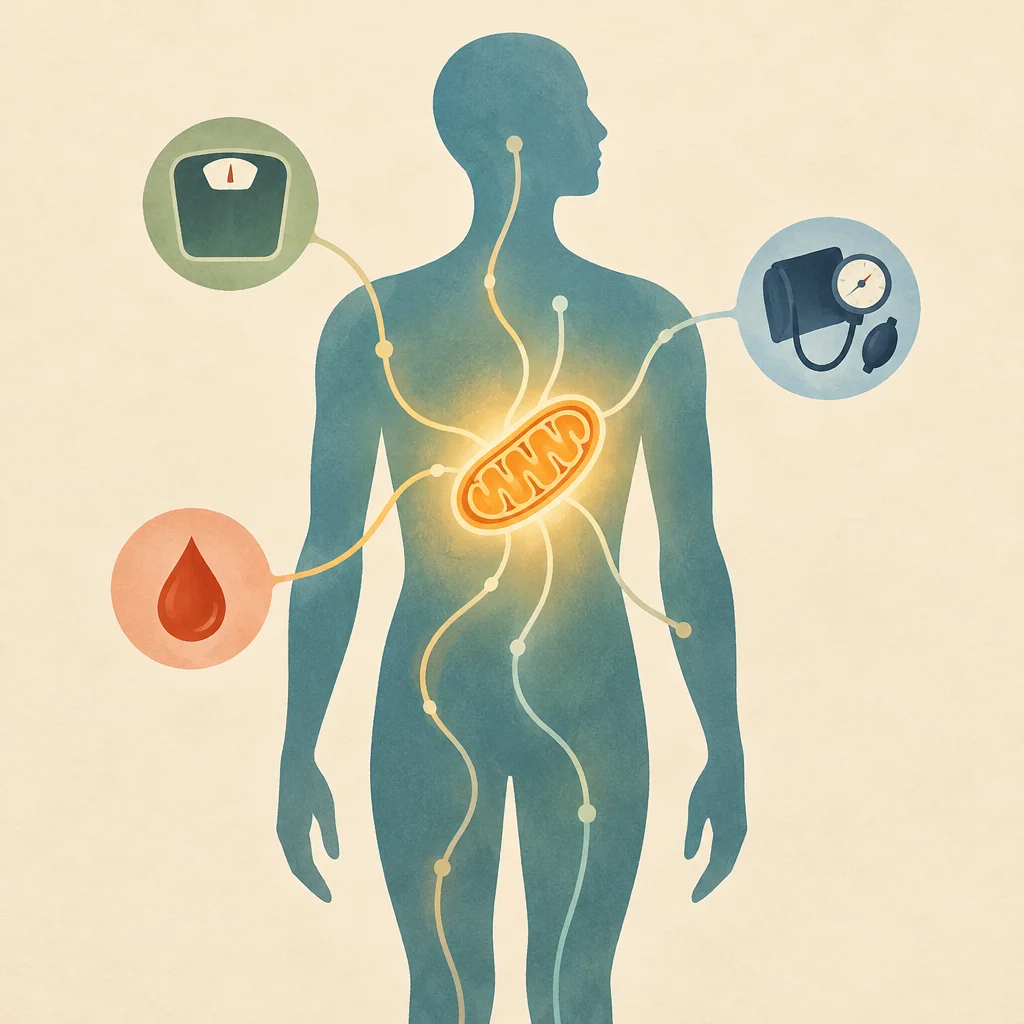
Illustrated key idea
Many symptoms are placed inside one energy story05
Personal Data Should Open Questions, Not Close Them
The book’s third major idea concerns feedback. Symptoms, laboratory results, journals, and wearable devices can help people compare what they believe about their habits with what they actually observe. The aim is not only earlier detection. It is a more active relationship with health decisions.
Emily’s pregnancy illustrates the difference between a snapshot and a pattern. The book reports that a standard screening assessment was reassuring, while continuous glucose monitoring showed sustained elevations. This example supports a limited point: different ways of measuring can reveal different features of a person’s experience. It does not prove that everyone needs continuous monitoring or that a monitor alone settles a diagnosis.
The recommended method starts with observing usual routines before changing them. That order matters. Without a baseline, it becomes harder to know what has changed. Meals, sleep, stress, activity, and timing then provide context for the readings. A number is useful because it helps frame a question, not because it speaks for itself.
The same principle applies to other measures. Heart-rate variability, the changing interval between heartbeats, is interpreted through personal patterns rather than a single universal target. The book acknowledges that its connection to cellular energy remains incompletely understood. Laboratory results also need context because factors beyond metabolic dysfunction can affect them.
A further distinction separates conventional disease thresholds from the book’s preferred ranges. Its targets are often more demanding. That is a substantive position, not merely a different way of displaying the same information. Readers need to ask what supports the proposed target, what action it would change, and how it relates to their own situation.
Lumina’s interpretation is that useful tracking requires a purpose and limits. Before adding a measurement, a reader can ask what question it is supposed to answer. After observing a pattern, the next question is whether it changes a decision. Otherwise, collecting information may become a task detached from understanding.
The habit program partly answers this problem by linking observation with manageable action and regular review. Difficulties become reasons to adjust a routine, not verdicts on someone’s character. Small changes and accountability aim to reduce dependence on repeated acts of willpower.
There is also a commercial consideration. The book identifies Casey Means as a cofounder of Levels, a continuous glucose monitoring company. That connection does not by itself refute the discussion of monitoring. It does make scrutiny of its value important, especially because the book challenges industry influence elsewhere.
The implication is informed participation, not measurement as authority. Personal data can enrich a conversation with a clinician. It should not turn uncertainty into false confidence simply because a device produces a precise-looking result.
06
How Stories, Mechanisms, and Meals Carry the Argument
Good Energy persuades through changes in scale. It moves between a person’s symptoms, cellular processes, institutional incentives, and ordinary routines. Lumina sees this movement as a central feature of its craft. The reader is repeatedly asked to connect an intimate problem with a wider explanation, then bring that explanation back into daily life.
Patient stories make the limits of fragmented care concrete. Biological explanations give those stories a possible connecting structure. Recipes and habit guidance then make the argument tangible. This combination can make a large theory feel usable, but each element carries a different kind of authority.
Lucy’s experience shows both the force and the limit of narrative evidence. The book describes improvements in several symptoms and more regular menstrual cycles after coordinated changes across food, sleep, stress, movement, and environmental factors. That is a meaningful account of improvement. It cannot establish which changes mattered most, or whether another person would have the same result. The account reports no pregnancy, so it should not be expanded into a fertility outcome it does not contain.
The recipes do another kind of work. They show that the framework can enter familiar meals rather than remain a list of prohibited foods. The collection includes plant and animal proteins, vegetable substitutions, and desserts using varied sweeteners. It is not accurately described as entirely sugar-free. Its practical argument is about redesigning food choices, not eliminating every familiar pleasure.
Precision matters at this level too. The dinner summary identifies dietary labels that conflict with ingredients: a nut-free label accompanies almond butter, and a soy-free label accompanies tofu. These errors do not settle the metabolic argument. They do show why ingredient lists matter more than reassuring labels, especially when food restrictions concern safety.
The evidence also changes character across topics. Studies in humans, animal findings, possible mechanisms, personal experiences, and spiritual reflections are not interchangeable. The book presents the narrator’s spiritual sense of connection as personal understanding, not scientific proof.
The critical reading task is to follow these shifts without flattening them. A moving story can establish stakes. A recipe can demonstrate feasibility. Neither, on its own, validates a broad claim about preventing disease.
07
The Strongest Objection—and the Fairest Reply
Lumina’s strongest objection is that the book risks giving one framework more explanatory power than its evidence supports. Cellular energy matters throughout the body, but that breadth does not prove that one metabolic model adequately explains nearly every chronic condition. A common process can be involved without being the decisive cause.
This concern becomes especially serious in the book’s expansive prevention claim. It asserts that following its habits throughout life could avert most pancreatic cancer and an almost unrestricted range of chronic illnesses. That goes well beyond saying habits may improve metabolic markers or influence risk. The evidence described in the supplied material does not establish this degree of preventive power. Personal conviction and a plausible biological story cannot close that gap.
The fairest reply, in Lumina’s view, is that a framework can still help before every part is fully demonstrated. The book directs attention toward patterns that separate appointments may overlook. It also supplies practical ways to observe routines and make changes. Its acknowledgment of uncertainty around some measures and interventions shows that it is not uniformly absolute.
But that reply must remain limited. Helpful habits do not validate every explanation used to recommend them. Nor does successful symptom improvement establish that an individual has prevented a future disease. A strong defense of the book should preserve its useful questions without defending its broadest statements automatically.
A second tension concerns responsibility. The book criticizes commercial and institutional pressures, yet much of its solution asks individuals to buy differently, cook, move, track, sleep, and reduce exposures. People have unequal control over work schedules, food access, money, and living conditions. Its budget suggestions and small-habit approach recognize some obstacles, but cannot remove them.
A third tension joins vigilance with emotional safety. Readers are urged to reduce chronic threat while also noticing more possible sources of harm. Lumina’s concern is that these messages could pull in opposite directions. A framework intended to build confidence might become another reason to monitor constantly.
The strongest reply is internal to the book: prioritize manageable actions, learn from difficulties, and remember that health serves a life beyond tracking. Read this way, agency means having more ways to respond. It does not mean total control, guaranteed prevention, or blame when illness occurs.
08
Turn the Framework into Better Decisions
The book’s ideas connect most usefully through a simple chain: notice a concern, gather context, choose a manageable response, and review what follows. This joins its cellular theory with its feedback tools and habit guidance. It does not require accepting every claim before asking a better question.
Consider an imagined example created by Lumina: someone notices afternoon fatigue and assumes lunch is the entire problem. Using the book’s lens, they could also consider sleep, meal timing, prolonged sitting, and stress. The point is not to diagnose the fatigue as metabolic dysfunction. It is to avoid deciding on a cause before examining the pattern.
A practical reading can then separate three questions. What deserves investigation? What change is feasible? What evidence would show whether that change helped? Keeping these apart prevents an ambitious theory from turning every recommendation into an immediate obligation.
The medical critique also connects with personal advocacy. The book argues that payment structures may reward interventions more clearly than prevention. A constructive response is to ask what a recommendation aims to achieve, what uncertainty remains, and how it fits the patient’s priorities. Questioning care need not mean rejecting expertise.
Likewise, its emphasis on small habits can moderate the burden of its wider program. A person can begin with an accessible routine rather than attempt food changes, extensive testing, filtration, and temperature exposure at once. The book presents its plan as a beginning, not a final health examination.
Boundaries remain essential. Its own guidance calls for care with fasting, individualized advice when kidney problems affect protein choices, and precautions around cold exposure. Its assessment of medication use should not be read as an instruction to stop necessary treatment.
Lumina’s application is therefore selective: use the framework to improve observation and discussion, while matching each action to its evidence, risks, cost, and purpose.

Illustrated key idea
Food, movement, sleep, light, stress, and exposures interact09
Discuss the Promise Without Defending Every Claim
A strong conversation about Good Energy begins by separating three claims. The first is that health problems can share contributing processes. The second is that daily conditions can influence those processes. The third is that the book’s specific program can prevent or reverse a very wide range of diseases. These claims require different levels of support.
This distinction allows thoughtful disagreement. Someone may welcome the challenge to fragmented care while questioning stricter laboratory targets. Another person may find the cooking guidance useful but see little reason for continuous monitoring. Neither position requires accepting or rejecting the whole book.
It also helps to ask what integration means. Does it mean better communication among specialists, more attention to daily routines, or replacing disease-specific explanations with one metabolic story? The first two do not logically require the third.
Lumina’s overall assessment is that the book offers a useful change of attention, paired with claims that need uneven levels of caution. Its strongest contribution is to make connections visible and discussable. Its weakest moments risk turning connection into certainty.
A reader can explain that argument without claiming to have examined every study or completed the original. The book remains worth engaging with for its sustained effort to connect biological explanation, patient agency, and practical choices—and for the questions that effort leaves unresolved.
What to remember
Use the metabolic framework to widen inquiry.
The book connects cellular energy, inflammation, and oxidative stress across many conditions. Its most defensible use is to prompt questions about shared contributors. That is different from assuming one mechanism explains every symptom or that improving a marker guarantees prevention.
Make measurements serve a decision.
Symptoms, laboratory tests, and trackers reveal different kinds of information. Ask what a measurement can clarify and what action it might change. The book’s preferred targets are often stricter than conventional thresholds, so precision in a reading should not be confused with certainty about its meaning.
Preserve agency without assigning total control.
The habit plan favors manageable actions and adjustment when routines prove difficult. That approach fits the book’s systemic critique better than blaming individuals. People can influence daily conditions without controlling every exposure, having equal resources, or becoming responsible for every health outcome.
Bring it into conversation
Talk about the book
When does a shared explanation illuminate illness, and when does it become too broad?
Lumina’s view is that the energy framework helps when it generates testable questions and adds context. It becomes weaker when a plausible common pathway is treated as a complete explanation for distinct conditions.
Take it further: What evidence would you need before moving from a useful connection to a claim about prevention?
How would you decide whether personal tracking is actually helping?
More information is not automatically more understanding. The book’s emphasis on baselines and context supports tracking with a clear purpose, while its discussion of individual variation limits what a single score can mean.
Take it further: What question would justify a device, and what would tell you that you had gathered enough information?
Can a health program challenge harmful systems while asking individuals to adapt?
Both responses can matter, but they operate at different levels. Affordable substitutions and small habits may help a person act; they do not resolve work schedules, pollution, or incentives that the book itself criticizes.
Take it further: Which recommendations seem personally manageable, and which would require changes beyond an individual household?
Keep in perspective
This reading draws on supplied accounts of the book, not an independent assessment of its cited studies. Those accounts support analysis of its arguments and examples, but do not establish every medical claim. No external reviews were provided, so reception is not assessed. The discussion explains the book’s framework; it does not provide individualized diagnosis, treatment, or testing advice.