
Main learnings
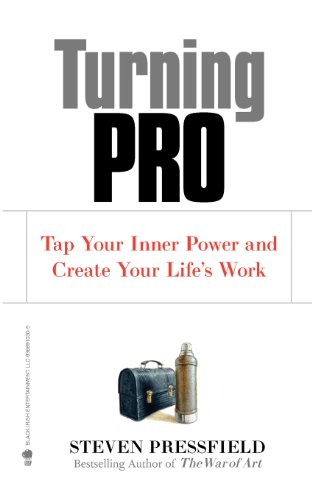
Turning Pro
by Steven Pressfield · 3 min read
- Type: Nonfiction
- Format: Practical guide
- Topic: Creativity
- Topic: Personal growth
About this book
A book about committing to creative work despite fear and distraction. Steven Pressfield contrasts the amateur, whose choices depend on confidence and approval, with the professional, who keeps showing up to the work. His direct advice and spiritual images ask what changes when a person treats a calling as a daily commitment.
Who it's for: For readers who want a forceful push toward consistent creative work and are comfortable with spiritual language.
AI-narrated · An AI-generated voice reads the same Lumina commentary shown on this page.
Turning pro before anyone claps

In Turning Pro, Steven Pressfield treats professionalism as a decision you make before results arrive. You “turn pro” when you accept responsibility for the work and return to it reliably, even with fear present. Payment, fame, and fast improvement are not the test. The test is whether fear runs your day, or whether you still do the work. Finishing a draft can matter even if it never earns approval.
Why it matters
It offers a standard you can apply before success shows up or outside validation appears.
An example
During his year in northern California, the narrator completes a manuscript even though it is rejected and later judged inadequate.
Keep in mind
The book does not claim this choice guarantees money, praise, or freedom from suffering.
Busy can be a disguise for avoidance

In Turning Pro, Steven Pressfield describes a “shadow life” as activity that resembles a calling from a safe distance. It can look intense—full of motion, drama, or repeated crises—yet still keep a person from the task that risks failure and rejection most directly. The book’s claim is not that the shadow work is fake, but that it can function as a substitute for the real commitment the person is avoiding.
Why it matters
It clarifies why effort and busyness may not equal commitment to the work that matters most.
An example
The narrator’s trucking life provides adventure and difficulty, but it also keeps him away from writing.
Keep in mind
A shadow career can still involve real skill and responsibility; the book’s point is about its role for that person.
Fear remains; the response can differ

Turning Pro by Steven Pressfield says both amateurs and professionals feel fear. The dividing line is what happens next. The amateur waits for permission, certainty, approval, or relief. The professional, as Pressfield describes it, prepares and shows up; asks for help; keeps order; and protects tomorrow’s work even after a bad day. Fear is not treated as a sign to stop. It is treated as something present while the habits continue.
Why it matters
It makes courage feel less mysterious by tying it to repeatable actions.
An example
After he forces himself to write for two hours, the narrator throws the pages away, yet he still feels relief while doing dishes.
Keep in mind
The summary supports this as the book’s framework, not as a tested rule for every person or condition.
Demand excellence without worshiping suffering
Turning Pro by Steven Pressfield rejects two extremes: sloppy comfort and harsh depletion. He praises standards—study, technique, editing, and the pressure to get better. At the same time, the book argues that practice should preserve your ability to return tomorrow, rather than treating pain, panic, or exhaustion as proof of devotion. The core idea is that a professional can be severe about results while still caring for the conditions that make continued work possible.
Why it matters
Without this balance, discipline can collapse into either avoidance or needless self-punishment.
An example
A horse trainer keeps learning pleasant and stops before exhaustion, while Picasso’s destroyed work is used to illustrate severity toward results.
Keep in mind
The examples show a principle, but the summary does not give a precise rule for every craft or person.
Create for an audience, not just for self-display

In Turning Pro, Steven Pressfield gives professional practice a spiritual meaning: the work is meant to reach beyond the maker’s private pride, status, or relief. The artist shapes raw experience into something another person can receive, while still remaining part of that audience. In this frame, the work becomes a form of service rather than only self-expression. The book’s example treats imagination and intuition as sources of material that exceeds conscious experience.
Why it matters
It shifts the goal from personal rescue alone to making something meaningful or useful for others.
An example
The narrator’s prison screenplay is offered as an example of imagination and intuition producing material beyond conscious experience.
Keep in mind
Readers who do not share the book’s spiritual frame may still accept the craft point while questioning the larger metaphysics.
Liked the ideas? Read Turning Pro in full.
The summary is free on Lumina. The complete book is available from: