
Main learnings
Nobody Wants to Read Your Sh*t
by Steven Pressfield · 3 min read
- Type: Nonfiction
- Format: Memoir
- Topic: Writing
- Topic: Creativity
- Topic: Communication
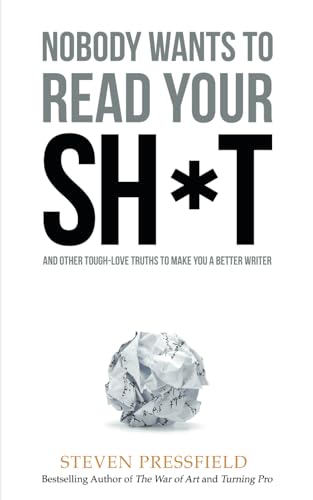
About this book
A craft memoir about learning to write with the reader in mind. Steven Pressfield draws on career struggles and commercial writing to argue that attention must be earned. He explores how writers turn experience and ideas into clear, structured work, with advice that reaches across fiction, nonfiction, screenplays, and other forms.
Who it's for: For writers who want blunt advice about structure, clarity, and earning an audience's attention.
Readers don’t owe you their time

In Nobody Wants to Read Your Sh*t, Steven Pressfield treats attention as something the writer must earn, not something a reader automatically gives. He starts from the idea that people are busy, so a writer can’t assume interest. The message has to be simple enough to grasp, interesting enough to keep moving, and worth the time it takes. This outlook comes from his advertising background, where indifference is the default.
Why it matters
This shifts writing from self-display toward a real exchange with another person.
An example
Pressfield describes learning at Benton & Bowles to ask whether an audience will understand a message and care about it.
Keep in mind
The source supports this as Pressfield’s craft standard, not as proof that all readers want the same things.
Concept attracts; theme deepens

In Nobody Wants to Read Your Sh*t, Steven Pressfield separates two jobs writers often blur. A concept is the attention-grabber: a fresh frame that helps people instantly see what the material is and why it matters now. A theme is the weight underneath: the deeper concern that keeps scenes and examples from feeling like random pieces. The book presents these as distinct layers—one to pull readers in, the other to give the work meaning beyond the surface pitch.
Why it matters
A writer needs both surface interest and deeper coherence to hold attention.
An example
Pressfield points to Avis framing itself as number two and promising to try harder, and to De Beers tying diamonds to lasting love.
Keep in mind
The summary also notes that strong framing can mislead, as political labels can do.
Structure exists to show pressure and change

In Nobody Wants to Read Your Sh*t, Steven Pressfield treats story structure as a tool, not a decoration. He describes elements like three acts, an inciting incident, sequences, an antagonist, and a climax as ways to build pressure and make change visible. He also argues that scenes should alter the situation rather than just add flavor. The point isn’t to worship a template; it’s to use structure to make the reader feel movement and consequence across the story.
Why it matters
Structure helps readers feel that events are moving, not just happening in a row.
An example
Pressfield describes Act Two in screenwriting as a stretch where danger rises and choices get harder before the final movement.
Keep in mind
The book itself admits that Hollywood’s preferred shape is not a universal model for every culture or work.
Shape nonfiction through selection, not invention

In Nobody Wants to Read Your Sh*t, Steven Pressfield argues that nonfiction still needs narrative shape: a hook, a build, and a payoff. He does not present that as permission to make things up. Instead, shaping means choosing focus, order, and theme so real events make sense to an audience. The writer can center certain moments and arrange material to clarify what happened, while still holding the line on factual accuracy.
Why it matters
This helps factual writing become readable without giving up honesty.
An example
Pressfield describes a pioneer memoir becoming clearer when a disastrous river crossing is treated as the center, rather than as one item in an exhaustive life record.
Keep in mind
The source supports selection and arrangement, but it does not license changing what happened.
Finishing matters, but it’s not the finish line

In Nobody Wants to Read Your Sh*t, Steven Pressfield treats completing a draft as a major gate, especially because he describes repeatedly abandoning work near the end. But he also argues that completion alone is not enough. After a manuscript exists, the writer still has to revise, take notes, learn the form, and move past imitation toward work shaped for readers. The book frames this as a long craft process rather than a single triumph at “The End.”
Why it matters
Persistence matters, but the final aim is useful work, not mere output.
An example
Pressfield describes finishing a manuscript that does not sell, and being told to start the next book immediately.
Keep in mind
The summary shows this through one writer’s career path, not through a broad study of writers.
Liked the ideas? Read Nobody Wants to Read Your Sh*t in full.
The summary is free on Lumina. The complete book is available from: