
Big ideas · from the full text
Machines of Loving Grace
by Dario Amodei · 3 min read · Lumina’s commentary, written with AI
Recommended by John Collison, Lex Fridman and Ezra KleinAbout this essay
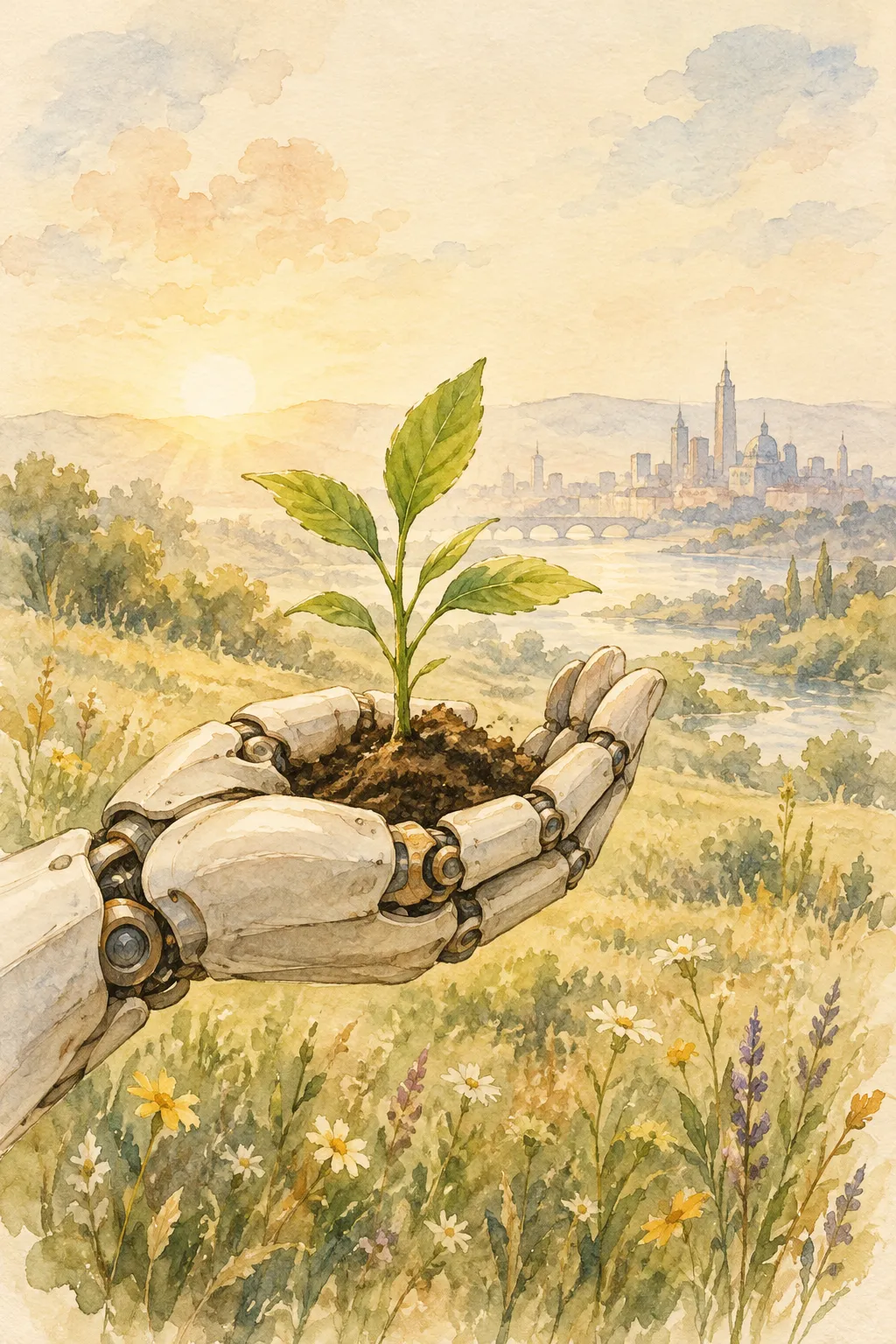
Dario Amodei's October 2024 essay on how AI could transform the world for the better: compressed decades of progress in biology and mental health, lifting billions out of poverty, and strengthening democracy, if the risks are handled. The optimistic case from the person who spends most of his time on the risks. Free to read at darioamodei.com/machines-of-loving-grace.
♫ AI-generated voice · press play below to listen and read along; tap any passage to jump to it
Hope depends on safety work

In Machines of Loving Grace, Dario Amodei argues that fearing AI and hoping for AI can be compatible. Public discussion may focus on dangers because useful AI products already attract money and attention, while safety needs deliberate effort. In this view, a high-benefit future is not automatic. It depends on lowering risks, building trust, and choosing shared goals before powerful systems reshape many parts of life.
Why it matters
This keeps the book from treating warnings and optimism as rival camps.
An example
The narrator presents risk reduction as part of the path toward large AI benefits.
Keep in mind
The source describes a possible best case, not a guaranteed future.
AI could speed entire research cycles

In Machines of Loving Grace, Dario Amodei argues that AI could accelerate science by speeding whole research loops, not just analyzing existing data. The biology section describes AI that can propose experiments, help execute them, interpret results, and design better tools for the next round. Because new instruments can unlock many lines of work, faster iteration could matter more than a single clever insight.
Why it matters
The idea explains fast progress while still leaving room for real-world bottlenecks.
An example
The summary names gene editing, advanced microscopes, cheaper sequencing, mRNA vaccines, and cell therapies.
Keep in mind
Experiments, clinical proof, noisy measurements, and complex living systems still slow discovery.
A cure is not the same as care

In Machines of Loving Grace, Dario Amodei separates scientific breakthroughs from real human benefit. A treatment matters only if people can actually receive it. The essay is more confident about speeding discovery than about ending poverty, because problems like distrust, corruption, weak institutions, and complex economies are not solved just by adding a smart adviser. It suggests only a tentative, partial spread of AI-enabled health gains to poorer countries.
Why it matters
This makes access and public capacity central, not side issues after invention.
An example
The essay suggests only a tentative partial spread of AI-enabled health gains to poorer countries.
Keep in mind
The path is aspirational, and the summary stresses uncertainty and self-determination.
Technology will not choose democracy for us

In Machines of Loving Grace, Dario Amodei argues that AI does not automatically favor democracy. The same broad tool might expose abuses, improve public services, and resist propaganda, or it might strengthen surveillance and manipulation. Because outcomes depend on how societies deploy it, the essay treats protecting democratic systems as a political project rather than a natural byproduct of invention. The summary also notes that these political proposals are less exact and may be more utopian than the science.
Why it matters
Readers see that better tools do not settle who holds power or how power is used.
An example
The proposed coalition would limit adversaries’ chip access while offering AI benefits to encourage cooperation.
Keep in mind
The summary says these political ideas are less exact and may be more utopian than the science.
Purpose and pay are different problems

In Machines of Loving Grace, Dario Amodei argues that automation does not automatically drain life of meaning. People can value friendship, play, creativity, competition, and hard personal projects even when they are not the best at them. But the essay separates that from the income problem. If AI makes most paid work cheap, society may still need new ways to provide fair support. The summary mentions basic income and value-guided reward systems as possibilities, without treating any as settled.
Why it matters
This distinction avoids an easy answer: meaning may survive while economic rules fail.
An example
The essay lists basic income and value-guided reward systems as possible responses.
Keep in mind
No response is treated as settled, and each would need testing and political struggle.
Who's talking about Machines of Loving Grace
Public statements we checked against the original source
- Recommends it
 John CollisonCo-founder of Stripe
John Collison said he really enjoyed Dario Amodei’s Machines of Loving Grace post and thought it was very well done.
- Recommends it
 Lex FridmanPodcaster
“Let’s talk about the incredible essay Machines of Loving Grace. I recommend everybody read it.”
- Read it
 Ezra KleinJournalist and podcaster
“And I’m someone who reads an essay like “Machines of Loving Grace,” by Dario Amodei, the chief executive of Anthropic, that is basically about the upside of A.I.”
- Discussed it
 Dwarkesh PatelPodcaster
“the kinds of things you discuss in “Machines of Loving Grace”
- Discussed it
 Bill GurleyInvestor, Benchmark
Bill Gurley discussed Dario Amodei’s Machines of Loving Grace on the All-In podcast as part of his critique of Anthropic.
- Discussed it
 Chamath PalihapitiyaInvestor, All-In podcast
“I had Claude read 'Machines of Loving Grace' and 'AI Policy on the Exponential' and then I asked it to do a psychological analysis.”
Portraits from Wikimedia Commons · photo credits and licences