Science · Popular works · Ciencia
A short history of nearly everything by Bill Bryson — Summary, Key Ideas & Quotes
2003592 pages✦ 3-min Big ideas★ 4.2 (101)
Rate it
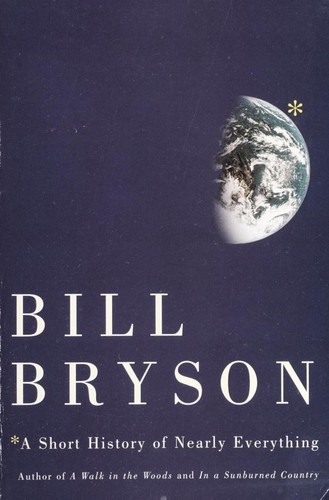
A Short History of Nearly Everything by American author Bill Bryson is a popular science book that explains some areas of science, using easily accessible language that appeals more so to the general public than many other books dedicated to the subject. It was one of the bestselling popular science books of 2005 in the United Kingdom, selling over 300,000 copies. A Short History deviates from Bryson's popular travel book genre, instead describing general sciences such as chemistry, paleontology, astronomy, and particle physics. In it, he explores time from the Big Bang to the discovery of quantum mechanics, via evolution and geology. Bill Bryson wrote this book because he was dissatisfied with his scientific knowledge—that was, not much at all. He writes that science was a distant, unexplained subject at school. Textbooks and teachers alike did not ignite the passion for knowledge in him, mainly because they never delved in the whys, hows, and whens. The ebook can be found elsewhere on the web at:
Bryson frames the history of science not as a dry list of facts, but as a series of human stories—full of eccentric personalities, lucky accidents, and dogged curiosity. He emphasizes that scientific knowledge is the result of countless individuals, often working in obscurity or facing ridicule, whose combined efforts have shaped our understanding of the world. This approach demystifies science, showing it as a profoundly human pursuit rather than an abstract authority.
One of the book’s core themes is how staggeringly improbable our existence is. Bryson explores the narrow margins that allowed life—and particularly human life—to arise: from the precise conditions of the Big Bang, to the delicate balance of Earth’s atmosphere, to the random mutations driving evolution. He invites readers to marvel at the sheer luck and complexity required for us to be here, fostering both humility and wonder.
“We are all so astonishingly unlikely.”
“Not one of your pertinent ancestors was squashed, devoured, drowned, starved, stranded, stuck fast, untimely wounded, or otherwise deflected from its life’s quest of delivering a tiny charge of genetic material to the right partner at the right moment.”