Mental work · Distraction · Success
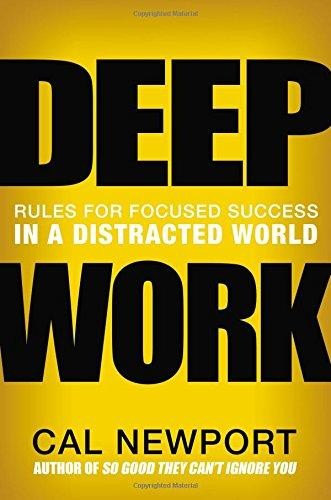
Deep Work by Cal Newport — Summary, Key Ideas & Quotes
2016303 pages✦ 3-min Big ideas★ 3.8 (191)
Rate it
One of the most valuable skills in our economy is becoming increasingly rare. If you master this skill, you'll achieve extraordinary results. Deep work is the ability to focus without distraction on a cognitively demanding task. It's a skill that allows you to quickly master complicated information and produce better results in less time. Deep work will make you better at what you do and provide the sense of true fulfillment that comes from craftsmanship. In short, deep work is like a super power in our increasingly competitive twenty-first century economy. And yet, most people have lost the ability to go deep-spending their days instead in a frantic blur of e-mail and social media, not even realizing there's a better way. In DEEP WORK, author and professor Cal Newport flips the narrative on impact in a connected age. Instead of arguing distraction is bad, he instead celebrates the power of its opposite. Dividing this book into two parts, he first makes the case that in almost any profession, cultivating a deep work ethic will produce massive benefits. He then presents a rigorous training regimen, presented as a series of four "rules," for transforming your mind and habits to support this skill. A mix of cultural criticism and actionable advice, DEEP WORK takes the reader on a journey through memorable stories -- from Carl Jung building a stone tower in the woods to focus his mind, to a social media pioneer buying a round-trip business class ticket to Tokyo to write a book free from distraction in the air -- and no-nonsense advice, such as the claim that most serious professionals should quit social media and that you should practice being bored. DEEP WORK is an indispensable guide to anyone seeking focused success in a distracted world.

Newport draws a sharp distinction between 'deep work'—intense, focused activity that pushes your cognitive capabilities—and 'shallow work,' which is logistical, low-value, and easily replicable. He argues that most modern workplaces and routines are dominated by shallow work, which saps our ability to produce meaningful results. Deep work, by contrast, is both rare and valuable, providing a competitive edge and a sense of personal satisfaction.
In an age of constant digital interruptions, Newport insists that our attention is one of our most precious assets. He explains how frequent context-switching (checking emails, social media, etc.) depletes our ability to think deeply and creatively. Protecting and directing your attention, he argues, is essential for mastering complex skills and producing high-quality work.
“Clarity about what matters provides clarity about what does not.”
“If you don’t produce, you won’t thrive—no matter how skilled or talented you are.”
“Deep work is not some nostalgic affectation of writers and early-twentieth-century philosophers. It’s instead a skill that has great value today.”