
Feminist theory · Femininity · Sex role
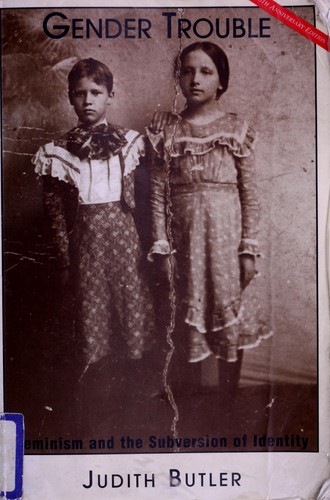
Gender Trouble by Judith Butler — Summary, Key Ideas & Quotes
1989221 pages✦ 3-min Big ideas★ 3.7 (7)
Rate it
One of the most talked-about scholarly works of the past fifty years, Judith Butler’s Gender Trouble is as celebrated as it is controversial. Arguing that traditional feminism is wrong to look to a natural, 'essential' notion of the female, or indeed of sex or gender, Butler starts by questioning the category 'woman' and continues in this vein with examinations of 'the masculine' and 'the feminine'. Best known however, but also most often misinterpreted, is Butler's concept of gender as a reiterated social performance rather than the expression of a prior reality. Thrilling and provocative, few other academic works have roused passions to the same extent.
Butler’s most influential idea is that gender is not a fixed or innate quality, but something we do—an ongoing performance shaped by social expectations. Rather than expressing a pre-existing identity, our gendered behaviors create the illusion of stable identities. This means that what we take for granted as 'masculine' or 'feminine' is actually produced by repeated acts, gestures, and language, not by biology or a true self.
Butler argues against the notion that there is an essential 'womanhood' or 'manhood' underlying our identities. She critiques strands of feminism that assume a universal female experience, showing how such assumptions can exclude or marginalize people who don’t fit normative categories. For Butler, clinging to essentialist ideas limits the political possibilities for gender liberation.
“There is no gender identity behind the expressions of gender; that identity is performatively constituted by the very 'expressions' that are said to be its results.”
“Gender is always a doing, though not a doing by a subject who might be said to preexist the deed.”
“The critical task for feminism is not to establish a point of view outside of constructed identities, but rather to consider the futility of any attempt to do so.”