

Logics · Teoria Do Conhecimento · Artificial intelligence
Gödel, Escher, Bach: An Eternal Golden Braid by Douglas R. Hofstadter — Summary, Key Ideas & Quotes
1979777 pages✦ 3-min Big ideas★ 4.2 (70)
Rate it
Winner of the Pulitzer Prize A metaphorical fugue on minds and machines in the spirit of Lewis Carroll Douglas Hofstadter's book is concerned directly with the nature of "maps" or links between formal systems. However, according to Hofstadter, the formal system that underlies all mental activity transcends the system that supports it. If life can grow out of the formal chemical substrate of the cell, if consciousness can emerge out of a formal system of firing neurons, then so too will computers attain human intelligence. Gödel, Escher, Bach is a wonderful exploration of fascinating ideas at the heart of cognitive science: meaning, reduction, recursion, and much more.
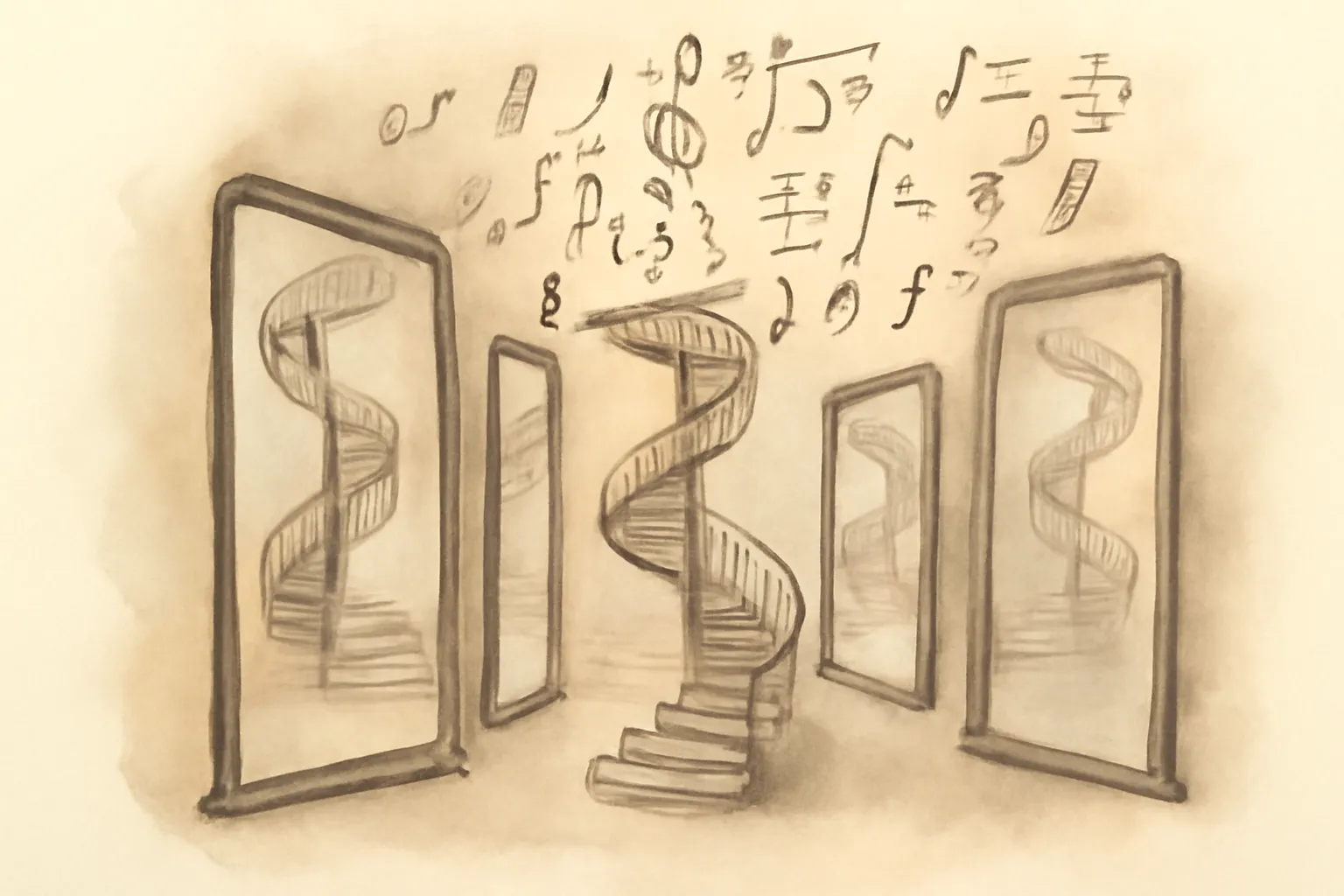
At the heart of the book is the concept of 'strange loops'—self-referential structures that turn back on themselves, creating layers of meaning and paradox. Hofstadter uses examples from Gödel’s incompleteness theorems, Escher’s impossible drawings, and Bach’s fugues to illustrate how self-reference leads to complexity and, potentially, consciousness itself. These loops are not just mathematical curiosities; they are presented as the possible basis for the emergence of 'I'—the sense of self—in minds and machines.
Hofstadter delves into formal systems—rigorous sets of rules that generate meaning, such as mathematical logic. He explains Gödel’s incompleteness theorem, which shows that any sufficiently complex formal system contains true statements that cannot be proven within its own rules. This insight shakes the foundations of mathematics and suggests limits to what any system, including computers, can achieve through pure logic.
“Meaning is not a property that can be assigned to strings of symbols in an absolute way.”
“A self-referential structure is one that, when you stand back and look at it, you see yourself looking at it.”
“The self is a hallucination hallucinated by a hallucination.”