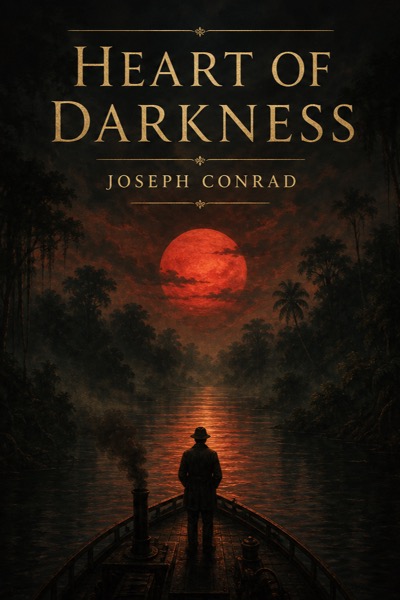

A journey into the Congo and the human psyche — colonialism, madness, and “the horror.”
Read full overviewShow less›
In 'Heart of Darkness', Joseph Conrad takes readers on a harrowing journey into the depths of the Congo River, where the true nature of imperialism and the darkness within humanity is laid bare. Through the eyes of Marlow, a seaman who navigates the treacherous waters of colonial Africa, the narrative unfolds as a complex exploration of civilization's facade and the primal instincts lurking beneath. As Marlow seeks to find Kurtz, a man of great ambition and idealism, he confronts not only the horrors of exploitation but also the moral ambiguities that challenge his understanding of humanity. This summary delves into the novel's key themes, characters, and philosophical inquiries, providing a comprehensive lens through which to understand Conrad's critique of colonialism and the human condition.
Joseph Conrad's 'Heart of Darkness' remains a powerful exploration of the darkness that resides within humanity and the moral complexities of colonialism. Through Marlow's journey, readers are confronted with profound questions about civilization, morality, and the nature of existence. The novel's rich symbolism, complex characters, and layered narrative structure invite reflection on the ethical implications of power and the consequences of human actions. As Marlow navigates the treacherous waters of the Congo, he ultimately reveals not only the horrors of imperialism but also the darkness that exists within us all. 'Heart of Darkness' serves as a timeless reminder of the fragility of ideals and the enduring struggle for meaning in a world marked by chaos and moral ambiguity.
- 1The Illusion of Civilization
- 2The Nature of Darkness
- 3The Complexity of Kurtz
- 4The Role of Women
- 5The Journey as a Metaphor
A glimpse inside

Conrad opens the narrative with a juxtaposition of the Thames River and the Congo River, suggesting that the darkness of civilization is not confined to Africa but exists… Read moreConrad opens the narrative with a juxtaposition of the Thames River and the Congo River, suggesting that the darkness of civilization is not confined to Africa but exists in the heart of Europe as well. The Nellie, anchored on the Thames, serves as a metaphor for the stillness of civilization, while the Congo represents the chaotic, untamed wilderness. Marlow's journey exposes the hypocrisy of imperialism, where European powers justify their exploitation of Africa under the guise of bringing 'civilization' to the 'savages.' This theme is exemplified in Marlow's reflections on the 'whited sepulchre' of Brussels, a city that embodies the moral decay hidden beneath the surface of European culture. Conrad challenges readers to question the true meaning of civilization and the darkness that often lies at its core. Show less
Throughout the novel, darkness serves as a powerful symbol, representing both the physical landscape of the Congo and the moral ambiguity of humanity. Read moreThroughout the novel, darkness serves as a powerful symbol, representing both the physical landscape of the Congo and the moral ambiguity of humanity. Marlow frequently contemplates the 'heart of darkness' that exists not only in the jungle but also within individuals. As he ventures deeper into the African wilderness, he encounters the brutal realities of colonial exploitation, where the native population is subjected to inhumane treatment for the sake of profit. This darkness manifests in the character of Kurtz, who, despite his initial idealism and eloquence, becomes consumed by the very forces he sought to control. Conrad suggests that the capacity for evil resides in all humans, and when stripped of societal norms, individuals may succumb to their primal instincts. Show less
Read the full text — free
About the author
Read Joseph Conrad's work free on Lumina — the complete text plus an 8-minute summary and key ideas, no account needed.
Frequently asked
Worlds to get lost in
Take Lumina everywhere
Read offline, listen to AI summaries, speed-read, and sync your progress across devices — free on iPhone.
Download for iPhone