
Psychological aspects of Economics · Economics · Psychological aspects
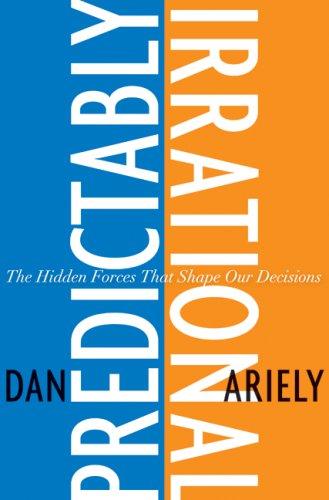
Predictably Irrational by Dan Ariely — Summary, Key Ideas & Quotes
2008368 pages✦ 3-min Big ideas★ 4.2 (13)
Rate it
How do we think about money?What caused bankers to lose sight of the economy?What caused individuals to take on mortgages that were not within their means?What irrational forces guided our decisions?And how can we recover from an economic crisis? In this revised and expanded edition of the New York Times and Wall Street Journal bestseller Predictably Irrational, Duke University's behavioral economist Dan Ariely explores the hidden forces that shape our decisions, including some of the causes responsible for the current economic crisis. Bringing a much-needed dose of sophisticated psychological study to the realm of public policy, Ariely offers his own insights into the irrationalities of everyday life, the decisions that led us to the financial meltdown of 2008, and the general ways we get ourselves into trouble.Blending common experiences and clever experiments with groundbreaking analysis, Ariely demonstrates how expectations, emotions, social norms, and other invisible, seemingly illogical forces skew our reasoning abilities. As he explains, our reliance on standard economic theory to design personal, national, and global policies may, in fact, be dangerous. The mistakes that we make as individuals and institutions are not random, and they can aggregate in the market—with devastating results. In light of our current economic crisis, the consequences of these systematic and predictable mistakes have never been clearer.Packed with new studies and thought-provoking responses to readers' questions and comments, this revised and expanded edition of Predictably Irrational will change the way we interact with the world—from the small decisions we make in our own lives to the individual and collective choices that shape our economy.

Traditional economics assumes that people act rationally in their own best interest, but Ariely’s research shows we are systematically irrational. Our decisions are influenced by context, emotions, and social pressures, leading us to make predictable mistakes. Recognizing these patterns is the first step toward making better choices, both individually and collectively.
We rarely know what something is truly worth, so we compare it to other options. Ariely demonstrates how the way choices are presented—such as decoy pricing—can nudge us toward decisions that may not be in our best interest. Understanding relativity helps us see through manipulative marketing and make more deliberate decisions.
“We usually think of ourselves as sitting in the driver’s seat, with ultimate control over the decisions we make; but, alas, this perception has more to do with our desires—with how we want to view ourselves—than with reality.”
“The problem is that the same type of mistake happens over and over, and we never learn from it.”
“Free is not just an amount; it’s an emotional hot button—a source of irrational excitement.”