
Conquerors · History · Social change
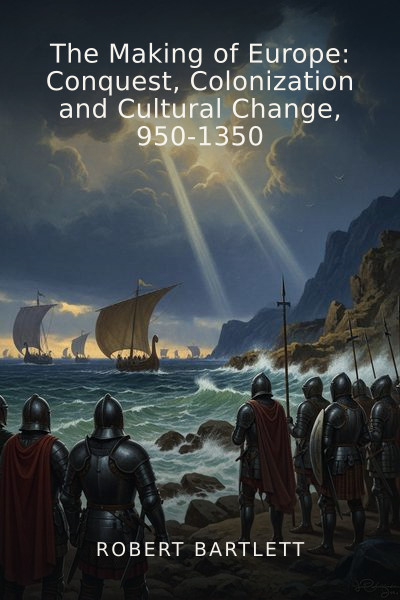
The Making of Europe: Conquest, Colonization and Cultural Change, 950-1350 by Robert Bartlett — Summary, Key Ideas & Quotes
1993440 pages✦ 3-min Big ideas★ 5.0 (1)
Rate it
"From our twentieth-century perspective, we tend to think of the Europe of the past as a colonizer, a series of empires that conquered lands beyond their borders and forced European cultural values on other peoples. This provocative book shows that Europe in the Middle Ages was as much a product of a process of conquest and colonization as it was later a colonizer." "Robert Bartlett concentrates on the establishment of states by conquest and the peopling of distant countries by immigrants along the peripheries of the European continent. He asks what developments in language, law, belief, and habit accompanied warfare and settlement, as he explores the formation of racially mixed societies on the edges of Europe and the ideological justification for aggressive expansion." "This fascinating account shows how the expansionary power of this civilization sprang from its centers, even if it may be seen most starkly at its edges. Hence the theme is not only colonial conquest and settlement, the moving edge, but also the formation of an increasingly homogeneous society that by the end of the Middle Ages lay poised to enter a yet more expansionary phase of its history: one whose consequences are still around us."--Jacket.
Bartlett challenges the common view of medieval Europe as merely a precursor to later colonial empires by showing that Europe itself was formed through internal colonization. Between 950 and 1350, regions like Ireland, the Baltic, and Eastern Europe were conquered and settled by people from Western Europe, bringing new laws, institutions, and cultures. This process was not just about military domination, but about transplanting populations and transforming societies, creating a patchwork of new communities that would eventually coalesce into a more unified Europe.
A central theme is the drive toward cultural uniformity. Through conquest and settlement, Latin Christendom spread its language, legal systems, religious practices, and social norms across diverse regions. Bartlett details how local customs and languages were often suppressed or marginalized in favor of Latin, Roman law, and Western Christian rites. This standardization was uneven and contested, but by the end of the period, a more homogeneous European culture had emerged—one that would later underpin Europe’s global expansion.
“The expansion of Latin Christendom was both a movement of conquest and a movement of colonization.”
“To be European in the Middle Ages was to be part of a process, not a place.”