Economics · Miscellanea · Paradoxes
The Winner's Curse by Richard H. Thaler — Summary, Key Ideas & Quotes
1992230 pages✦ 3-min Big ideas★ 4.0 (3)
Rate it
Richard Thaler challenges the received economic wisdom by revealing many of the paradoxes that abound even in the most painstakingly constructed transactions.
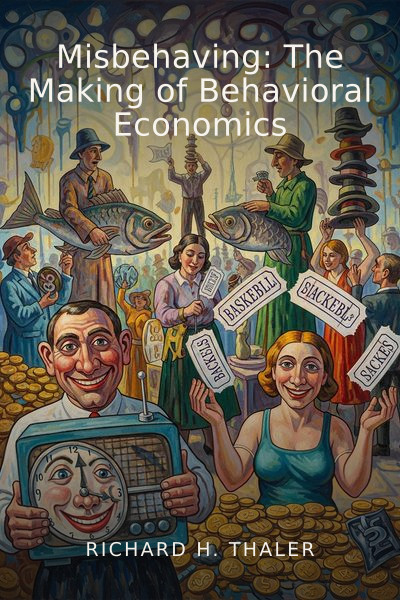
He presents literate, challenging, and often funny examples of such anomalies as why the winners at auctions are often the real losers - they pay too much and suffer the "winner's curse" - why gamblers bet on long shots at the end of a losing day, why shoppers will save on one appliance only to pass up the identical savings on another, and why sports fans who wouldn't pay more than $200 for a Super Bowl ticket wouldn't sell one they own for less than $400. He also demonstrates that markets do not always operate with the traplike efficiency we impute to them.
Thaler argues that recognizing these sometimes topsy-turvy facts of economic behavior will compel economists, as well as those of us who live by their lights in our jobs and organizations, to adopt a more balanced view of human nature, one reflected in Adam Smith's professed belief that, despite our selfishness, there is something in our nature that prompts us to enjoy, even promote, the happiness of others.

Thaler’s titular concept, the 'winner’s curse,' describes how auction winners often overpay due to competition and imperfect information. This paradox highlights a key flaw in classic economic theory: people don’t always bid rationally. Instead, emotion, overconfidence, and the desire to win can drive prices above true value. Thaler uses real auction data and experiments to show how even experts fall prey to this trap, challenging the notion that markets always allocate resources efficiently.
Thaler introduces the idea that people mentally separate their money into different 'accounts'—a process called mental accounting. This leads to inconsistent decisions, such as treating a tax refund differently from a paycheck. He also explores bounded rationality: our cognitive limits mean we use shortcuts and rules of thumb, not strict logic, when making choices. These tendencies often contradict the predictions of traditional economics, which assumes we maximize utility with perfect information.
“It is time to stop thinking about economics as a discipline that deals only with rational people.”
“People are not dumb. The world is hard.”