
The deep dive
Attention Is All You Need
by Ashish Vaswani et al.
19 min read · Original commentary by Lumina, written with AI
What changes when a sequence model connects positions directly instead of passing information along a chain? This paper answers with the Transformer. Its argument combines a new design, strong translation results, and practical limits. Understanding it means separating attention’s power from the much broader claims its title might suggest.
Prefer the quick version? Read the main learnings →♫ AI-generated voice · press play below to listen and read along; tap any passage to jump to it
01
A design argument, not a promise about everything
Attention Is All You Need is a technical research paper, not a general guide to human attention. Its subject is sequence transformation: turning an ordered input into an ordered output. Translation is the main test. The authors introduce the Transformer, which uses attention to connect relevant positions without recurrent or convolutional layers.
The basic question is accessible even when the machinery is unfamiliar. Must a model process information through a sequence of dependent steps to understand relationships within that sequence? The paper argues that it need not. Positions can exchange information more directly, allowing more training work to happen at once.
Readers should expect an engineering case rather than a universal theory. Architecture details explain what was built. Comparisons explain why it might help. Experiments test whether the proposed advantages accompany useful results.
Lumina’s reading is that the paper’s force comes from joining those three levels. A design that looks efficient on paper still needs to perform well. A high score alone would reveal less about why the model works. The Transformer’s case depends on both its structure and its reported performance, with neither standing as proof of unlimited usefulness.

Illustrated key idea
Attention becomes the center of the model02
Which parts of sequence modeling really need a sequence?
The central question concerns a hidden cost of processing things in order. In a recurrent network, each position depends on a state produced at the previous position. That dependency forces computation into a chain. More hardware does not simply remove the need to wait for an earlier link.
The authors distinguish this processing order from the relationships a model needs to learn. Two words may matter to each other despite being far apart. Attention lets the model connect their positions without carrying the relevant information through every intervening position. Earlier systems already used attention, but commonly kept recurrence. The Transformer asks whether attention can carry the main burden instead.
Two stakes follow. One is training speed: reducing unavoidable waiting makes parallel computation more useful. The other is information travel: shorter connections may help the model learn distant relationships. These are related benefits, not identical ones. A short route between positions does not mean the entire computation is cheap.
The paper also separates training from generation. Its decoder still produces output tokens one at a time, using earlier outputs. Removing recurrent layers therefore does not remove every sequential dependency. This distinction is essential to reading the title fairly.
Lumina interprets the central achievement as a separation of tasks previously bundled together. A model needs information about order. It needs ways to connect positions. It needs a rule preventing predictions from using future outputs. Those needs do not require one shared mechanism. The Transformer assigns them to position signals, attention, and masking.
The resulting question is more precise than whether attention is universally sufficient. Can attention organize a strong sequence model without recurrence or convolution, while other components handle the remaining jobs? The reported translation and parsing experiments support that narrower claim.
03
Direct connections change both learning and waiting
The first central idea is that a model’s information routes affect what it can learn and how efficiently it can train. The paper compares layer types through three questions: how much computation they require, how much work must happen sequentially, and how far information must travel between positions. Keeping these questions separate prevents a vague claim of speed from doing too much work.
Recurrence creates a chain of dependent states. Convolution allows positions to be processed in parallel, but a narrow convolution cannot connect every position in one layer. More layers are needed to link distant places. Self-attention instead lets positions connect directly within a layer. The authors present those short paths as an advantage for learning long-range dependencies.
Attention achieves this through queries, keys, and values. A query represents what a position is seeking. Keys provide the features against which it is compared. Values supply the information to combine. The model turns query–key matches into weights, then uses those weights to combine values. These are learned numerical representations, not words consciously asking questions.
Consider a deliberately simplified illustration created by Lumina. Imagine a sentence that names a city in its first few words and ends, forty words later, with a pronoun referring back to that city. In a chain design, the city’s information must survive every intermediate state before the pronoun’s position can use it. With self-attention, the pronoun’s query can match the city’s key in one step and draw in its value directly. The illustration shows why the route is shorter. It does not show that a trained model will learn to make that particular match, which is why the authors treat short paths as an aid to learning rather than a guarantee of it.
There is a price. Comparing every position with every other creates work that grows quickly as the sequence lengthens. The paper’s favorable comparison with recurrence holds only when the sequence is shorter than the representation size, meaning the number of values used to describe each position, which is 512 in the base model. The authors say this condition usually holds for the sentence representations used in leading translation systems. For much longer inputs it may fail, so the paper does not establish that full self-attention is cheaper for every input.
The authors propose restricting attention to nearby positions for very long sequences. That would reduce computation but lengthen routes between distant positions. Lumina sees this as the clearest expression of the design tradeoff: direct access buys short paths, while restricted access buys lower cost. Neither benefit comes free.
The connection to the next idea is important. Faster routes alone do not make a complete model. Once the old sequence-processing mechanism disappears, the architecture must still preserve order and keep different relationships from collapsing into one blended signal.
04
Removing recurrence means redistributing its jobs
The second idea is that architectural simplicity does not mean having only one kind of component. The Transformer removes recurrence and convolution, but retains an encoder–decoder structure, feed-forward networks, residual connections, normalization, embeddings, and output prediction machinery. Attention is the organizing mechanism for relationships, not the whole machine.
The encoder turns input tokens into numerical representations. The decoder uses those representations and earlier output tokens to predict what comes next. In the base design, each side has six layers. Encoder layers combine self-attention with a feed-forward network that acts separately at each position. Decoder layers also attend to the encoder’s output.
Order requires special care. Without recurrence or convolution, the model receives explicit position information added to its token representations. The authors use fixed sine-and-cosine patterns. The larger conceptual point is not the particular wave pattern. It is that representing order and processing positions in order are different jobs.
The paper offers a useful boundary here. Learned position representations performed almost identically in the reported tests. The authors chose the fixed patterns partly because they might help with sequences longer than those used in training. That possibility is a motivation, not a demonstrated advantage in these results.
Attention also has a blending problem. A weighted combination can mix information from several positions, making distinctions less clear. Multiple heads address this by learning separate ways to compare and combine information. The base model uses eight heads, with their outputs joined and transformed. The design allows several relationships to be represented rather than forcing every useful connection into one shared pattern.
The component tests strengthen this explanation without making it absolute. A single head performed worse than the best tested configuration at comparable workload. Yet adding too many heads also hurt. The finding supports multiple perspectives, not the rule that more heads always improve a model.
Finally, the decoder must not inspect the future output it is supposed to predict. Masking blocks access to later output positions, while the shifted inputs reinforce that restriction. This is a rule about permitted information, distinct from the mechanism used to move information.
Lumina’s interpretation is that the paper succeeds through careful division of labor. Position signals provide order. Heads provide several learned relation patterns. Masks enforce the prediction boundary. Feed-forward layers transform representations at individual positions. The lesson is not that these choices are all uniquely necessary. It is that removing an old mechanism requires identifying its jobs and ensuring the new system still performs them.

Illustrated key idea
The design must add order and separate attention patterns05
The evidence supports a model, not a universal law
The third idea concerns what counts as success. The paper does not rest only on an appealing architecture. It reports translation quality, training costs, component variations, and a second task. Each kind of evidence answers a different question. Their combination matters more than any single headline number.
On English-to-German translation, the large Transformer reports 28.4 BLEU, the translation-quality measure used in the paper. The authors describe this as more than two points above the strongest previously published results, including ensembles. The base model also reportedly exceeds earlier systems while using substantially less training computation. This supports the claim that abandoning recurrence need not sacrifice translation quality.
Cost needs its own careful reading. The base model trained for about twelve hours on eight P100 GPUs. The larger model trained for about three and a half days on the same number of GPUs. These are different configurations, so the shorter training time should not be attached to the large model’s headline result.
The training setup also matters. English–German training used roughly 4.5 million sentence pairs. English–French used 36 million sentences. Optimization schedules, dropout, label smoothing, checkpoint averaging, and decoding choices all formed part of the reported system. Lumina’s interpretation is that the results establish the value of a working design package, not attention operating in isolation.
Component variations provide a narrower form of evidence. Changing the number of heads, key dimensions, model size, or dropout helps test whether particular choices matter within this setup. These comparisons show that the design is not improved by blindly increasing every setting. They also cannot establish one best configuration for every task.
The parsing experiment asks a different question: does the model family work beyond translation? A four-layer Transformer performs strongly on English constituency parsing, which requires outputs with grammatical structure. It uses relatively little task-specific adjustment. Yet it does not surpass every reported alternative; the supplied account does not report it surpassing the Recurrent Neural Network Grammar.
There is also a numerical inconsistency to retain rather than repair. The abstract gives 41.8 BLEU for English–French, while the results section gives 41.0. Both support the authors’ reported improvement over earlier single-model systems, but the available material does not settle the exact figure.
The implication is disciplined confidence. The experiments support attention as the basis of a capable sequence model in the tested settings. They do not demonstrate success on every data type, unlimited input lengths, or fully parallel output generation.
06
How the paper turns an architectural wager into a case
The paper persuades by linking a problem, a mechanism, and several checks. The problem is forced sequential work. The mechanism is direct attention between positions. The checks include performance comparisons and altered versions of the model. In Lumina’s reading, this structure makes the design argument inspectable rather than merely impressive.
One useful anchor is scaled dot-product attention. The model compares queries and keys using dot products, then scales those scores before turning them into weights. The stated reason is practical: large scores can produce very small learning signals. This detail connects a clean conceptual mechanism to the numerical conditions needed to train it.
A second anchor is the comparison of layer types. Rather than treating efficiency as a single number, the authors separate total computation, unavoidable sequential steps, and maximum information-path length. This gives readers several grounds for disagreement. A method might look favorable on parallelism without winning on cost for a particular sequence length.
A third anchor is label smoothing, which deliberately makes the model less certain about its predictions. The paper reports that this change hurts the model on one of its own statistics of prediction quality while improving accuracy and BLEU, the score the paper uses to judge translation quality. The result warns against treating every evaluation measure as interchangeable. A model can look worse by one yardstick and better by another. Lumina’s reading is that the tradeoff is worth accepting because BLEU is the score tied to the translation task itself, but that is an interpretation, not a claim the paper makes.
The evidence also has different levels of directness. Translation scores are reported experimental outcomes. Training-operation costs are estimates based on time, GPU count, and assumed processing capacity. Attention patterns suggest that some heads track aspects of syntax or meaning, but this is a possible interpretability benefit, not a complete explanation of the model.
The main translation results come from models formed by averaging several of the last saved versions of the model’s weights, a step the paper calls checkpoint averaging. The component comparisons were instead run on a development set, a separate portion of data used for comparing variants rather than for the headline test, and without that averaging. Neither choice invalidates the other test. But the two sets of numbers were produced under different conditions, so they are not directly comparable, and a gap between a component-comparison score and a headline score cannot be read as the component’s effect alone.
Lumina’s assessment is that these details reward reading the original. The interesting question is not simply whether the Transformer wins. It is how the authors move from architectural reasoning to measurable claims, and where the evidence remains suggestive, conditional, or unresolved.
07
The strongest objection: the title outruns the result
Lumina’s strongest fair objection is that the title can invite a broader conclusion than the experiments establish. Attention is not literally the model’s only ingredient. Feed-forward layers, position signals, masks, and training choices remain important. Nor does the paper show that attention is the cheapest solution at every sequence length or the best solution for every task.
The speed claim has two further limits. First, favorable computational comparisons depend on the relationship between sequence length and representation size. Second, the decoder still generates outputs sequentially. A reader who takes removal of recurrence to mean removal of waiting everywhere will misunderstand the design.
The strongest reply, also framed here as Lumina’s interpretation, is that this objection risks making the paper defend a claim it does not need. Its substantive result is architectural: recurrence and convolution are not required for strong performance on the demonstrated sequence tasks. Other components do not weaken that result. They show how it was achieved.
The paper itself supplies several restraints. It proposes local attention for very large inputs rather than claiming that full attention has solved that problem. It identifies less sequential generation as future work. Its parsing result is strong without being universally best. These qualifications support a bounded reading rather than a sweeping one.
A second tension concerns explanation. Multiple heads can appear to follow different syntactic or semantic relationships. That offers a promising window into the model. Yet an appealing attention pattern is not, by itself, a full account of why a prediction succeeds. The supplied evidence supports possible interpretability, not complete transparency.
The fairest resolution is to hold ambition and scope together. The paper demonstrates that a major architectural ingredient can be removed without losing strong task performance. It does not establish that every remaining design problem has disappeared.
The English–French score discrepancy is a separate reporting issue. It deserves acknowledgment, but it should neither be concealed nor inflated into a rejection of all the other evidence. The exact number remains unresolved in the available account.
08
A practical habit: separate the jobs before choosing the tool
Consider an explicitly hypothetical decision, invented by Lumina, that the paper helps to structure. A small team has a translation model that performs well on sentences and now wants to apply it to documents several thousand tokens long. For the sake of the example, assume the cost that matters to them is the one the paper itself flags for very long sequences: comparing every position with every other grows expensive as inputs lengthen. The team’s first instinct is to add more attention heads. The paper suggests that this answers the wrong question. Heads give the model several learned ways to relate positions, and the component tests show that more heads do not reliably help. Heads say nothing about the cost this scenario assumes.
Separating the jobs makes the decision clearer. Order is handled by position information. The authors chose fixed sine-and-cosine encodings partly because these might cope with sequences longer than those seen in training, but that was a motivation for the choice rather than a tested result, so the team should treat longer-input order as an open question to check. Information exchange is handled by attention, which is where this scenario places the cost. The rule about what a prediction may inspect is handled by masking, and output still arrives one token at a time either way. The team’s main choice therefore concerns exchange, with positional behaviour as a second uncertainty to test: keep full attention and pay for it, or restrict attention to nearby positions, as the authors propose for long inputs, and accept that distant parts of the document connect only through longer routes. The paper does not make that choice for them. It tells them which tradeoffs they are actually weighing.
This habit also improves evaluation. Before accepting that a system is faster, ask whether the claim concerns training duration, estimated operations, or generation. Before accepting that it is better, ask which task and measure are involved. Before accepting that it generalizes, ask what new setting was actually tested.
The parsing experiment offers a concrete connection within the paper. Translation and constituency parsing both fit a sequence input–output framework, but their output demands differ. Strong parsing results therefore extend the evidence beyond the main task. They do not establish the proposed applications to images, audio, or video, which remain future directions here.
The useful application is therefore a way of reasoning, not a universal recipe: identify the bottleneck, name the function of each component, and match the evidence to the intended setting. The Transformer provides an example of that reasoning, including the tradeoffs it leaves open.
Illustrated key idea
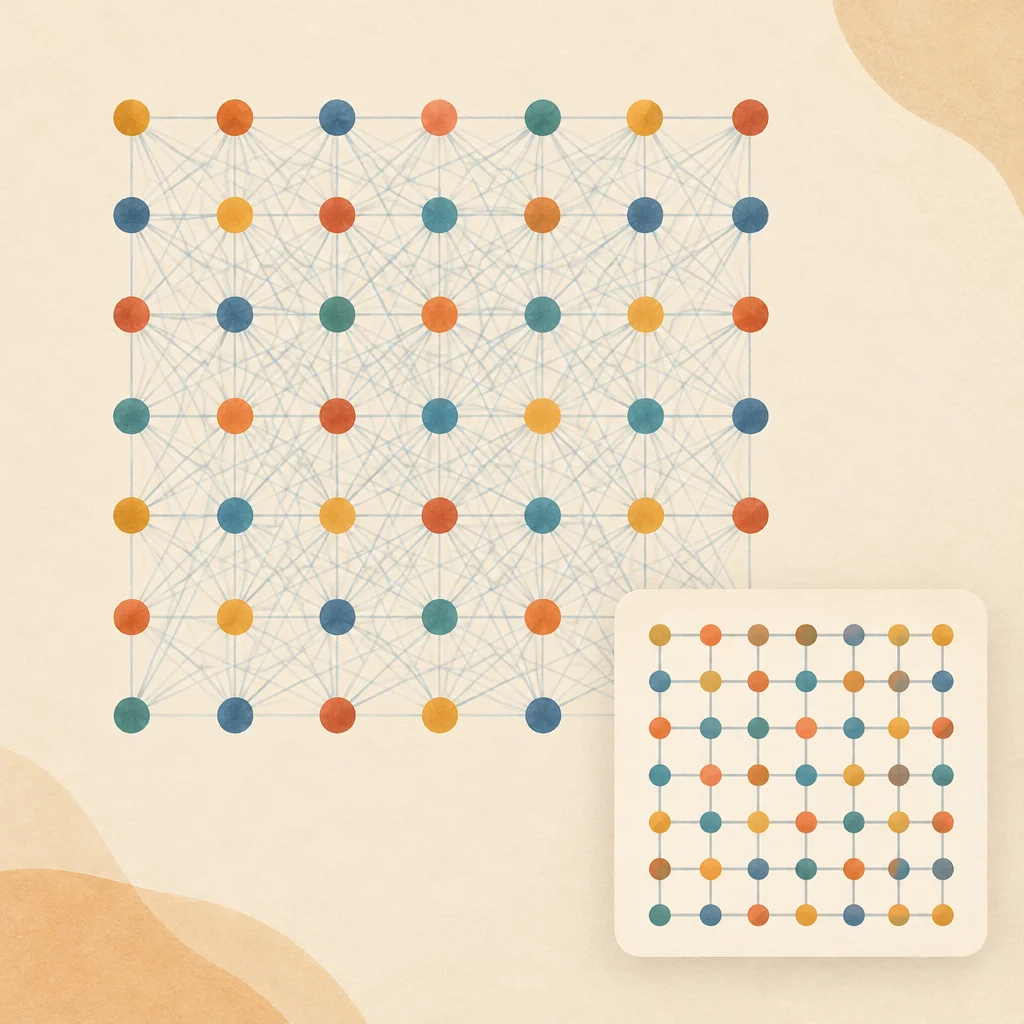
Parallel training helps, but the cost does not vanish09
How to discuss the claim without overstating it
A useful opening explanation is that the Transformer makes attention central to sequence modeling rather than adding it to a recurrent system. It connects positions directly, receives explicit order information, and still predicts outputs one token at a time. That account preserves both the change and its main boundary.
If someone asks why direct connections help, distinguish shorter information paths from parallel computation. The first concerns how positions influence one another. The second concerns how much work can proceed without waiting. The paper argues for both, but neither means unlimited efficiency.
If someone asks what proves the design, point to the combination of translation results, component variations, and parsing. Then qualify the answer: these support the tested architecture under stated conditions, not every possible attention-based model.
A thoughtful disagreement can focus on the right level of claim. One person may emphasize the reported gains. Another may emphasize long-input cost or the unresolved French score. Neither must deny the central architectural result.
Lumina suggests ending with a precise question: which remaining constraint matters most for the task under discussion? That moves conversation beyond admiration or dismissal. It also leaves room to read the original for the technical evidence rather than pretending this account supplies every experimental detail.
What to remember
Order and sequential processing are different requirements.
The Transformer supplies position information without recurrent processing. This supports the paper’s central design claim: a model can represent ordered sequences without computing every representation through the preceding one. It does not remove the decoder’s step-by-step generation.
A shorter information route is not a promise of lower cost everywhere.
Self-attention directly connects distant positions, but its favorable cost comparison has conditions. Local restrictions could reduce work on long inputs while lengthening distant paths. Lumina’s synthesis is to evaluate reach, parallelism, and total computation separately.
Read the experiments as evidence for a bounded design claim.
Translation, component tests, and parsing support attention-centered sequence modeling. They do not establish universal superiority or the proposed non-text applications. The strongest conclusion preserves both the reported gains and the limits of the settings tested.
Bring it into conversation
Talk about the paper
What does the title reasonably claim that attention is enough to replace?
Lumina reads it as a claim about replacing recurrence and convolution in the demonstrated sequence architecture, not eliminating every other component. Position signals and feed-forward networks remain part of the design.
Take it further: Would your judgment change if you assessed the title literally rather than through the architecture and experiments?
Which matters more for a proposed task: short information paths or lower computation?
The paper gives reasons to value both, but local attention exposes a tradeoff. Reducing access can save work while making distant connections less direct. The answer should depend on the input and the relationships the task requires.
Take it further: What evidence would you request before extending a short-sequence result to much longer inputs?
Which experiment most strengthens the case beyond a single winning score?
Component variations test whether design choices matter within the model. Parsing tests usefulness beyond translation. Lumina sees them as complementary: one probes internal choices, while the other widens the task evidence.
Take it further: Which uncertainty would remain even if both kinds of experiment looked strong, and what additional test would address it?
Keep in perspective
This account is limited to the supplied descriptions of the paper. They do not resolve the conflicting English–French BLEU figures or provide independent replications, reader reception, or later developments. Author biography is also unavailable beyond contribution notes. Proposed non-text uses, longer-sequence benefits of fixed position signals, and less sequential generation should remain possibilities rather than demonstrated results.
Who's talking about Attention Is All You Need
Public statements we checked against the original source
- Discussed it
 Eric SchmidtFormer CEO of Google
“a famous Google paper in 2017 called Attention is All You Need”
Transcript: US Lawmakers Probe AI's Role in Energy and Climate ↗TechPolicy.Press
Portraits from Wikimedia Commons · photo credits and licences