
The deep dive
Breath
by James Nestor
17 min read · Original commentary by Lumina, written with AI
Breathing happens without instruction, but does that mean we do it well? James Nestor investigates how breathing habits, airway shape, and bodily stress interact. His most useful challenge is not simply to breathe differently. It is to rethink what efficient breathing means, while separating plausible mechanisms, personal discoveries, and treatments still awaiting stronger evidence.
Prefer the quick version? Read the main learnings →01
An automatic act becomes an open question
Breath is nonfiction built around an investigation rather than a single clinical argument. Nestor combines bodily experiments, accounts of medical research, historical observations, and encounters with practitioners. He moves between ordinary problems, such as congestion and poor sleep, and practices meant to produce unusual physical or mental states.
The premise is that breathing deserves attention alongside other daily health habits. Yet the book does not present one technique as the answer to every problem. Breathing through an obstructed airway, taking excessive breaths at rest, and deliberately inducing an altered state involve different questions. Keeping those questions separate is essential to reading the book well.
Nestor serves as both investigator and test subject. His discomfort and surprise give abstract physiology a personal scale. That approach also creates a limit: his body can reveal a possibility without showing how common it is.
Lumina reads the book as an argument for informed attention, not unrestricted self-treatment. Its central intellectual question concerns a strange overlap: breathing normally runs without conscious thought, yet conscious choices can change it. How much useful control does that give us, and what evidence should guide its use?
Illustrated key idea
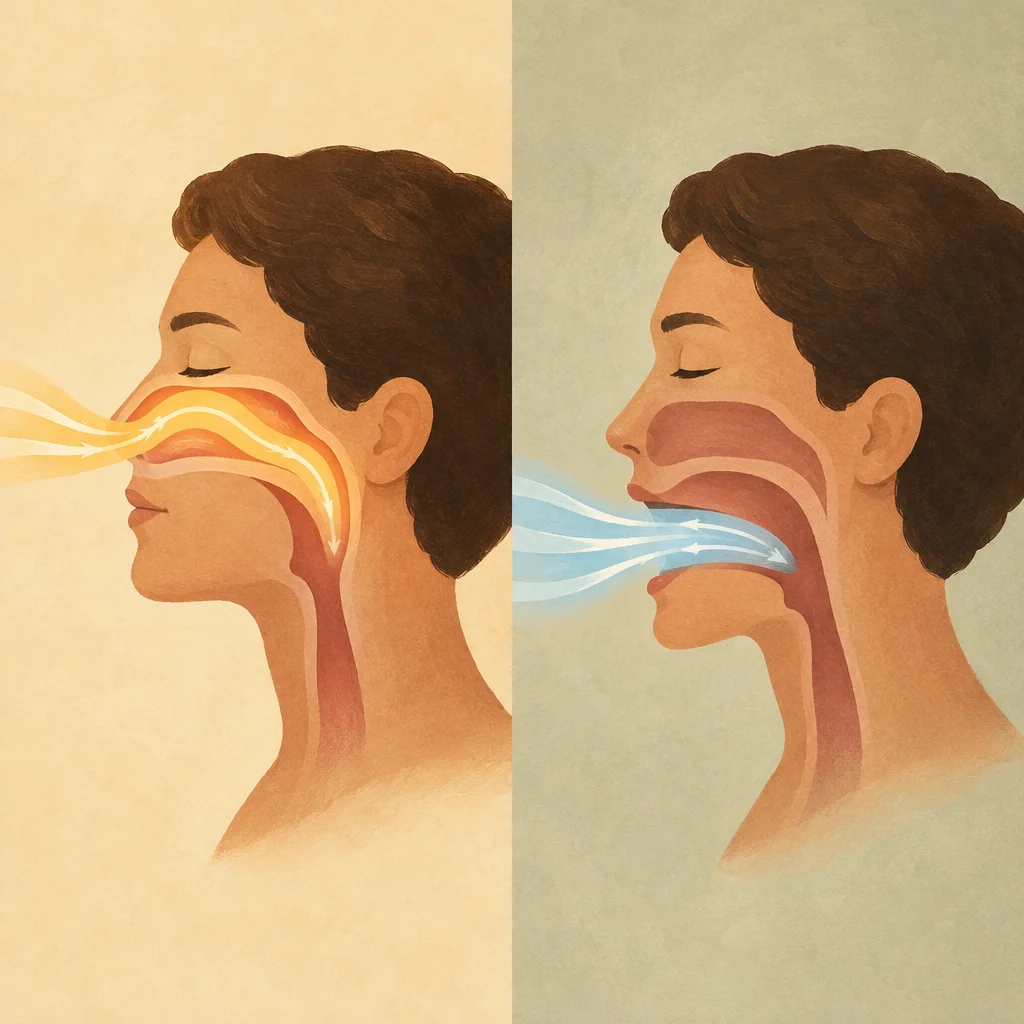
The nose does real work02
What would it mean to breathe well?
Nestor asks readers to replace a simple measure of breathing with a more demanding one. The question is not just whether air enters the lungs. It is whether breathing fits the body's needs, uses available structures effectively, and supports rather than disrupts other functions.
This changes the stakes. Someone may take in plenty of air while breathing inefficiently. Someone else may struggle because the passage available for that air is restricted. A third person may deliberately disturb normal breathing to explore stress or perception. The same visible act can therefore serve different purposes and carry different risks.
The book approaches this problem through three connected levels. First comes the route and physical space: the nose, mouth, jaw, and surrounding tissues. Next comes the process: how inhalation, exhalation, oxygen, and carbon dioxide work together. Finally comes regulation: how breathing interacts with alarm, recovery, and conscious experience.
Lumina's interpretation is that these levels form a useful check on one another. A technique cannot be understood apart from the body using it. A physical explanation does not automatically prove a treatment works. A powerful experience does not settle which mechanism caused it.
The practical stakes include sleep, exercise, anxiety, and chronic discomfort. But the book's broader challenge concerns how people judge familiar bodily functions. Automatic does not necessarily mean unchangeable; changeable does not mean fully understood.
Nestor's preferred everyday pattern is generally gentle, slow, nasal breathing suited to demand. That qualification matters as much as the pattern. The book allows occasional mouth breathing and distinguishes rest from exertion. Its strongest position is not that everyone should obey one number. It is that breathing quality depends on relationships among airflow, bodily demand, anatomy, and context.
03
The route is part of the work
The first major idea is that air does not arrive unchanged, and the route it takes matters. Nestor presents the nose as working equipment rather than a spare entrance. Its internal structures guide airflow. Mucus and tiny moving hairs help remove contaminants. Incoming air is warmed and moistened. The book also discusses nasal nitric oxide as a contributor to respiratory function.
These details change what counts as a breathing problem. If the nose performs several jobs before air reaches the lungs, bypassing it is not simply choosing another opening. Lumina's reading is that the book asks us to see breathing as a process distributed across several structures, rather than something the lungs do alone.
The Stanford experiment supplies the vivid anchor. Nestor and Anders Olsson make breathing route the central variable in a twenty-day comparison. For the first half, plugs prevent either man from using his nose. Nasal breathing and exercises define the second half. Repeated health measurements accompany an effort to avoid changes in diet and activity. The blocked-nose period brings both men severe discomfort and disrupted sleep. Nestor also describes poorer concentration, harder exercise, and a rise in blood pressure.
The experiment makes the nose's importance tangible, but its design limits the conclusion. Two participants cannot establish a typical response. Deliberately blocked nostrils also create a specific condition, not every form of everyday mouthbreathing. The recovery phase combines restored nasal access with exercises, making it difficult to assign every improvement to one change.
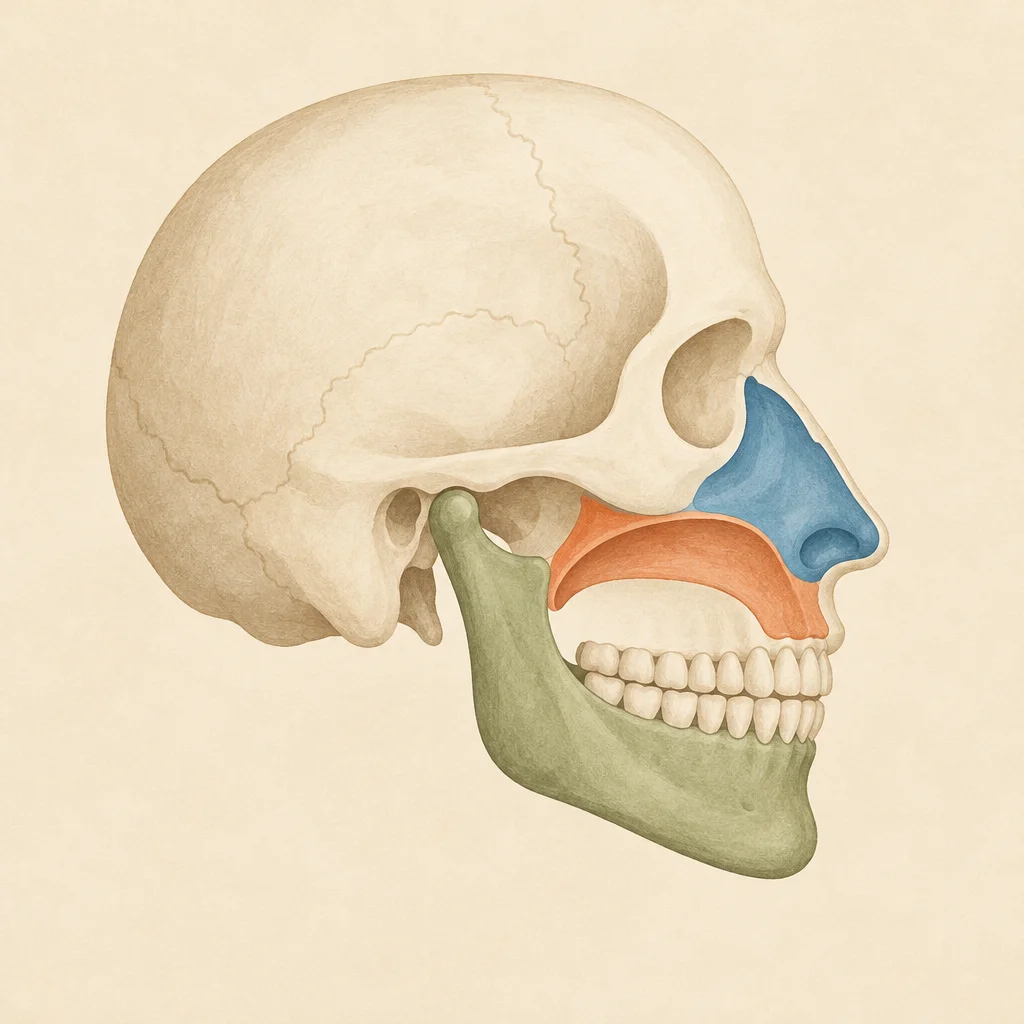
The structural argument goes deeper. Nestor connects restricted breathing with jaw development, food texture, teeth, and tongue space. Research discussed in the book includes population observations and animal experiments linking softer food with altered facial development. The point is not merely that food provides nutrients. Chewing also places demands on developing structures.
This creates a feedback problem: restricted space may make nasal breathing harder, while breathing habits may contribute to further structural change. If that account is right, advice based only on willpower misses part of the problem. A person cannot always correct an airway limitation by paying closer attention.
The boundary is especially important when Nestor discusses treatment. His reported improvement with an expansion appliance does not settle the effectiveness of adult expansion more broadly. Nor does his experience with mouth tape establish a treatment for sleep apnea; a clinician in the book explicitly cautions against that inference.
The implication is both practical and humane. Breathing habits may matter, but difficulty breathing is not necessarily a failure of discipline. Anatomy, development, and medical obstruction belong in the explanation.
04
Efficiency is not the same as taking in more
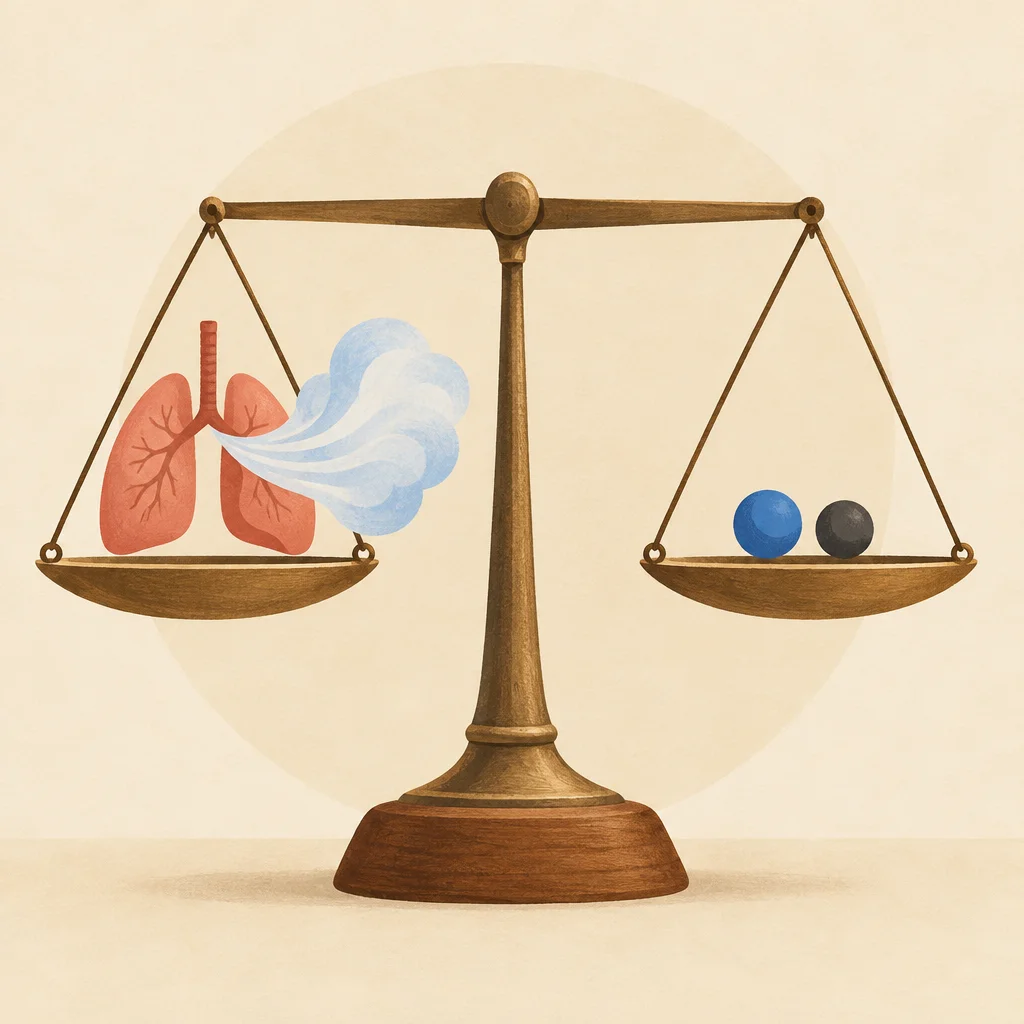
Once the route is clear, Nestor turns to a less intuitive claim: more air does not always mean better oxygen delivery. The body needs oxygen, but getting oxygen into blood is only part of the process. It must also reach the tissues that use it.
The book explains carbon dioxide's role through the Bohr effect. In simple terms, carbon dioxide helps oxygen leave hemoglobin, which carries oxygen through the blood. Excessive ventilation can lower carbon dioxide even when measured blood oxygen remains high. Nestor therefore challenges the idea that a fuller breath must always be a more useful breath.
Lumina's interpretation is that this is the book's central shift from quantity to coordination. A supply can look abundant while its delivery works poorly. That distinction helps explain why breathing cannot be judged through one appealing number, such as oxygen saturation, or one sensation, such as the size of an inhalation.
Nestor's stationary-bike comparisons make the idea concrete. He reports maintaining oxygen saturation while finding slower nasal breathing less effortful and improving his performance. Those observations support his inquiry, but they are not a controlled clinical trial. Their value lies partly in showing why his original assumption deserved testing.
The discussion of exhalation adds another dimension. In Nestor's account of Carl Stough, a choir conductor helps emphysema patients breathe more effectively without undoing their disease. Stough focuses on air left trapped in the lungs and on restricted diaphragm movement. Patients reportedly regain abilities that illness had limited: some can move or speak more easily, and some need less supplemental oxygen. These outcomes concern what the remaining lung tissue can accomplish; the damaged tissue itself has not been restored.
That distinction matters beyond this example. Functional improvement and structural cure are different claims. Someone may do more with the capacity they retain without reversing the underlying disease. Breath is most precise when it preserves this difference rather than treating all improvement as healing in the same sense.
The book also distinguishes slow breathing from reduced ventilation. A person can breathe slowly but take such large breaths that total airflow remains excessive. Matching breath to demand is the aim; minimizing air at all costs is not. Nestor acknowledges that some respiratory patients already retain too much carbon dioxide, so retaining more cannot be a universal answer.
His preferred gentle rhythm is therefore best read as a practical proposal, not a law governing every body. The deeper lesson is relational: inhalation, exhalation, gas balance, and metabolic need must work together. The body needs an adequate exchange, not a contest to take the largest possible breath.
Illustrated key idea
More air is not always better05
A lever on stress is not a promise of mastery
The third idea follows from the first two but changes their purpose. Breathing does not merely supply the body. It can also influence bodily state. Nestor explores how conscious breathing might affect processes usually experienced as automatic, including arousal, recovery, and responses to threat.
The book describes the autonomic nervous system through two broad functions: mobilizing the body for challenge and supporting recovery. Slow breathing is presented as one possible route toward calmer regulation. More forceful practices deliberately create stress. These are not opposing explanations so much as different uses of the same adjustable process.
Lumina reads this distinction as essential to the book's coherence. Daily maintenance aims to reduce needless strain. Intense practice asks whether a brief, controlled disturbance might produce a useful response. The fact that both involve breathing does not make their effects, evidence, or risks interchangeable.
The studies of Wim Hof and trained volunteers illustrate the difficulty of assigning causes. The book reports altered stress and immune responses in small experiments, but the training also involved cold exposure. Even a striking result cannot show that breathing alone produced it. Nor can practitioners' reports establish cures for autoimmune disease.
The investigation of panic adds a sharper challenge to ordinary ideas of control. In Justin Feinstein's research, concentrated carbon dioxide provoked panic in people without functioning amygdalae, structures associated with fear. The finding supports the existence of another route into alarm, connected with the body's monitoring of breathing chemistry.
This matters because fear can begin with a bodily signal, not only an interpretation of an outside threat. The book considers whether retraining responses to respiratory sensations might help anxiety. But experimental exposure is not established treatment, and provoking panic does not itself prove a lasting therapeutic benefit.
Altered-state practices raise a related distinction. Nestor describes powerful sensations during Holotropic Breathwork, while leaving open the roles of physiology, expectation, music, and setting. An experience can be vivid without providing a reliable explanation of itself. It can also feel important without demonstrating clinical improvement.
The spiritual material requires the same care. Prana belongs to the traditions Nestor explores as a concept of vital energy. Reported physiological changes in practitioners do not directly measure that concept or establish an equivalence with electron activity.
The implication is limited agency, not total mastery. Breathing may offer a way to influence bodily responses, but influence is not command. The book's warnings about fainting, medical conditions, training, and destabilizing experiences keep that distinction consequential.
06
How a bodily investigation becomes persuasive
Breath persuades through movement between scales. A dry mouth or sleepless night leads into anatomy; an exercise session opens onto gas exchange; an unusual experience raises questions about consciousness. This makes technical material easier to follow because a specific bodily problem gives the explanation a purpose.
Nestor's position as a participant strengthens that effect. He does not simply report that a practice feels difficult or strange. He exposes his own expectations to uncomfortable results. Lumina sees this as a useful narrative method: the investigator's changing assumptions model curiosity without requiring readers to begin as believers.
But personal immediacy can make evidence feel more decisive than it is. The Stanford measurements provide more than an unsupported impression, yet the experiment remains small. Consistent meals and repeated exercise sessions improve comparison without removing all uncertainty. The recovery phase also changes several things together.
Historical accounts supply another kind of persuasion. George Catlin's observations connect nasal breathing with the health he believed he saw among Indigenous communities. They broaden the inquiry, but observation cannot isolate breathing from other differences. Similarly, accounts of Stough's work invite renewed attention without independently explaining why his methods faded from practice.
The recurring stories of overlooked practitioners create a strong narrative pattern. They encourage readers to ask whether useful knowledge can exist outside accepted institutions. The boundary is that neglect cannot prove effectiveness, just as institutional acceptance cannot substitute for examining a particular claim. Nestor's explanation of why a method was neglected remains an explanation to assess.
A final technique is convergence: prayer, chanting, clinical exercises, and older traditions sometimes appear to reach related breathing patterns. This makes comparison productive, but a shared rhythm does not establish a shared mechanism or equal therapeutic value.
The best reading method is to keep several evidence categories visible: physiological explanation, measured personal response, controlled study, historical report, and practitioner testimony. They can inform one another without becoming equivalent. The book's appeal lies in bringing them together; critical reading requires noticing the joins.
07
Can curiosity outrun the cautions?
Lumina's strongest objection is that the book's range may blur differences in certainty. Nasal anatomy, carbon dioxide physiology, contested dental treatments, and altered-state practices can all become parts of one compelling journey. A reader may carry confidence earned by a sound explanation into a later claim supported mainly by testimony.
This is more serious than simply saying the evidence is uneven. The concern is transfer: does understanding one mechanism make a treatment built around it seem proven? Knowing that carbon dioxide affects oxygen release does not establish every reduced-breathing claim. Observing unusual bodily control does not verify prana. Reporting anatomical change in one adult does not resolve a treatment controversy.
The strongest reply is that Nestor often supplies the distinctions needed to resist that transfer. He notes uncertain mechanisms, disputed results, subjective reports, and risks. He distinguishes temporary intensive practices from habitual overbreathing. He also makes clear that serious illness requires medical care.
On Lumina's reading, the fair standard is therefore not whether every subject is settled. An investigative book can explore uncertain territory. The standard is whether uncertainty remains visible when an intriguing possibility becomes practical advice. Here the book offers safeguards, but the reader must still apply them actively.
A second tension concerns simplicity. The gentle daily recommendation is memorable, while the anatomy and clinical exceptions are complicated. That tension cannot be solved by choosing either a universal rule or complete inaction. The book's own examples show why context matters: obstruction may need assessment, excessive carbon dioxide can already be a problem, and mouth tape is not a sleep-apnea treatment.
The most defensible reply preserves both sides. Ordinary breathing habits may deserve attention without every symptom becoming a breathing problem. Some practices may help without replacing treatment. Curiosity can remain valuable while stronger claims carry a higher burden of proof.
The unresolved question is one of proportion: does the space given to dramatic practices deepen understanding, or make cautious everyday advice harder to distinguish from speculative treatment?
08
Use the distinctions before choosing a method
The book's ideas become most useful when connected rather than turned into a menu. Route affects how air is prepared. Structure affects which routes are available. Breath size and timing affect ventilation. Ventilation can influence both gas balance and sensations of alarm. None of these connections requires every breathing problem to have the same cause.
Lumina proposes a simple interpretive sequence: identify the aim, examine the mechanism, then judge the evidence. Is a practice meant to calm someone, improve breathing coordination, address obstruction, or create an intense experience? What is supposed to produce the benefit? What kind of observation supports that claim?
Consider an imagined example created by Lumina. Two people describe wanting to breathe better. One wants a calmer rhythm during ordinary stress. The other wakes repeatedly and struggles to move air through the nose. The shared phrase hides different problems. A relaxation practice might fit the first aim, while the second calls for attention to possible airway or sleep problems rather than an assumption that pacing alone will solve them.
The same reasoning clarifies the book's appendix. Its methods serve different purposes; they are not interchangeable prescriptions. A brief calming pattern and a forceful practice involving breath retention should not be judged by the same expectations or attempted with the same casual attitude.
Another useful connection joins efficiency with restraint. Nestor's exhalation discussion and his carbon dioxide discussion both challenge the urge to solve difficulty by adding more effort. Yet restraint is not deprivation. The goal remains adequate function, not enduring the greatest discomfort.
This approach preserves the book's practical value without making this deep dive a treatment guide. Its most transferable contribution is a better set of questions. Before asking which exercise is best, ask what problem needs explaining and what would count as a meaningful improvement.
Illustrated key idea
The airway is shaped by the face and mouth09
Discuss the argument without overstating the result
A strong conversation about Breath begins with its distinctions, not a verdict that breathing techniques either work or do not. Ask which practice, for which purpose, in which people, supported by what evidence. That turns a broad wellness claim into something people can examine.
You can explain the central argument as a challenge to simple assumptions: automatic breathing is not beyond influence, more air is not always more useful, and a powerful bodily experience is not proof of treatment. Each point opens a different discussion.
If someone finds the Stanford experiment decisive, acknowledge its measured changes before discussing its small scale and combined recovery methods. If someone dismisses the book because it includes disputed practices, ask whether uncertainty in one area cancels its clearer distinctions elsewhere. Neither response requires pretending that all claims deserve equal confidence.
It is also worth separating the book's position from your assessment. Nestor advocates greater attention to breathing and explores ambitious possibilities. Lumina's interpretation gives greatest weight to his framework of route, efficiency, and context, while treating broad therapeutic extensions more cautiously.
The original remains worth reading for how those questions develop through encounters, doubts, and bodily experience. This analysis provides an argument map, not a substitute for following that investigation or evaluating its fuller presentation of evidence.
What to remember
Breathing quality includes the airway, not just the lungs.
Nestor connects nasal function with jaw space, development, and obstruction. Lumina's synthesis is that habit and anatomy must be considered together. Encouraging a different breathing pattern does not establish that someone has the physical access needed to sustain it.
Useful breathing matches exchange to demand.
The book links fuller exhalation and carbon dioxide balance to efficient function. Slower breathing is not necessarily less ventilation, and less is not always better. The important question is whether the pattern serves the body's needs, not whether it looks impressive.
Experience, mechanism, and treatment benefit are separate claims.
Breath describes striking sensations and plausible physiological explanations, but neither alone proves lasting benefit. Lumina's critical lesson is to assess each step separately, especially when moving from gentle daily practice toward intense methods or disputed treatments.
Bring it into conversation
Talk about the book
What can a carefully measured two-person experiment establish?
Lumina's view is that it can reveal changes worth explaining and generate useful questions. It cannot establish how common those changes are or isolate every cause when several interventions occur together. Its narrative force and its scientific reach are different strengths.
Take it further: Which additional comparison would most improve your confidence in the book's practical conclusions?
Does the idea of breathing efficiency improve on the advice to breathe deeply?
The book makes efficiency more precise by discussing exhalation, carbon dioxide, and metabolic demand. Yet efficiency can become another vague ideal unless the desired outcome is clear. Lumina would judge it through function and context rather than one rhythm applied to everyone.
Take it further: How would you explain the difference between slow breathing and reduced ventilation to a skeptical friend?
Do the intense practices strengthen or distract from the everyday argument?
They extend the book's inquiry into conscious influence over bodily states. They also introduce greater risks and more uncertain therapeutic claims. Lumina sees a genuine trade-off: dramatic experiences can sharpen curiosity while making modest, better-bounded lessons less prominent.
Take it further: Where would you draw the line between exploring an uncertain practice and recommending it?
Keep in perspective
This analysis draws on accounts of the book's content, not independent inspection of the studies it discusses. It cannot verify treatment effectiveness, reconstruct full research methods, or assess wider professional agreement. No independent reception or biographical evidence is available here. Health-related passages explain Nestor's argument and its limits; they do not provide individualized medical advice.