
The deep dive
Chip War
by Chris Miller
18 min read · Original commentary by Lumina, written with AI
- Topic: Business
Computing can seem weightless until a factory, supplier, or government stops its flow. Chris Miller follows the people and choices that made chips cheap and powerful. His central puzzle is why the system that spread computing so widely also made the world depend on a few hard-to-replace firms.
Prefer the quick version? Read the main learnings →♫ AI-generated voice · press play below to listen and read along; tap any passage to jump to it
01
The world inside a small component
Chip War is nonfiction history about technology, business, and political power. Its subject is not just how people invented chips. Miller asks how firms learned to make them reliably, sell them cheaply, and build whole industries around them.
A transistor controls electrical current and can work as a switch. An integrated circuit puts many electronic parts together on a small piece of material. Yet these basic facts only open the story. Miller’s larger subject is the work needed to turn tiny switches into useful computing. Scientists, factory workers, buyers, investors, and governments all play a part.
Expect a wide cast rather than one inventor’s journey. Miller follows skills and businesses across borders. A firm may design excellent chips without owning a factory. Another may make those chips while relying on tools it cannot build itself.
Lumina reads the book as a study of the gap between having a device and keeping a whole system working. A successful design is one achievement. Making it cheaply, in large numbers, through market shifts and political disputes is another. That gap turns a history of small electronic parts into a much larger question: who holds power when everyone needs something that few people can make?
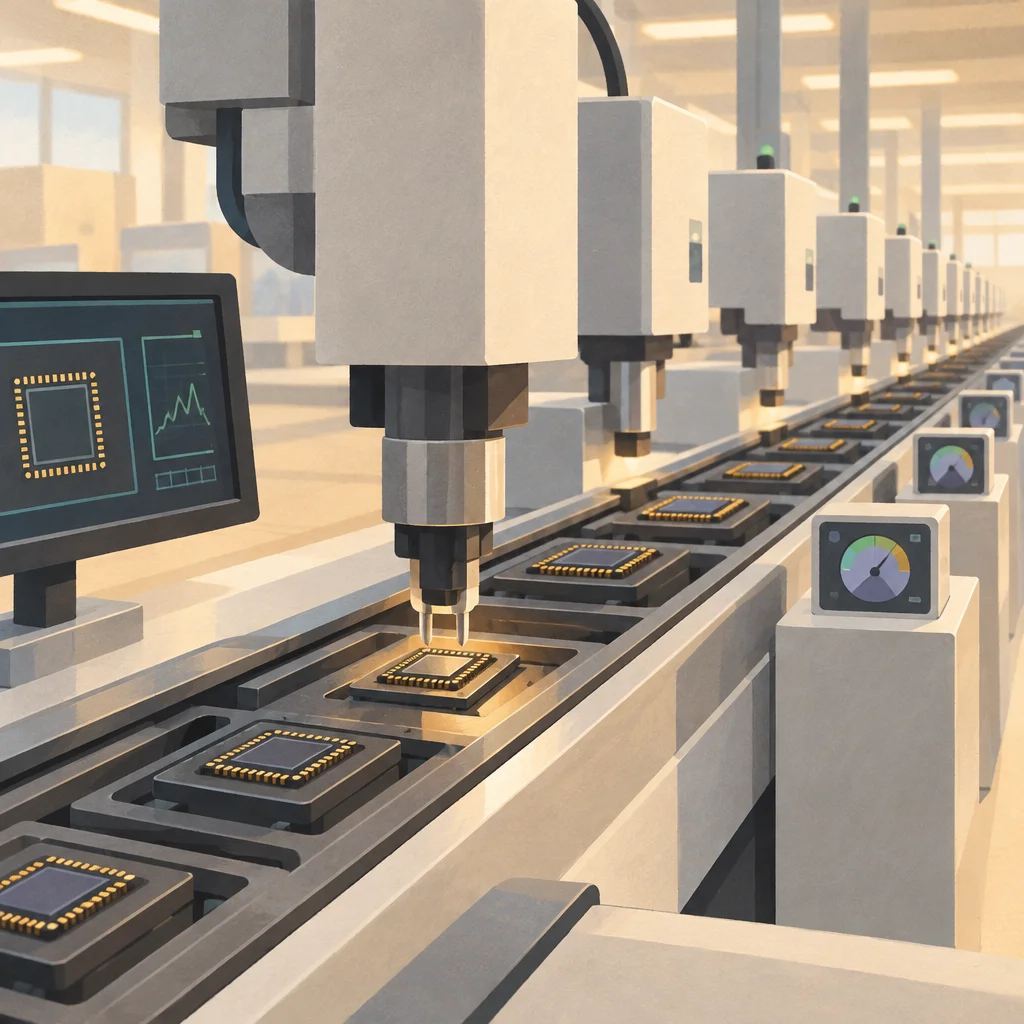
Illustrated key idea
Invention needs a production system02
When does shared dependence stop feeling safe?
How did an industry built through work across borders become a field of conflict between states? Miller’s answer is not that firms stopped working together. The same links that made progress possible also gave governments ways to apply pressure.
Consider three kinds of dependence. A chip designer needs a factory that can turn its plans into working devices. The factory needs special tools, materials, and software. Governments need the finished chips for both the economy and their armed forces. To judge any of these ties, we must ask how quickly one partner could replace another.
Miller traces how those ties formed. Early government orders helped firms learn how to make chips. Civilian buyers later created much larger markets. Dividing the work let firms focus on the tasks they did best. But some tasks became so hard and costly that only a few suppliers could perform them.
The stakes reach beyond phones and computers. Chips also support cars, communications networks, industrial machines, sensors, and weapons. Trouble at one factory can hurt people who never knew that factory existed.
Still, the book does not call every shortage a failure of global trade. Its pandemic account stresses rising demand and automakers’ canceled orders. Total chip output rose even while some buyers could not get what they needed. A busy production system and an unsafe one are not quite the same problem.
Lumina’s key distinction is between needing a partner and needing a partner with no timely substitute. The second creates both risk and power. This is why the book offers no easy choice between open trade and full independence. The global network helped build the very skills that governments now want to protect. Replacing it takes more than money or new factory buildings.
03
An invention matters only when production works
Miller’s first major claim is that invention and industrial strength are different achievements. Science can show what is possible. Factory work decides whether enough working devices reach buyers at a price they will pay. Much of Chip War takes place in the gap between those two steps.
Yield makes this point clear. Yield is the share of devices that work after they are made. A process may produce a brilliant sample while turning out mostly faulty chips. That wastes materials, machine time, and money. Raising yield can make a design much cheaper without changing its basic idea. Knowing how to run production is therefore a source of power, not a minor task that follows discovery.
The early factory accounts show how hard that knowledge was to gain. Photolithography uses light to create tiny patterns on chip material. But better patterns did not solve every problem. Firms also needed pure chemicals, accurate masks, and steady control over each production step. Engineers tested causes of failure they could not always measure or explain. Mary Anne Potter’s careful tests and Morris Chang’s process changes put people behind this slow work.
Lumina reads these cases as a challenge to a common picture of knowledge. Some knowledge can be written in a design. Other knowledge lives in practiced judgment, team habits, and ties with trusted suppliers. Getting the drawing does not mean getting the skill to make it work.
That difference helps explain Miller’s account of Soviet copying. He does not blame Soviet failures on a lack of able scientists. A copied chip still needed good equipment, pure materials, working methods, and spare parts. Meanwhile, American firms kept advancing. Even a successful copy could leave Soviet engineers chasing an older design rather than choosing their own next move.
Factories also needed buyers. Apollo and Minuteman orders gave early chipmakers demand and room to learn. Later, civilian markets offered far greater sales. Noyce cut prices to attract customers who might not otherwise use chips. In Miller’s account, firms did not merely meet demand; they helped create it. Lower prices opened new uses, while more sales helped support further gains.
The lesson is not that factories explain everything. New designs and scientific ideas remain vital. Rather, Miller shows why patents, samples, or research budgets alone cannot measure lasting strength. Ideas must connect with production, money, suppliers, and buyers.
Lumina’s broader reading is that a country can possess impressive technology yet lack a dependable industry. This claim has a clear limit: the book supports it through chip history. It does not prove that every field of technology needs the same mix of skills or the same business model.
04
More designers, fewer places to make their chips
The second major idea is a paradox. Making chip design easier to enter helped place advanced production in fewer hands. Miller shows how these two trends could grow from the same set of choices.
A foundry is a business that makes chips designed by its customers. A fabless firm designs chips but owns no chip factories. This split removed a huge cost for new designers. They no longer had to fund a factory before bringing an idea to market. Shared design rules and software tools helped make the split possible.
TSMC added a crucial promise: it would make customers’ chips without selling rival chip designs of its own. An older chipmaker might put its own products first when factory space grew scarce. Outside customers could also worry about giving valuable plans to a possible rival. TSMC’s promise gave them a reason to trust it.
Lumina reads this promise as part of the system that made new technology possible. Better tools were not enough. Designers also needed a business partner whose interests fit their own. Trust helped turn a technical option into a model that many firms could use.
Nvidia shows what this allowed. By paying other firms to make its chips, it could focus resources on graphics designs and software. Its graphics processors perform many simple calculations at once. CUDA software let programmers use that power for tasks beyond images, including scientific work and AI. Production had not become less important. A specialist factory let a designer build a different kind of skill.
Yet this opening for designers also helped the largest foundries grow stronger. More orders spread factory costs across more chips. Larger output gave engineers more chances to learn and raise yield. TSMC also built ties among designers, toolmakers, and suppliers around its own processes. Many new design firms could thus come to rely on a small number of factories.
ASML shows a related pattern in chipmaking tools. Its extreme-ultraviolet machines use very short-wavelength light to make fine patterns. Many countries and suppliers helped develop them. In Lumina’s reading, the lesson lies in a distinction: how many firms take part in a project is a different question from how many could step in if one dropped out. Thousands of suppliers took part in the EUV effort, and ASML built only a small fraction of the machine itself. Yet for some critical parts there was nowhere else to turn. Wide participation and thin backup capacity existed side by side in the same tool.
The implication is that a long supplier list does not prove a system has many backup options. Work can be spread across the world while one step remains hard to replace.
Miller also sets a boundary. Analog and power-related chips often use older processes and face different factory costs. Not every chip market follows the same path. The strongest reading concerns the forces that narrowed advanced production, not a rule that all kinds of chips must end up in the same few places.

Illustrated key idea
Civilian markets reshaped military power05
The power to deny access
The third idea follows from the first two. If production skills are hard to copy, and key tasks sit with a few suppliers, access becomes a source of political power. Miller’s account of export controls shows governments using business ties to put pressure on rivals.
Huawei makes the gap between design skill and production access especially clear. The book credits it with serious research, strong manufacturing, better management, and advanced chip designs through HiSilicon. Miller does not explain its rise through state aid or theft alone. Yet Huawei still needed outside firms to make its best chips and supply other parts.
Washington first restricted sales of American-made chips to Huawei. This did not stop TSMC from making Huawei’s designs in Taiwan. Later rules reached chips made abroad using American technology. Moving production outside the United States had not removed the need for American tools and software. The rules sharply reduced Huawei’s access, though some licensed purchases and older chips remained available.
Lumina reads this as power over a network rather than ownership of every factory. A government need not control the final production site to affect whether it can work. Its influence may lie in an earlier step that the factory cannot avoid. This makes the source of power less obvious than the label on a finished product.
But power in the present need not last forever. Restrictions give the target more reason to seek substitutes. Miller considers whether American pressure could make Chinese chip policy more focused. He also describes wasted funds, fraud, and failed projects. Strong resolve can raise spending without producing the needed skills.
This leads to an important distinction. Complete independence is not the only response that matters. China could reduce selected needs for foreign goods, expand older-process production, improve memory chips, or use other processor designs. Such gains might increase its influence without reproducing the whole global system. Falling short of full independence would not make every effort a failure.
Taiwan presents another kind of pressure point. Its chip output gives many countries a reason to avoid conflict. But shared costs cannot guarantee peace. A blockade, limited attack, or accident could stop production without a full invasion. Nor would taking the factories ensure working output. They still need foreign tools, materials, software, and skilled staff.
The book’s uncomfortable lesson is that the same dependence can support trade, threats, and efforts to prevent war. These effects can exist together. Lumina’s caution is to keep possibility separate from fact. Miller describes paths a crisis could take, not a certain future war. Export controls also show real power at a given time, not proof that one country will keep the same advantage forever.
06
How the history makes its case
Miller builds his case by linking small choices to large outcomes. A change in a factory process can lower a firm’s costs. A firm’s choices can reshape a market. That market can then change military plans and relations between countries. The available accounts show this method, though they do not allow a close judgment of the original prose.
Japan’s challenge to American chipmakers offers one strong anchor. Customer tests found much better reliability in Japanese memory chips. This grounds the story in product quality, not just American fears. Miller then adds cheap finance, buying practices, research support, and cases of spying. He does not treat those cases as enough to explain Japan’s rise. Different evidence supports different parts of the argument.
GCA’s equipment business supplies another test. Its troubles involved poor reliability, weak service, bad management, and lost customer trust. Public aid and better technology could not by themselves build a sound business. Lumina reads this case as a check on an easy claim: calling a supplier vital to national security does not make it well run or able to survive.
The military examples also carry a useful limit. Better guidance made weapons more accurate in Vietnam, but it did not win the war. The Gulf War later showed the force of chip-based guidance, sensors, and communications. Holding both cases in view blocks the claim that better electronics always deliver political success.
Miller also changes the test of progress. Moore’s Law appears as a forecast sustained by hard work and investment, not a natural rule. The conclusion asks whether useful computing can keep getting better at an affordable cost. That is broader than simply counting transistors.
For Lumina, the book’s strongest method is to compare outcomes rather than rely on hero stories. Similar goals can lead to different results because firms, markets, and production systems differ. Yet not every cause has equal proof. Intel’s slow use of EUV, for example, is a suspected cause of its delays, not a fully established account of what went wrong.
07
Whose security, and at whose cost?
Lumina’s strongest fair objection is that showing a risk does not tell us which policy to choose. A book can explain chip dependence well while leaving readers unsure how much governments should spend or restrict. Finding a weak point is easier than deciding what safety is worth.
The Japan episodes bring this problem into focus. Aid for chip producers could hurt computer makers that wanted cheaper parts. Export limits raised memory prices without restoring most American producers. The interests of one industry did not stand for the needs of the whole country. A related conflict appears when American firms see China as both a major buyer and a state-backed rival.
The strongest reply, also Lumina’s reading, is that Miller offers reasons to distrust simple answers. The chapters cited here make the record of public support hard to score. In Lumina’s reading, the question is not whether government helped but what each form of help was able to do. Changes to tax, investment, and intellectual property rules improved the industry’s position without taking back the memory market Japan had won. Miller credits Pentagon spending on microelectronics with a military edge that no one else matched. And Sematech’s extensive support of GCA could not dispel its customers’ fear that the firm might go bankrupt and leave them without replacement parts. Markets encouraged new uses and lower costs, but also left risks that firms had little reason to solve alone. Neither government control nor free trade works as a complete answer in this history.
A second tension concerns China’s search for security. Miller treats its fear of foreign chip dependence as real and understandable. He also sees its plans to replace foreign suppliers as a threat to existing trade networks. Both views can be true. Still, readers should ask when one country’s effort to feel safe makes another feel less safe. Explaining that conflict does not settle what each side may fairly do.
Labor raises a further question. The book describes mostly female assembly workers, low pay, and managers who opposed unions. These costs helped shape where chips were made. Micron’s survival also involved layoffs, pay cuts, and heavy pressure on workers.
Lumina’s concern is that a story centered on firms and states can push workers’ lives into the background. The strongest reply is that Miller includes these costs rather than offering a clean tale of success. Even so, readers may want more about workers’ choices and welfare. Secure supply, profitable firms, cheap devices, and decent work are separate goals. Industrial success should not make the conflicts among them disappear.
08
Ask what cannot be replaced
Chip War joins three questions often kept apart: who invents, who makes, and who can keep production running under pressure? Lumina’s practical reading is to test each one separately. Strength in one does not ensure strength in the others.
For business, this changes what counts as a valuable asset. Designs matter, but so do yield, customer trust, steady funding, and close work with suppliers. TSMC’s promise not to compete with customers and ASML’s skill at bringing parts together show why business ties can be hard to copy.
For policy, ask what a new investment actually changes. Does it add output, improve technology, train staff, or create a backup supplier? Those are different results. New factories outside Taiwan may reduce some risks without replacing the island’s scale or best technology. A factory announcement is not a finished alternative to a whole production system.
For reading the news, separate shortage from lack of substitutes. Demand can outrun supply even when output rises. At the same time, plentiful supply in normal conditions can hide a serious weakness if one source fails. The pandemic and Taiwan discussions concern the same industry but different forms of danger.
Lumina offers a simple tool drawn from this reasoning: name the skill, the dependency, and the time needed to find a replacement. Then ask who pays if access stops. This is a way to apply the book’s ideas, not a claim that Miller provides a checklist for every industry.
The last connection concerns progress. Better computing can come from new packaging and chips built for specific tasks, not only smaller transistors. Policy can protect those gains or make them more costly. The useful question is not merely whether a country has more chips. It is whether its choices keep useful computing affordable while reducing the risks it judges too great.
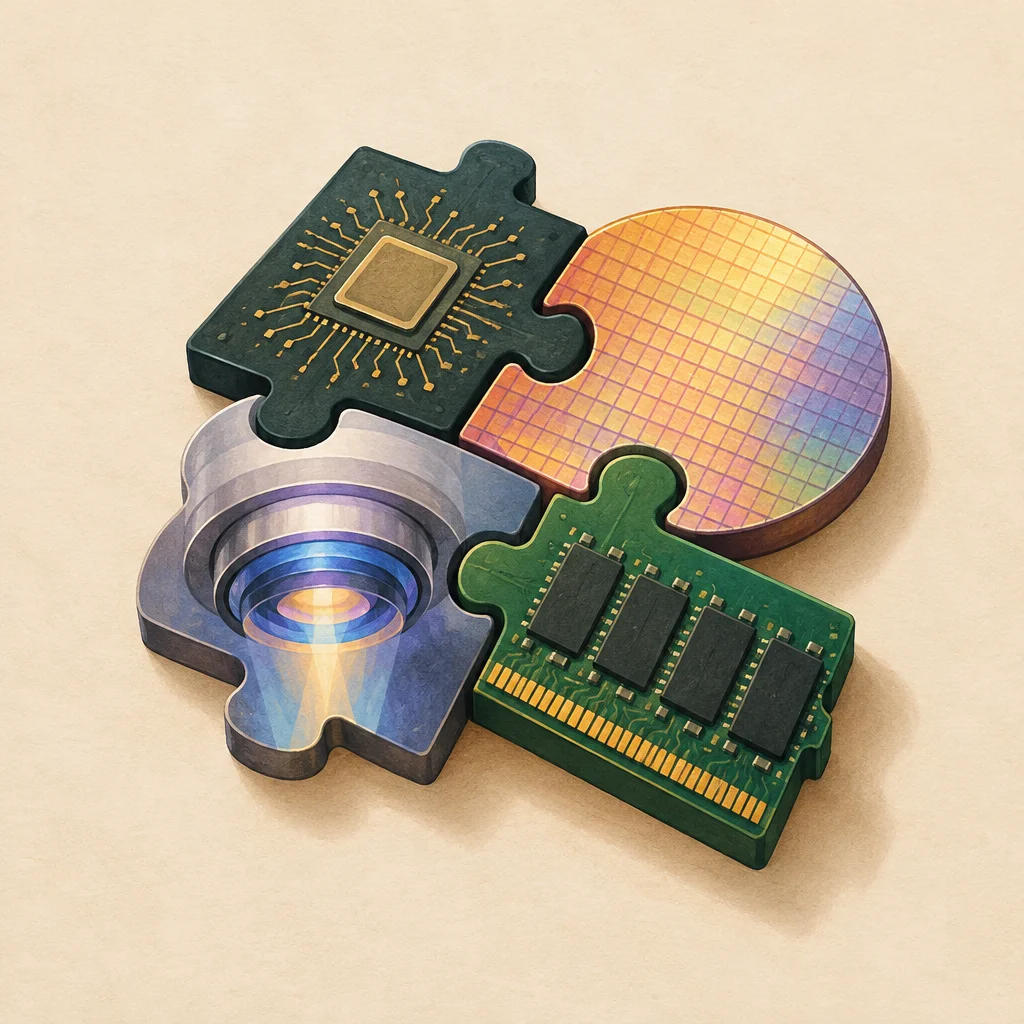
Illustrated key idea
Specialization made chips cheap and fragile09
Keep the distinctions alive
A good discussion of Chip War should avoid declaring one permanent winner. First name the skill at issue. Leadership in design differs from leadership in production. Memory chips and advanced processors serve different markets. Who owns a firm and where its factories stand are also separate questions.
One useful opening is that low costs and high risks can grow together. Then test that claim against the gains for fabless firms. They could try new ideas because specialist factories carried the cost of production. The challenge is not to deny this benefit, but to ask how its risks should be shared.
If someone says export controls solve the problem, separate present pressure from later efforts to find substitutes. If someone says shared dependence prevents war, separate a reason for peace from a guarantee. If someone credits invention alone, return to production skill and buyers.
These distinctions also set honest limits. This deep dive prepares a reader to discuss the book’s arguments, not to claim knowledge of every episode or its original wording. A useful disagreement names the goal, asks which evidence bears on it, and admits what remains uncertain.
What to remember
A design is not a working industry.
Miller links invention to yield, suppliers, factory habits, and buyers. Lumina’s takeaway is that access to plans cannot replace a skilled team and a sound business. Ask whether a device can be made reliably and cheaply, not just whether someone can show that it works.
More partners do not always mean more backup options.
Foundries let designers enter markets without building factories. Yet rising costs and gains from scale placed advanced production in fewer hands. Lumina’s lesson is to count real substitutes, not just participants. A network can span many countries while relying on one narrow step.
Security needs a clear goal.
Cheap computing, steady supply, domestic factories, and limits on rival military power are different aims. The book shows conflicts among them. Lumina would judge a policy by the risk it reduces, the costs it creates, and the backup options it can truly provide.
Bring it into conversation
Talk about the book
Should public money build new skills or save suppliers at risk?
Miller gives grounds for both action and caution. Research support helped new skills emerge, while national importance did not ensure successful rescues. Lumina would separate the need to preserve a vital task from the case for saving one particular firm.
Take it further: What would show that a supplier needs temporary help rather than a new business model?
Can a country become safer without making all its own chips?
The book treats full independence at the frontier as unrealistic, but selected reductions in dependence can still matter. Lumina’s view is that safety can be partial. Backup sources, skills, and trusted partners need not all be domestic to be useful.
Take it further: Which dependency would you reduce first, and what would you pay to reduce it?
Who should pay to keep computing cheap and supply secure?
The history ties lower costs to public funds, factory skill, and hard working conditions. Lumina sees a question of fairness beneath the policy debate. Workers, firms, consumers, and taxpayers do not receive equal shares of the gains or bear equal risks.
Take it further: Would you support a policy that secured supply but raised prices or weakened workers’ bargaining power?
Keep in perspective
This reading uses accounts of the book’s arguments and events, not close access to its prose, notes, or source records. No author biography or independent reviews are available here. Miller’s explanations and forecasts remain his claims where noted. Lumina’s readings do not prove those claims or update chip-industry conditions beyond the period the book describes.