
The deep dive
Guns, Germs, and Steel
by Jared Diamond
18 min read · Original commentary by Lumina, written with AI
- Topic: History
Why did some societies gain the means to conquer others? Jared Diamond looks beyond weapons to the environments that helped produce them. Lumina examines his chain of causes, the gap between power and well-being, and the challenge of explaining large historical patterns without losing sight of human choice.
Prefer the quick version? Read the main learnings →♫ AI-generated voice · press play below to listen and read along; tap any passage to jump to it
01
An explanation of power, not a ranking of people
Guns, Germs, and Steel is nonfiction built around a large historical puzzle. Why did wealth and military power develop so unevenly across societies? Diamond’s answer starts with unequal opportunities, not unequal inborn abilities. Local plants and animals, routes of exchange, and population histories helped shape what people could build and sustain.
Expect a connected argument rather than a complete world history. Diamond moves between the details of living things and patterns across continents. The way a plant releases its seeds can affect how easily people grow it. Farming can then support larger populations, skilled workers, and governments. Over many generations, these changes can alter the balance of power.
The key distinction is between naming an advantage and explaining its origin. Steel weapons may help an army win. That still leaves the question of why one side had them.
Lumina’s reading is that the book asks us to stop treating success as its own explanation. Victory shows an imbalance of power; it does not prove greater human worth. Diamond must then explain how that imbalance arose, and show where his account reaches its limits.

Illustrated key idea
Inequality explained by history and environment, not innate rank02
What lies behind an unequal encounter?
Contains plot details — open to read
The book’s central question becomes clearer when we separate two kinds of cause. Immediate causes explain how an event happened. Deeper causes explain why the conditions for it existed. We need both, though they answer different questions.
Diamond uses the encounter at Cajamarca to draw this distinction. Pizarro’s men captured the Inca ruler Atahuallpa while a much larger Inca army stood nearby. Armor, steel blades, and mounted soldiers helped give the Spaniards their military edge. An earlier epidemic had upset the Inca line of succession and helped set off civil war. Ships and state support brought the expedition across the ocean. Written records gave Europeans access to knowledge beyond their own experience.
Even here, the book’s title can mislead if read too simply. The Spaniards’ early guns were less decisive than their swords and horses. Central government also worked differently on each side. Spain could support an overseas venture. Inca reliance on one ruler made his capture especially damaging. An advantage mattered through the way people used it and the setting in which they acted.
Diamond then works backward. Why had these tools, diseases, and stores of knowledge gathered so unevenly? He links them to earlier differences in farming and exchange.
The stakes concern both evidence and human worth. If we explain victory by calling the winners superior, we use the result to prove the cause. Diamond instead looks for earlier conditions that can be studied apart from the outcome.
Lumina’s interpretation is that this improves the question without settling every answer. A deeper cause is not always the most useful cause for every purpose. Geography may explain a long-run imbalance. A leader’s decision may explain one campaign. The book works best when these levels add to each other rather than compete.
03
Useful resources are not always usable starting materials
Diamond’s first major move is to ask what people could do with the species around them. A place rich in wild plants might still lack promising crops. A place full of large animals might offer few good livestock candidates. What matters is not abundance alone. It is whether particular species have traits that people can use together.
Domestication means changing plants or animals across generations through cultivation or controlled breeding. Training one wild animal is different. A tame creature may belong to a species that rarely breeds in captivity or cannot safely live near people. Skill and patience cannot remove every such barrier.
This matters because several separate problems can block success. An animal might provide valuable food but cost too much to feed. Another might grow quickly but react badly to confinement. One useful trait cannot cancel every harmful one. Diamond explains the small number of major livestock species through conditions that had to work together.
Plants raise a related problem. Farmers need useful traits to pass reliably to the next generation. A plant that matures quickly offers a faster return on effort. A tree that takes years to bear fruit makes experiments slower and more costly. If several genes affect an unwanted trait, selecting plants without it may also be difficult. The obstacle need not be a failure to notice that the wild plant has value.
The larger issue is a working mix of resources. Diamond presents the Fertile Crescent’s crops and livestock as a strong starting combination. Different foods and animal products could meet different needs. Farming had to offer enough value to compete with established ways of finding food. One good crop did not guarantee that people would make the change.
New Guinea helps test the difference between local knowledge and local resources. Diamond describes people with deep ecological knowledge who developed agriculture for themselves. Yet their crop base and lack of large local livestock still placed limits on production. Their later use of sweet potatoes shows that those limits did not reflect a general refusal to try useful crops.
Lumina’s interpretation is that Diamond changes what needs explaining. Before asking why people failed to develop something, ask whether they had the materials and support it required. That does not mean every useful change was welcomed. Diamond allows that communities sometimes rejected benefits they could have gained.
The claim is narrower: results alone cannot reveal ability. Human skill works on a set of available options, and those options differ. Nor are early limits permanent ceilings. They can delay a change without ruling it out forever. Diamond’s argument concerns unequal opportunities and timing, not fixed limits on what a people can achieve.
04
A society can grow stronger while its people live worse
The next link separates a society’s power from the quality of life within it. Farming could help a population expand without making life better for each person. This is vital to Diamond’s argument. Otherwise, his chain of causes could look like a simple march toward progress.
The book does not treat the first farms as an obvious bargain for those who worked them. A growing food supply could come with serious costs to health and daily life. People did not need to see agriculture as a better future and choose it all at once. Smaller decisions about food and effort could gradually change how they lived. Farming, hunting, and gathering could overlap. People could also turn away from cultivation for a time.
Once farming took hold, population and production could feed each other. More food could support more children. Diamond adds a second pressure that came from staying put rather than from the harvest. A mobile band had to transport its infants on every move, and that limit spaced births apart; a village family faced no such limit and could have the next child sooner. In Lumina’s reading, this matters for the question of welfare: both pressures add to the number of people who must be fed, and neither promises each of them more. More people then needed more food. If population grew faster than supply, the community could become larger while its members remained poorly fed.
Food stores also changed how people spent their time. Some could make tools, keep records, fight, or govern because others produced their meals. These roles could increase a society’s ability to organize work and war. But rulers could also claim part of that food for themselves. A system that enabled shared projects could at the same time support an elite.
Diamond’s account of government keeps both effects in view. Central rule can help strangers settle disputes and work together. It can also force people to provide labor and goods. A larger state may therefore have greater power without offering greater fairness. Its size tells us what it can organize, not whether everyone benefits.
Disease adds a further effect that people need not have intended. Some fast-spreading infections leave survivors immune and soon run out of new hosts in small groups. Larger, connected populations can keep supplying susceptible people. Livestock also brought repeated chances for animal microbes to adapt to humans. Diamond stresses that most such transfers did not become lasting human diseases.
Lumina’s reading is that the chain reveals a gap between people’s aims and the systems they helped create. A person could seek a reliable meal without seeking a ruling class or an epidemic. Effects could build far beyond the scope of that choice.
This does not turn every society into a step on one ladder. Some hunter-gatherers settled and stored food. Some farmers moved about. The Inca state did not need writing to become powerful. These cases show that Diamond is tracing links whose strength depends on conditions, not a sequence every society must follow.
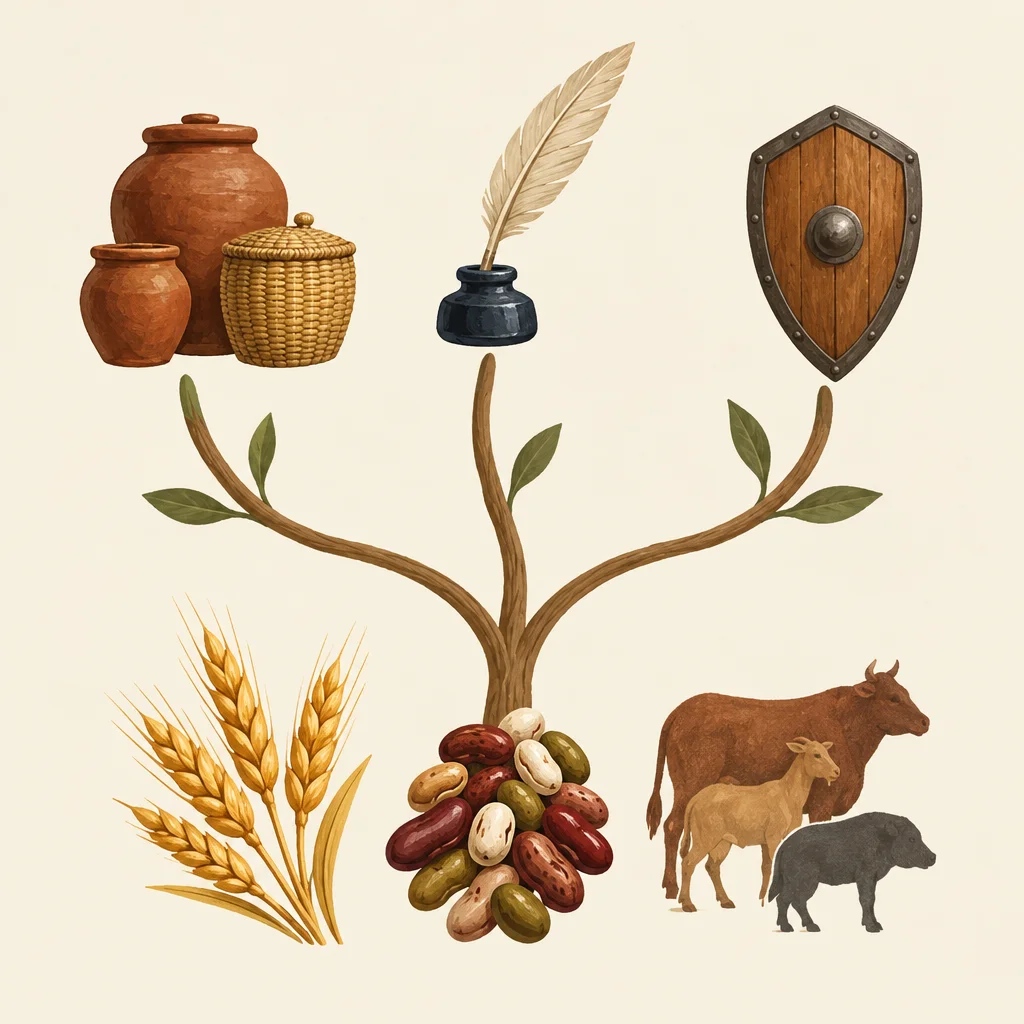
Illustrated key idea
Food production triggers downstream social and political changes05
Connection changes what ingenuity can accomplish
Good starting resources explain only part of Diamond’s account. People also differed in how easily they could receive crops, animals, and techniques from elsewhere. An invention kept in one place has a different reach from one that travels and joins with other inventions. Exchange can multiply the value of work already done.
Diamond argues that Eurasia’s wide east–west span often helped farming spread. The reasoning turns on how much adjustment a domesticate must make at its destination. Carried east or west, a crop or animal meets days that lengthen and shorten on the schedule it already knows, and often a climate much like the one it left, so farmers could take it up with little alteration. A crop moving north or south is more likely to face unfamiliar seasons. It may need changes before farmers can use it well. The shape of a continent could thus affect how far an early farming advantage traveled.
Latitude is not the whole explanation. Rainfall, deserts, mountains, forests, narrow routes, and disease could block movement. Two places might both suit a crop yet be separated by land where it could not thrive. A useful destination did not ensure that farmers could get the crop there.
Writing extends this reasoning beyond food. Diamond finds few clear cases in which people invented writing without another system to draw on. More often, people adapted a script or learned that writing was possible and created their own. Information could spread as a detailed model or as a goal worth pursuing. Food stores could support scribes, but they did not ensure that writing would appear.
Technology also relied on earlier work. Existing skills and tools made later inventions possible. Borrowing enlarged that store. Yet people did not adopt every useful device. Cost, status, powerful interests, and visible results all affected their choices. Diamond therefore rejects the idea that whole peoples possess a fixed appetite for innovation or a fixed resistance to it.
Lumina’s interpretation is that access to other people’s work is itself a major resource. Looking only at the final owner of a technology can hide a long history of exchange and revision. What looks like one society’s achievement may depend on many sources of knowledge.
Political divisions also shaped access. In the epilogue, Diamond suggests that Europe’s rival states gave rejected projects other possible sponsors. A decision by China’s central rulers could have wider reach within a unified state. This is a more specific claim than the argument about crop movement. It needs evidence of its own.
The boundary is that connection does not make adoption automatic, or make every outcome better. Lumina would state the lesson cautiously: contact widens the options people can use. Institutions and interests still affect which options receive support. Geography helps shape the routes, but people make decisions along them. This is where Diamond’s account of environment meets his harder questions about choice.
06
How the causal chain earns—or risks—your trust
Diamond builds his argument by changing scale. Seed traits and animal behavior make its early links concrete. Comparisons among societies then connect food to population and power. The task is to show how one thing affects another, not simply to point at matching patterns on maps.
Polynesia is one useful anchor. Related settlers developed different economies and forms of rule on different islands. Their shared roots weaken an explanation based on inborn differences. But this is not a laboratory test. Climate, island size, resources, distance, and customs vary together. The comparison shows that environment can matter without measuring each factor’s exact share.
A second anchor is the evidence for the start of farming. Diamond describes how researchers use food remains, plant biology, and the ranges of wild ancestors. Dates help them judge whether people developed a crop locally or received it from elsewhere. Dating a seed directly can avoid mistakes caused by older or newer material found beside it. This detail matters: an argument about a head start needs a sound timeline.
A third anchor is the use of awkward cases. Japan’s settled Jomon communities challenge any neat equation of hunting and gathering with constant movement. The Inca state shows that writing is not a requirement for political power. Tropical diseases show that infection did not always favor European expansion. Exceptions help when they reveal which conditions a claim needs.
Lumina’s assessment is that these concrete links and contrasts do the book’s strongest work. The risk lies in how smoothly the whole chain can read. Strong evidence for one link does not give every later link the same force. A disputed crop date, an uncertain migration, and a proposed language relationship each need a different kind of judgment.
The photographs work in another way. Their captions identify people from the regions used in the comparisons. They do not prove the thesis. Lumina reads them as a reminder of what large categories contain: named people and distinct communities, not simply examples of a continental pattern.
07
When does a broad explanation become too flexible?
Lumina’s strongest objection concerns what could count against the argument. If environment shapes farming, population, tools, and government, many later results may seem to fit. A successful society had useful resources. An unsuccessful one faced barriers, poor timing, or bad choices. If every result can be explained this way, how do we test the framework rather than merely apply it?
Diamond’s own claims create a further tension. He allows that culture and unusual individuals can redirect events. Yet his epilogue makes a stronger judgment about the Americas: the long separation of the hemispheres had, in his view, made European conquest all but certain. That goes beyond saying Europeans held large advantages. It asks readers to accept that those advantages left little room for a different broad outcome.
The strongest reply, in Lumina’s interpretation, turns on scale. Geography need not predict a ruler’s decision to explain a lasting imbalance between large populations. Many different local paths could lead toward the same broad result. Doubt about one encounter does not erase differences in livestock, farming history, exchange, or prior disease exposure.
The Norse case also challenges the idea that being European was enough. Their overseas settlements had limited people and support, difficult farming, and competitors suited to local conditions. Diamond must explain how an expansion could sustain itself. He cannot simply assume success from the settlers’ origin.
That reply has force, but it does not settle the question of certainty. A clear advantage does not by itself prove that an outcome could not be avoided. Lumina would keep the environmental framework while asking for more care when a strong tendency becomes a near-certainty.
A second tension concerns responsibility. Long chains of causes can make violence sound like something that simply happened. Yet Diamond also describes actions: rulers extract goods, settlers seize land, and armies conquer. Environment can help explain the means available to them. It cannot grant moral permission.
Both distinctions matter. Winners need not be naturally better for their advantages to be real. People need not have created those advantages to bear responsibility for their use. Readers can accept the book’s rejection of inborn hierarchy while still testing its historical claims.
08
Institutions matter—but where did they come from?
The afterword connects Diamond’s historical argument to modern wealth. He accepts that schools, government, contracts, and limits on corruption affect prosperity. He then asks how societies came to develop those institutions.
This repeats the distinction between immediate and deeper causes. An institution can shape life now while having roots in earlier farming, settlement, and political change. Explaining its origin does not make its current effects less real. Naming it as important does not finish the explanation either.
The two Koreas show a clear limit to inherited opportunity. Shared historical roots do not guarantee similar rule or wealth. Diamond also argues that geography affects income through more direct routes. Disease can damage health and working capacity. Growing conditions affect farm output. Access to sea transport can lower trade costs. His explanation combines these factors with institutions rather than replacing one with another.
Lumina’s practical use for this approach is a way of asking questions, not a plan for national development. When someone offers one cause of inequality, ask how it works. Then ask what helped produce it, and which cases reveal its limits.
Consider an imagined example created by Lumina. Two communities adopt the same tool. Only one can afford to send its goods to a large market. Different returns would not prove different intelligence or effort. They would prompt questions about transport, supporting resources, and rules of trade. This illustrates the reasoning; it is not a case from Diamond’s book.
The boundary matters. Ancient farming history cannot tell a government exactly what to do today. Diamond also names colonial legacies, policy, resources, and environmental damage as factors. Inherited barriers do not make present choices useless. They help explain what those choices must work with, and why the same action may not produce the same result everywhere.
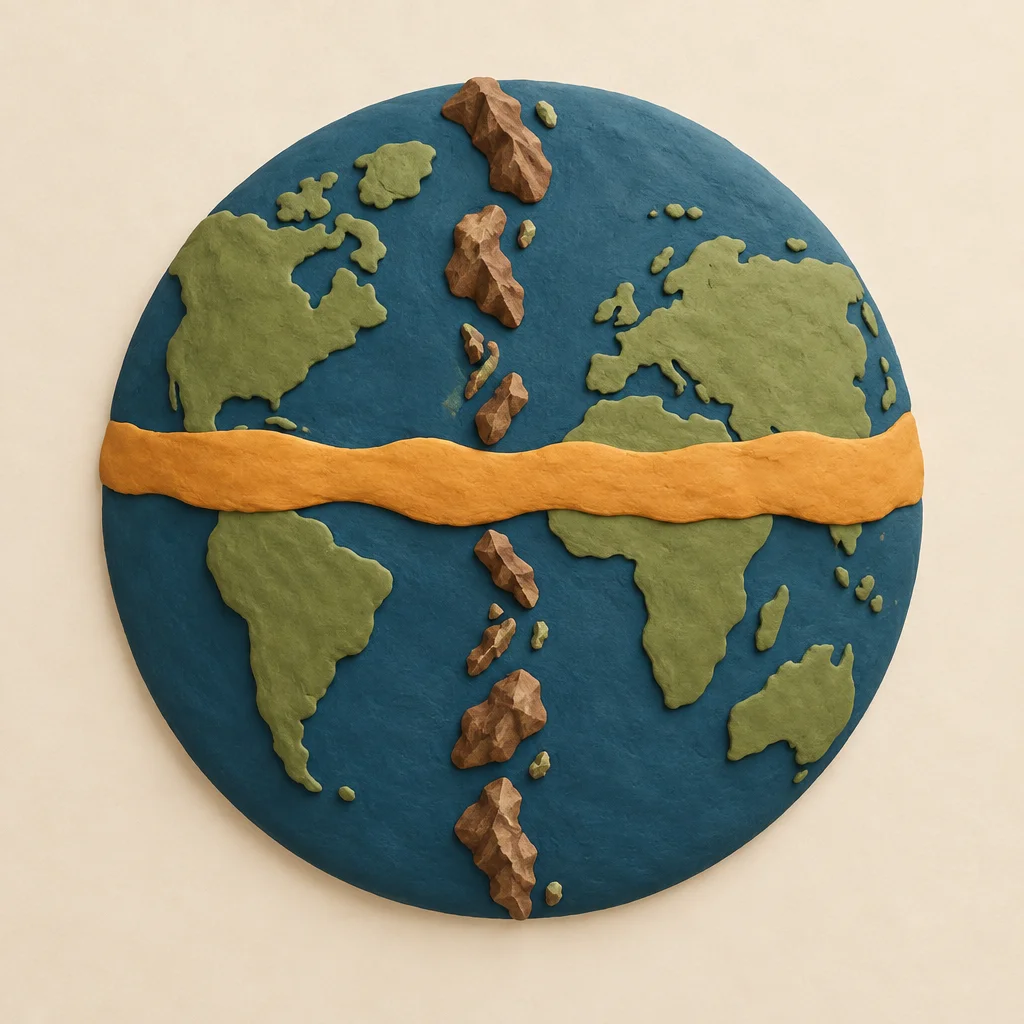
Illustrated key idea
Innovation depends on spread, and geography can slow it09
Discuss the argument, not just the slogan
Start a conversation with the full claim. Diamond argues that environmental histories strongly shaped unequal power over long periods. He does not merely say that climate matters. His account links resources and exchange to the means by which societies gained power.
Then separate agreement with his question from agreement with every answer. Rejecting inborn superiority does not prove each claim about crops, disease, or states. Every link still needs evidence. Equally, doubt about one case does not defeat the whole framework.
Lumina suggests keeping three contrasts in mind: local knowledge versus available species; collective power versus personal well-being; and invention versus access to others’ work. These distinctions help a discussion move beyond restating the thesis.
When disagreement arises, ask about scale. A claim about continents cannot settle every question about one government. One influential person cannot explain every pattern across thousands of years. Both may matter, but in different ways.
Be clear, too, about your reading position. This deep dive offers an analytical map, not familiarity with every page of the original. A reason to read Diamond himself is to judge whether his detailed evidence supports his broadest claims—and whether the difficult cases change your view of them.
What to remember
Explain the conditions behind an advantage.
Diamond works backward from power to the conditions that helped produce it. Lumina’s key distinction is between explaining why a society gained an advantage and treating that advantage as proof of superior people. The first approach opens a question; the second risks assuming its answer.
Collective strength is not the same as a good life.
Farming could support larger populations and organized force while imposing costs on the people within them. Diamond’s argument is therefore not a simple story of progress. A system’s ability to spread must be judged apart from the health, freedom, or security it gives its members.
Count access to others’ work as a resource.
Crops and tools gain reach through movement, adaptation, and combination. Diamond asks us to study routes and barriers alongside invention. Lumina’s synthesis is that achievement reflects both local skill and access to knowledge built elsewhere. The final owner of a technology need not be its sole source.
Bring it into conversation
Talk about the book
What would show that an environmental explanation is wrong?
Lumina would look for a clear causal link, a useful comparison, and conditions under which the claim should fail. Exceptions strengthen an argument when they sharpen its limits. They weaken it when each receives a new explanation that leaves the main claim untouched.
Take it further: Which link seems easiest to test on its own: domestication, crop movement, or the growth of states?
Does farming’s population advantage change what we mean by progress?
Diamond separates growth in numbers and power from improvements in daily life. Lumina’s view is that progress needs a named measure. More food, stronger government, and better health are different gains. They can support one another, but we should not assume that they do.
Take it further: Which measure would you choose when comparing societies, and whose experience might it leave out?
How can inherited limits matter without making present choices seem powerless?
The afterword gives institutions real force while asking how history helped shape them. Lumina reads this as a layered account. Earlier conditions neither fix every later outcome nor leave people free to start from nothing. Choices work through conditions that people did not necessarily choose.
Take it further: What evidence would help you separate the effects of current rule from inherited barriers?
Keep in perspective
This guide interprets the book’s argument; it does not independently verify its historical or biological claims. Disputed dates, migrations, disease histories, and language links remain uncertain. It offers no account of outside scholarship, reception, or author biography. Lumina’s objections and applications are readings to test against the original, whose fuller evidence is needed to judge the largest claims.