
The deep dive
Material World
by Ed Conway
17 min read · Original commentary by Lumina, written with AI
A digital service can seem almost free of physical weight. Ed Conway explores the mines, chemicals, machines and skills that make that impression possible. Through six materials, he asks what modern comfort depends on—and whether building a cleaner future can avoid repeating the damage that helped create the present.
Prefer the quick version? Read the main learnings →♫ AI-generated voice · press play below to listen and read along; tap any passage to jump to it
01
Look beneath the finished product
Material World is nonfiction that starts with substances and opens onto questions about how we live. Conway organises his account around sand, salt, iron, copper, oil and lithium. Their chemical traits matter, but so do the people who extract them, the skills needed to process them and the choices that govern their use.
A phone looks unlike a furnace. An online service feels remote from a quarry. The book closes that apparent gap. It shows how things we regard as advanced still require heat, rock, water and factories. These requirements become easier to miss when products work well and cost little.
Expect accounts of industrial places and processes, not a single plan for government. Conway keeps benefits and burdens together. Concrete can make homes healthier while its ingredients come from damaged landscapes. Batteries can help reduce fuel use while putting new pressure on mineral supplies.
Lumina reads the book as an invitation to look past an object's finished surface. Ask what had to happen before it reached us. This wider view brings human skill into focus, alongside costs that prices may fail to show. The central issue is how to keep the gains without treating the damage as inevitable or remote.

Illustrated key idea
Digital life is built from physical stuff02
Can we keep the benefits without hiding the bill?
The book's central question is not whether materials are good or bad. It is how societies can preserve their benefits while confronting their costs. The difficulty is that the same industrial system often produces both. Cheap steel supports buildings and machinery, but conventional production releases large quantities of carbon dioxide. Fertiliser supports food supplies, but excess nitrogen escapes into air and water.
That connection raises the stakes beyond personal buying choices. Some benefits need whole networks: power plants, chemical works, transport links and specialist suppliers. Refusing an object does not explain how to replace the service it provides. Equally, showing that a service matters does not justify every method used to supply it.
Conway approaches this problem by tracing production backwards. A final product becomes a chain of requirements. A battery needs carefully prepared chemicals, controlled manufacturing and mineral supplies. A semiconductor needs much more than silicon. Its production relies on extreme purity, precise equipment and knowledge held across several countries. Following those requirements makes broad promises about independence or clean technology harder to sustain.
Lumina interprets this as a challenge to two shortcuts. One assumes that better ideas can lift society away from material limits. The other treats industry chiefly as something to reject. Conway's position allows neither escape. Modern health and reduced drudgery owe much to industry, while further progress requires changing how industry works.
The unresolved issue is who decides which costs are acceptable. A benefit shared by millions of consumers can coexist with severe harm in one place. Understanding a supply chain exposes that imbalance, but does not settle it. The book offers a stronger basis for public judgment, not a formula that makes every conflict easy to resolve.
03
Abundance is not the same as availability
The first useful lens is suitability: industry needs the right material, in the right form, supported by the right skills. A substance can be plentiful in nature yet difficult to supply for a particular purpose. Conway's sand examples make this distinction concrete. Rounded desert grains generally cannot replace suitable construction sand. Clear glass needs ingredients with different qualities again. Counting all sand together hides the differences that determine usefulness.
The point reaches beyond raw materials. A deposit becomes an industrial resource only through a chain of changes. Chip production requires silicon with extraordinary chemical purity and a carefully ordered crystal structure. Equipment used at later stages depends on special optics and machinery. Possessing rock, money or a factory does not mean possessing the ability to make the product.
Conway's chip account therefore changes what dependence means. The weak point need not be the largest or most expensive part of a device. Specialist quartz used in crystal-growing vessels can matter enormously, even though it attracts less attention than a chip factory. Something with a small market value can have a large role in keeping a system working.
Lumina's interpretation is that the book replaces a warehouse picture of the economy with a network picture. In the warehouse view, security means holding enough stuff. In the network view, security also means keeping skills, suitable machinery and dependable relationships. Stockpiles may help, but they cannot automatically replace years of manufacturing practice. Nor can moving final assembly give a country control over earlier stages of production.
Copper adds another distinction. The book explains that reserves are deposits judged worthwhile to recover under current conditions. They are not a complete inventory of everything underground. Changing prices or processing methods can expand the reserve figure without creating new copper. Yet better recovery may still require moving more rock, consuming more water or accepting greater damage.
The resulting lesson is precise: a shortage can arise from quality, cost, expertise, concentrated supply or political limits, not only physical exhaustion. Those causes require different responses. More exploration will not necessarily solve a missing manufacturing skill. A cheaper extraction method will not by itself resolve a dispute over water.
There is a boundary to this lens. The chip network does not prove that every industry has the same weak points. Reserve figures cannot tell us how much damage societies should accept. Conway's examples establish the need to examine each chain closely. They do not justify a sweeping prediction of either looming scarcity or endless abundance.
04
Cheap materials can spread comfort—and concentrate harm
The second lens concerns price and access. A material changes society not simply because someone discovers its properties, but because people learn to make it cheaply and reliably. Conway gives production methods a role often reserved for famous inventions. Concrete becomes socially important through construction at scale. Steel becomes transformative when useful grades and standard parts become widely available.
This matters because a strong or versatile material that few people can afford has limited reach. The book connects cheaper concrete with housing, sanitation and infrastructure. It connects steel tools with reduced farm labour, and electrical appliances with relief from exhausting household work. These examples make material progress a question of access, not merely technical novelty.
Salt-based chemistry offers a useful correction to what we notice. Table salt is familiar; the chemicals derived from brine are less visible. Chlorine and caustic soda help support clean water, sanitation and manufacturing. Their importance lies partly in how routinely their benefits arrive. In Lumina's reading, reliability can make a system seem less valuable precisely because it no longer demands daily thought.
But low prices do not measure every cost. Conway describes sand removal that disrupts rivers, copper mining that demands scarce water, and chemical plants with severe pollution legacies. Cheap goods can spread benefits widely while leaving particular communities with damaged surroundings. The distance between consumers and production sites makes that unequal pattern easier to miss.
The book also questions whether useful and harmful applications can always be separated. Industrial ammonia supports food production, while related skills and processes supplied wartime explosives. The lesson is not that nourishment and warfare are morally equivalent. It is that productive power does not arrive with a guaranteed purpose. Rules, commercial decisions and political choices shape what people do with it.
Lumina's interpretation is that material success needs two separate tests. First, what useful service does a system provide, and to whom? Second, how are its burdens imposed, disclosed and shared? A strong answer to the first question cannot substitute for an answer to the second. Essential infrastructure can still be built through unfair decisions. Environmental harm can still accompany genuine gains in health or freedom from drudgery.
The boundary matters here. The book's examples do not supply a common measure for every cultural loss, health benefit and tonne of emissions. Nor does explaining material dependence establish that current consumption levels are necessary. Conway shows why industry cannot be dismissed lightly. That leaves room to question wasteful uses, unequal access and choices that treat local damage as someone else's problem.
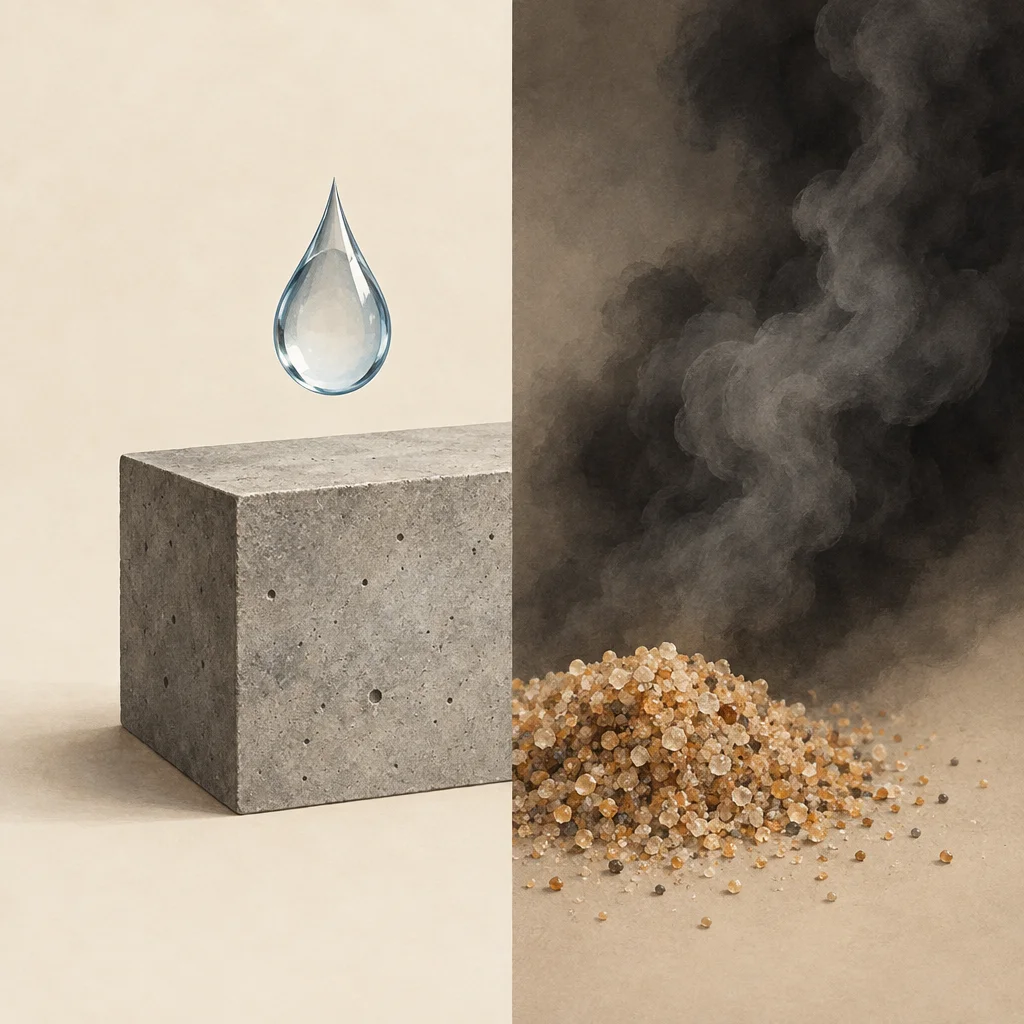
Illustrated key idea
The same materials can help and harm05
A cleaner economy must first be built
The third lens concerns what an energy transition actually involves. Conway argues that cutting carbon emissions means rebuilding systems, not merely choosing a different fuel. New grids require metals. Battery output depends on mines, chemical plants and exacting factory work. Industrial processes that use less fossil fuel may need vast new sources of clean electricity.
This brings the first two ideas together. Material quality and technical skill shape what builders can deliver. Prices shape who can afford the results. The timing creates a further problem: digging, construction and spending must happen before many gains appear. Public support has to survive that gap. A technical target alone cannot secure it.
Recycling shows why timing matters. Before a recycler can recover a battery's contents, someone must make and use that battery. If demand grows quickly, too few worn-out batteries exist to supply the expanding industry. The book discusses an optimistic projection for 2030 in which recovered battery materials would cover roughly 10 per cent of expected mineral demand. Even that outcome leaves a large need for new supply.
Recovery also has limits within the plant. Umicore reports that it retrieves a larger share of copper, cobalt and nickel than of lithium. Materials lost during one round cannot enter the next. Repeating the process compounds those losses. Lumina's reading is that a useful recycling system need not be a perfect one. Its value lies in reducing the need for extraction, not in proving that matter can circulate forever without loss.
There is still a major difference from fuel. Burning oil uses it up as an energy source. A battery's mineral contents remain available for possible recovery after use. That gives electrification a different long-term prospect. More mining during a period of rapid construction could coexist with less dependence on mines later. The first outcome does not guarantee the second, but it does not rule it out.
Conway finds another basis for hope in practical learning. He discusses Wright's law: costs tend to fall as producers gain experience through increased output. Battery factories show why invention is only a start. Workers and firms must also learn how to avoid defects, maintain safety and make consistent products at speed.
This hope has clear limits. Experience cannot guarantee that every cost will fall fast enough. Cleaner steel faces demands for suitable ore and affordable hydrogen. New concrete formulas need evidence that they will last. Trade disputes and public resistance can delay construction. Lumina therefore reads Conway's optimism as a case for sustained effort under difficult conditions, not a forecast that technology will make those conditions disappear.
06
How a familiar substance opens into a hidden system
Conway's method moves between scales. A familiar substance offers an entry point. A manufacturing process reveals hidden needs. A wider network brings power and environmental costs into view. In Lumina's assessment, this movement helps explain why a simple material name can conceal a complex industrial story.
Glass is one useful anchor. We see it every day, yet may overlook its role in scientific instruments and communications. Moving from an ordinary object to a technical foundation challenges the divide between old industry and advanced technology. The argument gains force by showing a connection, rather than merely insisting that everything is connected.
A second anchor is the difference between energy and chemical ingredients. Oil is not presented only as something burned in engines. Refineries alter molecules to make useful products, including inputs used in batteries. That detail complicates a simple contrast between old fossil industries and new clean technologies. Ending a fuel's use would not instantly replace every industrial role it serves.
A third anchor is factory precision. The battery account separates cell production from pack assembly and shows why cleanliness and consistency matter. This gives substance to the wider claim about hard-won expertise. A brand name on a building tells us less than knowing who does the work inside it.
The evidence needs care. Conway presents estimates, company reports, disputed explanations and possible technologies. These do not all carry the same weight. Reported recovery rates do not prove that materials can circulate without loss. Early seabed findings do not prove that underwater mining is safe or profitable. A refinery conversion plan is not a completed result.
The supplied accounts preserve several such distinctions, including uncertainty about the marine die-off near Teesside. That restraint matters: recognising industrial dependence should not mean pretending disputed harms are settled. This deep dive cannot assess the original prose, the full sourcing or the balance of every encounter. Its strongest judgments concern how the documented examples build the argument.
07
Does necessity make expansion too easy to defend?
Contains plot details — open to read
The strongest objection, in Lumina's reading, is that material realism can become an excuse for whatever expansion industry proposes. If housing needs concrete and clean energy needs metals, local resistance may start to look like an obstacle rather than a valid demand. A strong case for shared need could leave the people facing immediate damage with too little power.
The book contains evidence that resists that slide. At Juukan Gorge, the supplied account describes alternatives that could have preserved the caves at the cost of valuable ore. Those options were not disclosed to the community. This was not simply a case of geology forcing an unavoidable choice. People's decisions, access to information and treatment of alternatives mattered. The heritage loss shows why legal permission cannot, by itself, settle whether extraction is fair.
That case sharpens a distinction running through the book. Some trade-offs arise from physical limits. Others arise from prices, habits or decisions about who receives information. Calling all of them unavoidable would hide chances to act differently. Lumina's criticism is therefore not that Conway ignores harm. It is that readers must resist using his broad case for industry to excuse particular industrial choices.
The strongest reply is that understanding dependence can make opposition more precise, not weaker. Knowing what a material does allows people to ask which demand is essential, which source is preferable and which process can improve. Conway considers recycling, recovery from existing waste and other production methods. His account does not require treating the present system as the only possible one.
A related tension concerns hope. Production experience can reduce costs, but political cooperation and ecological safety do not follow automatically from technical learning. The conclusion itself names delayed benefits, barriers to construction and disrupted trade as risks. Lumina therefore reads the optimism as support for a possible direction, not proof that the transition will succeed. The book is most defensible when it keeps both claims intact: industry is necessary, and its specific choices remain open to challenge.
08
Ask what changes—and what merely moves elsewhere
The book's ideas connect through a question about replacement: when one material or process takes another's place, which burdens disappear, and which move? This is not an argument against change. It is a way to judge whether change delivers the benefit claimed for it.
Conway's plastics discussion offers a grounded example. Replacing plastic does not automatically lower emissions or improve disposal. A substitute may use more resources, perform poorly or fail to break down as expected. The relevant comparison is the service delivered across production, use and disposal, not the reassuring appearance of the replacement.
Lumina suggests separating four questions. What service is needed? Which material properties provide it? What production chain supplies those properties? Who bears that chain's costs? These questions bring the technical and moral arguments together without pretending they yield one universal answer.
Consider a hypothetical town choosing materials for new infrastructure. This is Lumina's illustration, not a case from the book. A low-carbon label would be a starting point, not the final decision. Officials would still need to ask about durability, local conditions, water use and reliable supply. A product that performs well in one respect could cause problems in another. The point is to compare choices openly rather than assume one desirable feature decides everything.
The same approach helps test claims about national independence. A domestic factory may improve security while still needing foreign equipment or chemicals. Dependence is not simply present or absent. Different needs can be reduced, spread among suppliers or left unchanged.
This framework has a limit. Most people cannot trace every purchase through its full supply network. Conway's call for maps of supply chains and material use points toward shared public knowledge. The task is not to make every consumer an industrial expert, but to improve the information behind collective decisions.

Illustrated key idea
Decarbonisation still needs mining and building09
Discuss the argument without pretending it settles everything
A strong conversation about Material World can begin with a distinction: dependence describes a need; justification defends a choice. The book shows why societies rely on mines and factories. That does not settle whether a particular mine should open, how much a society should consume or what conditions communities may demand.
Another useful distinction separates a promising invention from a working industrial system. Conway repeatedly stresses production skills, scale and specialist suppliers. If someone argues that new technology solves a material problem, ask what must happen between a successful design and reliable mass production. The question invites detail without dismissing innovation.
Disagreement about optimism can also become more precise. One reader might trust the record of manufacturing improvement. Another might worry that political conflict will prevent changes from arriving fast enough. Both engage with the book if they identify the conditions on which success depends.
When discussing this deep dive, be clear about its scope. It offers an interpretation of the book's argument, not a claim to have inspected every page or resolved its industrial disputes. Reading the original offers a chance to test how convincingly Conway joins technical explanation with the voices and choices of people affected by production.
What to remember
Ask what makes a resource usable.
Quantity alone tells an incomplete story. Purity, grain shape, processing skills and specialist equipment determine whether a material can meet a need. Conway's examples encourage a better question than whether enough exists: what must work for an available substance to become a dependable supply?
Separate useful services from fair production.
Concrete, chemicals and electricity can improve lives while imposing serious local costs. Lumina's reading keeps those judgments separate. Showing a material's value does not approve every way of obtaining it. Identifying harm does not erase the need to provide the service by better means.
Treat recycling as a growing contribution, not an instant escape.
Materials must first enter products and reach the end of their useful lives before recyclers can recover them. Fast growth and incomplete recovery limit recycling's immediate role. Its promise remains substantial because battery minerals can serve again, unlike burned fuels. That difference supports hope without ending extraction.
Bring it into conversation
Talk about the book
What would count as genuine material security?
Conway's chip and battery accounts suggest that owning deposits or building final-stage factories is insufficient. Security also depends on processing knowledge, machinery and relationships. Lumina's view is that reducing one dependency should not be confused with removing all dependence.
Take it further: Would you prioritise domestic factories, diverse foreign suppliers, strategic reserves or stronger cooperation—and what weak point would your choice leave?
How should widespread benefits be weighed against concentrated damage?
The book shows that lower prices can expand access while extraction burdens particular communities. Lumina's interpretation is that total benefit cannot be the only test. Information, alternatives and the power of affected people also matter, though the sources provide no single rule for balancing them.
Take it further: What process could recognise both essential infrastructure needs and a community's reasons to refuse a project?
What makes Conway's optimism reasonable rather than wishful?
Factory experience supports the possibility of cheaper, better technologies. But the book also identifies political delay, energy needs and supply disruption. A considered answer should name the conditions needed for improvement, rather than appeal only to past invention or present difficulty.
Take it further: Which condition seems hardest to secure: technical progress, affordable power, public consent or international cooperation?
Keep in perspective
This analysis draws on supplied summaries rather than the full book. It can assess the documented argument and examples, but cannot verify every underlying claim or judge the original prose closely. No author biography or independent reviews were provided. Technologies, forecasts and industrial plans are discussed as presented in the book, not as confirmed current outcomes.