
The deep dive
Outlive
by Peter Attia with Bill Gifford
18 min read · Original commentary by Lumina, written with AI
Outlive asks readers to think beyond surviving longer. Its deeper concern is preserving the abilities and relationships that make more time desirable. Peter Attia’s case for earlier prevention is also an argument about judgment: how to act before disease appears, without confusing promising evidence, personal experience, and proven benefit.
Prefer the quick version? Read the main learnings →♫ AI-generated voice · press play below to listen and read along; tap any passage to jump to it
01
A longer life is not yet a better life
Outlive is a nonfiction argument about medicine, aging, and the purpose of prevention. It combines explanations of chronic disease with clinical stories, personal experience, and practical discussions of exercise, nutrition, sleep, and emotional health. Readers should expect a framework for decisions, not one routine that promises exceptional age.
Its key distinction is between lifespan and healthspan. Lifespan measures duration. Healthspan concerns the physical and mental abilities that let someone participate in life. Attia also makes emotional well-being central: remaining alive and capable does not ensure that the future feels worth reaching.
The medical proposal is Medicine 3.0, his name for earlier, individualized prevention. He argues that conventional care often responds to chronic illness after years of hidden deterioration. Yet he credits modern medicine’s success with infections and emergencies. His challenge concerns its timing and priorities, not the value of treatment itself.
Lumina’s reading is that the book asks two linked questions. What should people do now to protect their later lives? And what should count as success? The first requires evidence and risk judgment. The second requires values that no laboratory result can supply.

Illustrated key idea
Prevention should start before disease is obvious02
When does waiting become a medical choice?
The book’s central problem is a mismatch between disease timelines and decision timelines. Chronic disease can develop over decades. Diagnosis, however, often arrives when a test crosses a threshold or symptoms become hard to ignore. Attia asks whether that moment is too late to begin serious prevention.
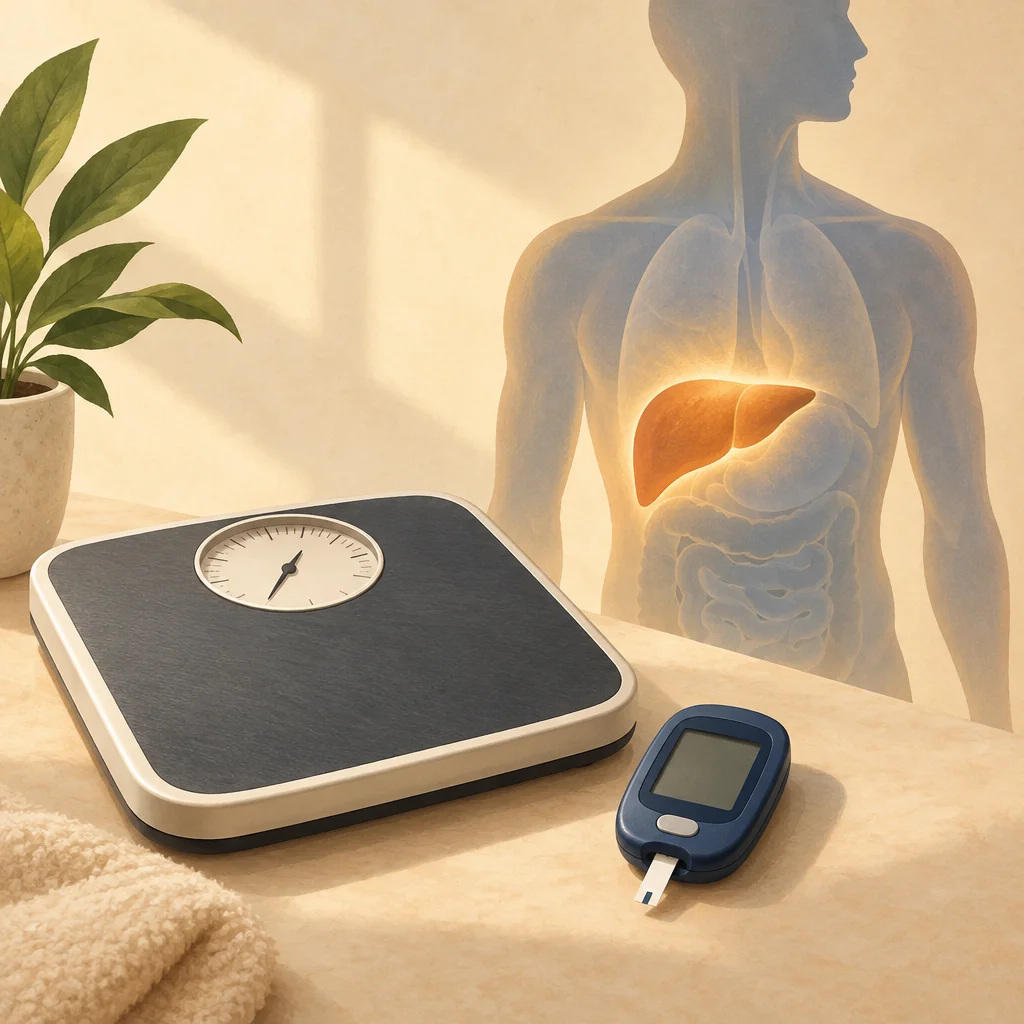
His account of metabolic dysfunction makes the issue concrete. Blood glucose can remain within a conventional range because the pancreas produces more insulin. A reassuring result may therefore coexist with a worsening underlying problem. The book does not treat every normal result as meaningless. It argues that a single measurement cannot always describe a long process.
This changes the comparison behind a health decision. The choice is not simply between an intervention with possible harms and an untouched state without risk. Waiting also has consequences. Attia’s experience modeling financial losses reinforces this way of thinking: small risks can build while the immediate picture still looks manageable.
But earlier action creates its own difficulty. If prevention begins long before illness, people may accept costs or side effects without ever knowing whether they avoided disease. Trials cannot answer every question about decisions sustained over a lifetime. Attia therefore combines several kinds of evidence, while accepting that none removes uncertainty.
Lumina’s interpretation is that Outlive turns prevention into a problem of responsible judgment. Neither waiting for certainty nor acting on every plausible mechanism is automatically wise. The relevant questions become more specific: How strong is the evidence? How large might the benefit be? What are the harms? Does this person resemble those studied?
That approach raises the stakes of patient participation. The book asks people to understand tradeoffs rather than merely follow instructions. Its most demanding claim is not that everyone needs more tests. It is that preserving future health may require decisions before the need for them feels urgent.
03
Risk accumulates before it becomes a diagnosis
The first major idea is that health should be understood as a changing course, not just a present category. A person can lack a diagnosis while moving toward disease. Conversely, a risk factor can increase danger without making a bad outcome inevitable. Attia’s framework needs both distinctions to remain useful.
Cardiovascular disease provides a clear example. The book distinguishes cholesterol from the particles that carry it. Particles containing apoB can become trapped in artery walls and contribute to plaque. Attia emphasizes both the amount of exposure and its duration. His concern is not only what a blood test says today, but what repeated exposure might mean across decades.
This helps explain his disagreement with decisions based mainly on ten-year risk. Someone may face limited near-term danger while carrying a risk that matters greatly over a longer period. Attia favors earlier, substantial apoB reduction, sometimes using medication. Yet the supporting long-term models reach beyond actual trial durations. The distinction between a reasonable projection and a demonstrated lifetime outcome remains important.
Metabolic health adds another layer. Body weight alone cannot show where fat is stored or how well someone responds to insulin. The book describes fat beneath the skin as a storage buffer with limits that differ between people. When that capacity is exceeded, fat can collect in organs and muscle. This makes the same outward appearance compatible with different internal risks.
Lumina’s interpretation is that these examples challenge the idea of health as a simple pass-or-fail test. They also challenge the reverse mistake: treating one worrying marker as a complete verdict. The book’s account of the e4 variant of APOE makes that boundary explicit. Genetic susceptibility to Alzheimer’s is not a diagnosis or a prediction that must come true.
The practical implication is to read measurements together with family history, habits, and time. That is more demanding than chasing a single ideal number. It also requires asking whether additional information would change a decision. A scan, for example, has limits: an absence of coronary calcium does not exclude noncalcified plaque.
The boundary is crucial. Showing that disease can remain hidden does not establish that every earlier test improves health. Nor does it prove that the earliest possible treatment is always best. Outlive makes a case for looking sooner and thinking longer. Lumina’s assessment is that its argument is strongest when those two habits lead to a clearer decision, rather than simply more measurement. Its best lesson is about interpreting information, not collecting it without limit.
04
Build a reserve for the ordinary things you value
Preventing a diagnosis and protecting an ability are not quite the same task. This distinction drives the book’s second major idea. Attia wants readers to specify what good health would let them do, rather than define success only through the absence of illness.
The Centenarian Decathlon makes that change in perspective tangible. Its starting point is a set of personally important activities for old age. The book’s examples include managing stairs and lifting a child. These choices give training a purpose beyond completing today’s workout. They also introduce a planning problem: if physical capacity falls over time, meeting a demand comfortably now may not mean meeting it decades later.
Lumina interprets the answer as building a margin. The relevant achievement is not simply a faster time or heavier lift. It is having enough capacity that some loss does not immediately remove a valued activity. This explains why narrow athletic excellence can be misleading. Attia’s own intensive endurance exercise did not spare him metabolic problems, and sporting ability cannot stand in for every aspect of health.
Different demands require different preparation. Steady aerobic activity supports sustained effort, while more intense work challenges the body’s upper limit for oxygen use. Training against resistance develops muscular force and helps protect bone. Movement control matters alongside these capacities: the body must direct force well, not merely produce more of it.
That last point changes the meaning of progress. Attia treats technique, appropriate loading, and coaching as ways to keep exercise available over many years. Injury can interrupt the very activity meant to protect later function. In Lumina’s reading, a sustainable routine is therefore not a weaker version of an ambitious one. Its durability is part of its value.
Food choices must answer to this broader goal too. Losing weight can be a poor result if the loss includes muscle that someone needs. Attia’s reassessment of extended fasting illustrates the conflict. A tactic that appears useful for metabolism may carry a cost elsewhere. Evaluating energy intake without considering muscle would miss that tradeoff.
The attraction of this approach is that useful abilities matter before old age arrives. A routine can improve present participation even when its effect on total lifespan remains uncertain. But the book’s fitness evidence still needs careful handling. Observed links between fitness and survival do not reveal exactly how much longer a particular person will live by training.
Lumina’s assessment is that the strongest claim concerns direction, not destiny. Readers can choose exercise around the activities they value. They cannot secure those activities permanently. The framework offers a reasoned way to prepare, not a contract against decline.
Illustrated key idea
Health can look normal while metabolic risk grows05
Optimization cannot decide what life is for
Contains plot details — open to read
The third idea questions the purpose of everything that comes before it. Disease prevention may protect years, and exercise may protect abilities. Neither can decide whether those years will feel meaningful. Attia’s personal account gives this limit a difficult, specific form.
He describes a life in which medical knowledge and intense effort existed alongside serious emotional harm. His work commitments kept him away even after his infant son suffered a medical emergency. The episode makes a painful contradiction visible: someone focused on obtaining more time was failing to share the time already available with his family.
Therapy leads Attia to examine the abuse he experienced as a child and its connection to later behavior. Anger, withdrawal, and relentless striving were not separate from his health project. They affected how he lived with other people and how he judged himself. Lumina reads this material as a challenge to any account of longevity that treats relationships as a benefit automatically delivered by physical health.
The account also separates explanation from permission. Learning how an adult pattern developed does not make its effects on others acceptable. Attia’s growing ability to reject blame for what happened to him helps him confront responsibility for his own conduct. Those two judgments can coexist. He need not keep punishing himself in order to take the harm seriously.
Nor does one insight settle the problem. Changes in outward behavior leave deeper hostility toward himself unresolved. A later crisis brings further intensive care. The resulting picture of recovery involves repeated therapeutic work and practiced responses, rather than a decisive moment after which everything is repaired. Dialectical behavior therapy contributes methods for handling powerful feelings and choosing a response instead of immediately acting on an impulse.
For Lumina, this creates the book’s sharpest internal tension. Planning and discipline can protect health, but achievement can also become a way of avoiding pain. A health routine cannot be judged solely by how rigorously someone follows it. One must also ask what it makes possible—and what it may be displacing.
The sleep discussion offers a related, less dramatic example. A device may provide useful feedback, yet cease to help when its readings provoke anxiety. The tool has to answer to the person’s welfare. The person should not have to organize life around satisfying the tool.
There is an important boundary here. Attia’s experience does not establish a universal cause of emotional distress or one correct treatment. He recognizes the personal basis of this part of his argument. Its broader contribution is to redefine success: more years become desirable through connection, emotional well-being, and engagement, not through biological improvement alone. Lumina sees that distinction as a necessary check on the entire project.
06
How the book moves from explanation to persuasion
Outlive persuades through several forms of authority. It explains biological processes, considers research, presents patient experiences, and shows Attia revising his own judgments. These forms do different jobs. Their value depends on keeping those jobs distinct.
Mechanisms make hidden processes understandable. The account of insulin compensation explains why normal glucose may not settle a question about metabolic health. The discussion of nutrient sensing shows how cells respond to available energy. Such explanations make preventive action seem plausible, but plausibility is not proof that a treatment improves human longevity.
Rapamycin is an important analytical anchor. Repeated lifespan extension in mice gives the drug a serious research basis. Yet that does not establish longer life or long-term safety in healthy humans. Attia also discloses his own off-label use and support for dog research. Those disclosures clarify his involvement; they do not strengthen the human outcome evidence by themselves.
Nutrition provides a different kind of lesson. Attia examines inaccurate food reporting, confounding, and poor adherence. Confounding means that another factor may help explain an apparent relationship. A food choice can travel with income, activity, or other behaviors. Randomized trials reduce some problems, but prescribing a diet does not ensure people follow it. The book therefore distinguishes what might work under ideal conditions from what works when recommended in daily life.
Personal examples make such questions matter. Attia’s endurance training alongside metabolic problems gives the reader a reason to doubt easy signals of health. His changing views on ketogenic diets and fasting show revision rather than fixed allegiance. Still, an individual response cannot establish what another person should do.
Lumina’s assessment is that the book’s strongest persuasive move is to connect abstract risk with concrete function. Its greatest evidentiary danger is that a vivid story can feel as convincing as a controlled comparison. A careful reader should therefore ask what each passage supplies: an explanation, an observed association, an experimental result, a personal example, or a judgment about action. The book’s usefulness increases when those categories remain visible.
07
Does earlier prevention risk becoming too much medicine?
Lumina’s strongest fair objection is that the case for prevention can make intervention seem wiser than the available evidence warrants. Once hidden disease becomes the central concern, reassuring results may never feel sufficient. There may always be another marker, scan, or possible treatment.
Cancer screening exposes this problem clearly. Attia favors earlier, individualized detection because smaller cancers are generally easier to treat. But screening carries its own costs: the risks and expense of the procedures themselves, the anxiety involved, procedures that prove unnecessary, and results that wrongly suggest cancer. A negative emerging blood test cannot rule cancer out. Further testing can therefore produce both information and fresh uncertainty.
The objection extends beyond screening. Decades-long medication decisions may rely partly on models rather than trials of equal duration. Continuous glucose monitoring may reveal personal patterns, while lacking randomized-trial confirmation of benefit in healthy users. A coherent story about prevention does not give each tactic equal support.
The strongest reply, also framed here as Lumina’s interpretation, is that uncertainty does not make waiting neutral. Disease processes continue while evidence develops. A demand for complete lifetime proof could rule out useful action simply because the ideal trial is impractical. Attia also repeatedly names limitations: animal findings are not human outcomes, fitness associations are not exact causal estimates, and screening has harms.
The real disagreement is therefore about thresholds for action, not a choice between science and speculation. How persuasive must evidence be when an intervention is burdensome? How does that change when the action is useful now, even if its distant benefit remains uncertain? These questions allow different answers for different tactics.
A further concern is access. The book criticizes insurance incentives and acknowledges barriers to emotional care. Yet individualized monitoring and sustained professional support can demand money and time. Naming those barriers does not remove them. Nor should difficulty following a plan be treated as proof of indifference.
Lumina’s judgment is that the framework works best when intervention burden rises only with a clear reason. Earlier attention is a principle, not a blanket endorsement of greater medical intensity. The strongest version of Medicine 3.0 must be able to explain when not to add a test or treatment.
08
Use the framework without turning it into a rigid protocol
The book’s ideas connect most usefully through the distinction between objective, strategy, and tactic. The objective describes the life or capacity someone wants to preserve. Strategy explains the main threats and how to address them. Tactics are particular actions. Lumina reads this distinction as protection against confusing a tool with a goal.
Consider a hypothetical created by Lumina: someone wants to keep enjoying long walks with friends. That objective suggests preserving endurance, strength, and confidence in movement. A particular workout is only one tactic. If it causes repeated injury or displaces sleep, loyalty to it may undermine the goal it was meant to serve. This illustration is not a case from the book.
The same reasoning connects nutrition and exercise. A lower number on the scale is not enough if muscle is being lost. A flatter glucose trace is not a complete account of dietary health. The relevant question is whether several measures, present function, and sustainable habits point toward improvement together.
Sleep links the domains further. The book describes its effects on metabolism, performance, and emotional regulation. That means a difficulty in one area may not be solved entirely within that area. Poor training recovery, for example, should not automatically lead to demands for greater effort. The book’s framework invites attention to interacting conditions.
Application also requires restraint. These ideas do not establish a personal testing schedule, medication choice, or protein target for every reader. Their value here is in shaping better questions for a clinician and clearer priorities for daily life.
Lumina’s suggested reading practice is simple: for each attractive tactic, identify its goal, evidence, possible cost, and reason to revise it. That preserves Attia’s commitment to feedback without treating every fluctuation as a command. It also makes abandonment of an unsuitable tactic a form of sound judgment rather than failure.

Illustrated key idea
Train for the future life you want09
How to discuss the book without overselling its claims
A useful conversation about Outlive begins by separating its goal from its preferred methods. Someone can agree that medicine should protect future function while questioning aggressive screening or treatment thresholds. That is a disagreement within the book’s problem, not a refusal to value prevention.
It also helps to distinguish evidence for a general principle from evidence for a particular tactic. Exercise can be central to preserving capability without every training benchmark becoming necessary. Animal research can reveal a promising mechanism without establishing a human longevity treatment. Personal feedback can guide adjustment without proving that a device improves health outcomes.
Lumina would also keep the meaning of healthspan open for discussion. Independence matters, but a worthwhile life cannot be defined only by physical performance. The book includes emotional well-being, relationships, and purpose, which prevent its aims from being captured by fitness scores alone.
The most productive question is therefore not whether Attia is simply right or wrong. It is where his framework clarifies a decision, and where it asks judgment to carry more weight than the evidence can yet bear. Readers can discuss those distinctions honestly without implying that this deep dive replaces the book’s fuller explanations and personal accounts.
What to remember
Think in trajectories, not just diagnostic categories.
Attia argues that disease risk can build while symptoms and routine results remain reassuring. Lumina’s key distinction is that earlier attention does not automatically justify every early intervention. The task is to interpret change over time and ask whether new information would alter a decision.
Preserve useful capacity rather than chasing one score.
The book connects future activities with present training and nutrition. Endurance, strength, stability, and muscle preservation serve related goals. Lumina reads this as a reason to evaluate a routine by the range of abilities it supports, not only its most impressive result.
Keep the purpose of prevention visible.
Health practices are means, not final measures of a good life. The book includes emotional well-being and connection within its account of longevity. Lumina’s synthesis is that added time and greater capacity matter most when they support participation in a future someone values.
Bring it into conversation
Talk about the book
What evidence should justify acting before disease is diagnosed?
Lumina’s view is that the answer should depend on both evidence strength and intervention burden. The book offers reasons not to wait for certainty, but it also documents harms from testing and treatment. A low-burden habit and a long-term medical intervention need not face identical decision thresholds.
Take it further: Which uncertainty would matter most to you: the chance of benefit, possible harm, or the cost of waiting?
Does planning for future ability expand freedom or create pressure?
The book makes distant health goals concrete through desired activities. Lumina sees that as useful, provided goals remain adaptable. A plan can support independence without making physical performance the sole measure of worth or treating unavoidable decline as personal failure.
Take it further: How could a meaningful late-life goal change if someone’s circumstances or abilities changed?
When does personal feedback become excessive monitoring?
Attia values individual response, yet notes that glucose readings are incomplete and sleep trackers can increase anxiety. Lumina’s perspective is that monitoring earns its place when it improves a meaningful decision. More data alone does not establish that a person is receiving better care.
Take it further: What would tell you that a measurement was no longer helping?
Keep in perspective
This reading draws on accounts of the book’s arguments and chapter content, not an independent assessment of its medical recommendations. No external clinical updates, independent biography, or published reader criticism are included. The discussion therefore evaluates the book’s reasoning and stated qualifications; it cannot establish which preventive tests, treatments, or targets suit an individual.