
Big ideas · from the full text
Outlive
by Peter Attia with Bill Gifford · 4 min read · Lumina’s commentary, written with AI
About this book
Wouldn’t you like to live longer? And better? In this operating manual for longevity, Dr. Peter Attia draws on the latest science to deliver innovative nutritional interventions, techniques for optimizing exercise and sleep, and tools for addressing emotional and mental health. For all its successes, mainstream medicine has failed to make much progress against the diseases of aging that kill most people: heart disease, cancer, Alzheimer’s disease, and type 2 diabetes. Too often, it intervenes with treatments too late to help, prolonging lifespan at the expense of healthspan, or quality of life. Dr. Attia believes we must replace this outdated framework with a personalized, proactive strategy for longevity, one where we take action now, rather than waiting. This is not “biohacking,” it’s science: a well-founded strategic and tactical approach to extending lifespan while also improving our physical, cognitive, and emotional health. Dr. Attia’s aim is less to tell you what to do and more to help you learn how to think about long-term health, in order to create the best plan for you as an individual. In Outlive, readers will discover: • Why the cholesterol test at your annual physical doesn’t tell you enough about your actual risk of dying from a heart attack. • That you may already suffer from an extremely common yet underdiagnosed liver condition that could be a precursor to the chronic diseases of aging. • Why exercise is the most potent pro-longevity “drug”—and how to begin training for the “Centenarian Decathlon.” • Why you should forget about diets, and focus instead on nutritional biochemistry, using technology and data to personalize your eating pattern. • Why striving for physical health and longevity, but ignoring emotional health, could be the ultimate curse of all. Aging and longevity are far more malleable than we think; our fate is not set in stone. With the right roadmap, you can plot a different path for your life, one that lets you outlive your genes to make each decade better than the one before.
As an Amazon Associate, Lumina earns from qualifying purchases. How this works
♫ AI-generated voice · press play below to listen and read along; tap any passage to jump to it
Prevention should start before disease is obvious

In Outlive by Peter Attia with Bill Gifford, “Medicine 3.0” means looking for long-term risk before chronic illness becomes easy to label. It still respects emergency medicine and modern treatment. The key idea is that many big diseases develop slowly, so short time horizons and strict diagnostic cutoffs can miss chances to protect function earlier. The narrator discovers insulin resistance despite doing endurance swimming, showing that warning signs may appear before an obvious diagnosis.
Why it matters
It shifts the aim from saving someone in a crisis to protecting strength, judgment, and independence over decades.
An example
The narrator finds he has insulin resistance even though he has done endurance swimming.
Keep in mind
The book says plans should change as new evidence appears, since many longevity trials are hard to run.
Health can look normal while metabolic risk grows
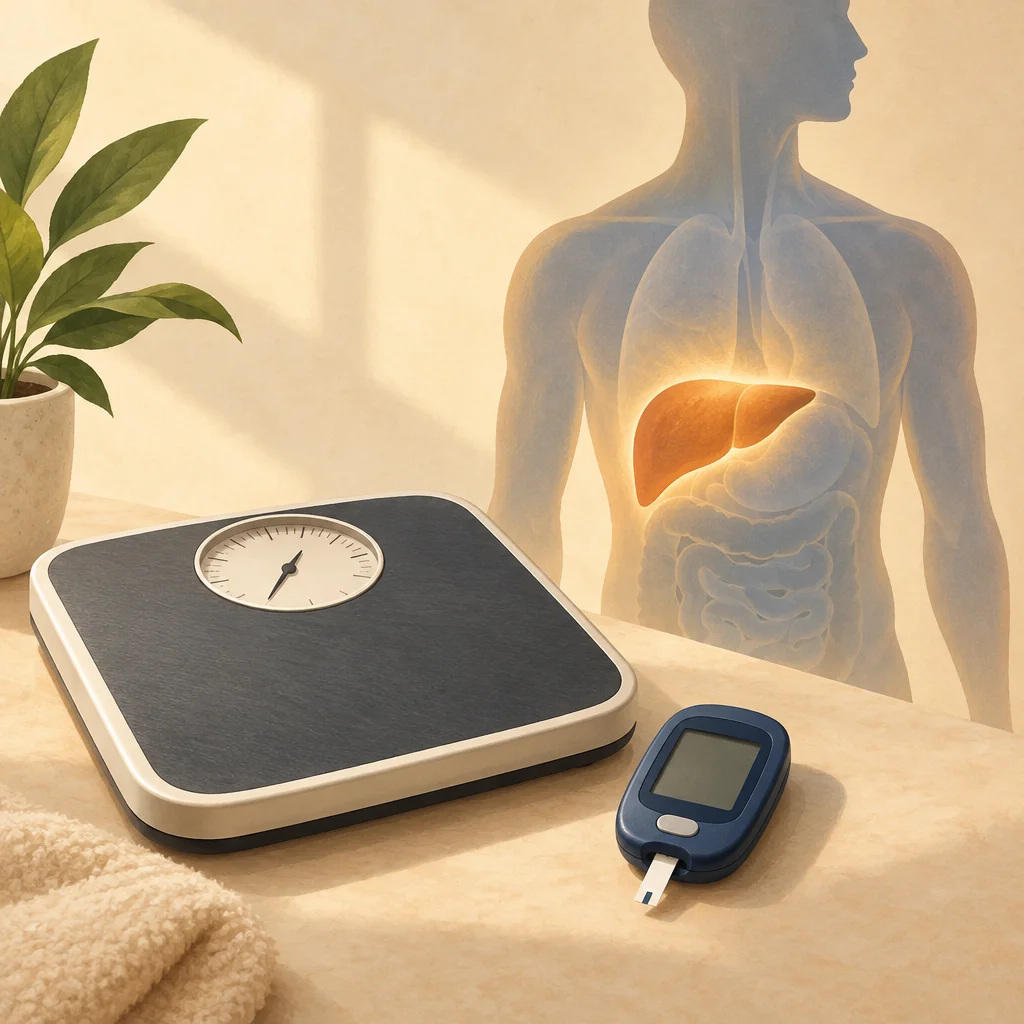
In Outlive by Peter Attia with Bill Gifford, a main warning is that body weight and basic glucose results can create false reassurance. Subcutaneous fat may store extra energy, but each person has limits. When fat builds up in the liver, muscle, or around organs, insulin problems can worsen even while glucose still appears “normal,” because the pancreas can compensate by making more insulin. The book’s example is a fatty liver found during cancer surgery despite routine signs not making the issue clear.
Why it matters
It supports looking earlier for metabolic risk signals that standard checkups may miss.
An example
A fatty liver is discovered during cancer surgery, even though routine signs had not made the problem clear.
Keep in mind
The summary supports earlier assessment, but it does not prove one testing schedule for every person.
Train for the future life you want

In Outlive by Peter Attia with Bill Gifford, the “Centenarian Decathlon” turns hopes for later life into abilities to train for now. Instead of saying only that exercise is good, it asks what you want to be able to do decades from today. The book notes that strength, balance, and aerobic power can decline, so you may need more capacity than daily life currently demands. Examples of goals include carrying a child, hiking, climbing stairs, and getting up from the floor.
Why it matters
It connects exercise to a concrete future you want to live, not just a metric.
An example
The book lists goals such as carrying a child, hiking, climbing stairs, and rising from the floor.
Keep in mind
The summary says fitness links with lower mortality, but observational studies cannot remove all confounding.
Act under uncertainty, but count the costs

Outlive by Peter Attia with Bill Gifford repeatedly describes decisions made without perfect proof. It mentions areas where people act on incomplete evidence—such as rapamycin in animals, broader cancer screening, or glucose monitors that teach some people about food responses—while also naming potential downsides. Harms can include side effects, false positives, unnecessary biopsies, cost, distress, and muscle loss. The example given is that cancer screening may detect disease earlier but can also trigger false alarms and biopsies that were not needed.
Why it matters
Prevention is more convincing when it openly weighs harms and weak evidence, not just potential upside.
An example
Cancer screening may find earlier disease, but it can also lead to false alarms and unnecessary biopsies.
Keep in mind
The book relies on judgment in many places; the summary does not show final outcomes for every tactic.
Longer life needs emotional health and purpose
Contains plot details

In Outlive by Peter Attia with Bill Gifford, the final section expands healthspan beyond labs and training. The narrator describes therapy that connects childhood abuse to anger, workaholism, shame, and emotional distance from family. The book argues that improved biomarkers and stronger bodies are not enough if close relationships are harmed and the future feels empty or not worth reaching. As an example, after his infant son’s medical emergency, the narrator’s slow return highlights damage occurring at home.
Why it matters
It challenges longevity as only a project of measurement and performance, and restores the human reasons for wanting more years.
An example
After his infant son’s medical emergency, the narrator’s slow return shows the harm caused at home.
Keep in mind
The summary presents recovery as continuing work, not as a completed cure or easy formula.
Liked the ideas? Read Outlive in full.
The big ideas are free on Lumina. The complete book is available from:
As an Amazon Associate, Lumina earns from qualifying purchases. How this works