
The deep dive
Prisoners of Geography
by Tim Marshall
18 min read · Original commentary by Lumina, written with AI
- Topic: Politics
Why do governments keep worrying about the same borders, ports and shipping routes? Tim Marshall answers by looking beneath political speeches to the physical setting of power. This deep dive explores his map-led argument, its account of unequal opportunities, and its hardest question: when does explaining pressure make a human choice sound inevitable?
Prefer the quick version? Read the main learnings →01
The land beneath the headlines
Prisoners of Geography is nonfiction about the material limits of political power. Its premise is simple: leaders cannot choose their mountains, neighbours, rivers or access to the sea. They can build roads, form alliances and launch wars, but those actions begin within a physical setting they did not create.
Marshall examines ten selected regions rather than offering a complete world history. His subject is geopolitics: the interaction of place, population, resources and power. Readers should expect a broad introduction to strategic pressures, not a detailed explanation of every conflict or country discussed.
The book does not formally claim that terrain determines events. It allows roles for ideas, leaders, institutions and technology. Its stronger claim is that explanations become weaker when they ignore the physical conditions that make some options practical and others costly.
Lumina’s reading is that the title creates a useful tension. Being constrained is not the same as having no choice. The book becomes most interesting where it moves between those positions. Its intellectual question is therefore not simply whether geography matters. It is how much geography explains, and what remains for politics to decide.

Illustrated key idea
Begin with terrain, then add the rest02
How much freedom does a government really have?
Marshall asks readers to change the starting point of political explanation. Instead of beginning with a ruler’s speech or beliefs, begin with the practical problem that ruler faces. Where can an army advance? How does food reach a port? Which river supplies the population? What could an opponent block?
His reporting examples establish this approach at a manageable scale. In Afghanistan, severe weather delayed an intended advance despite American technological strength. In Syria, access to a major road helped explain the strategic value of connecting areas of territory. These examples do not prove that weather or roads explain an entire war. They show how physical conditions can reveal purposes that a purely ideological account misses.
The stakes grow when that method reaches the scale of states. Russia’s open western approaches help explain its pursuit of defensive depth. China’s reliance on overseas trade helps explain its growing concern with maritime access. Geography makes distant or sparsely populated places matter because they can protect a core region, carry supplies or expose an economy to interruption.
Lumina’s interpretation is that Marshall is strongest when he replaces vague descriptions of ambition with concrete questions about access and vulnerability. Wanting greater power is an incomplete explanation. Wanting a usable naval exit or an alternative energy route is more specific and can be examined against actual conditions.
But explanation needs a stopping rule. A vulnerable frontier does not itself decide whether a government should negotiate, build defences, seek allies or seize territory. The map identifies pressures; it cannot settle every response. Reading the book intelligently means holding those two thoughts together: choices are materially constrained, yet constraints rarely erase all alternatives. That distinction will shape the three ideas that follow.
03
Security for one state can threaten another
The first central idea concerns where a state’s sense of danger comes from. In Lumina’s reading, Marshall’s explanations start from concrete features of the surrounding land and sea: a heartland with few natural barriers, a territory exposed to a neighbouring army’s advance, a capital within range of entrenched guns. Distance, high ground and controlled approaches can make a government feel safer. Yet obtaining those protections may make neighbouring societies less secure. Lumina reads this as one of the book’s most important patterns: defensive reasoning can produce coercive action without ceasing to describe itself as defensive.
Russia provides the sharpest case. Marshall links its security fears to the North European Plain, where few natural barriers protect its western heartland. Expansion creates distance between potential attackers and the core. That distance can stretch invading supply lines, but acquiring it also means extending control into other people’s territory.
The language of a buffer can hide that second perspective. To a powerful state, a neighbouring country may appear to be protective space. To the people living there, it is a political community with its own interests. Marshall’s account of Russian pressure on Ukraine, Moldova and Georgia therefore raises a question beyond military geography: whose security receives priority in the explanation?
The book also shows that physical exposure does not produce identical outcomes. It treats NATO membership as a reason direct Russian attacks on the Baltic states are less likely. An institutional commitment changes the risks attached to action, even though it does not move the terrain. Geography helps define the problem; alliances alter the available responses.
Pakistan’s pursuit of influence in Afghanistan extends this pattern. Marshall connects that policy to Pakistan’s narrow territory and the vulnerability of Punjab to an Indian advance. A friendly Afghanistan could provide strategic depth. Yet the account also traces how support for militant groups contributed to severe violence inside Pakistan. A policy meant to improve security can create dangers that its original spatial logic does not resolve.
Korea supplies a different boundary. Seoul’s proximity to North Korean artillery makes military intervention dangerous even if the attacking forces could ultimately prevail. Here, geography does not simply encourage expansion. It raises the cost of attempting a decisive solution and helps explain an unresolved confrontation.
The implication is not that every government’s security story deserves acceptance. It is that strategic claims become clearer when we identify what is being protected, by what means, and at whose expense. Lumina’s distinction is between understanding a fear and endorsing a response. The book provides strong material for the first task, but its treatment of Russia sometimes makes the second distinction harder to maintain. That difficulty is central to a fair criticism of its argument.
04
Wealth depends on connections, not just deposits
The second idea shifts from defending territory to making it productive. Land and resources do not arrive as ready-made national power. They must be connected to workers, consumers, ports and public institutions. Lumina’s synthesis is that the book treats geography as a system of relationships, not simply a list of valuable things a country possesses.
Marshall’s United States chapter makes this visible. Fertile farmland matters, but navigable rivers make its produce easier to move. The Mississippi basin links an agricultural interior to overseas trade. Ocean protection and comparatively secure neighbours then allow economic advantages to develop within a relatively protected continental space.
Even this favourable case requires political action. The book describes territorial acquisition, settlement and railways as part of constructing that continental system. It also records Indigenous dispossession and the contradiction of slavery alongside professed American ideals. The resulting power was not a gift from nature alone, nor was its creation morally neutral.
In the Africa chapter, the cost of connecting communities is a central concern. A river may be present without offering a continuous shipping route; difficult crossings and disease can make movement costly. Marshall also distinguishes these physical burdens from damage caused by colonial extraction and boundaries that divided or grouped communities without their consent. Mineral wealth in the Democratic Republic of the Congo did not produce broad security or prosperity; the account connects it with weak authority, outside intervention and devastating conflict.
That case matters because it breaks a tempting shortcut: valuable resources do not automatically create a strong public economy. Extraction can enrich particular actors while leaving transport, health, education or political stability weak. The important question is not merely what can be sold, but how the gains travel through society.
Argentina provides a useful limit on geographical explanation. Marshall describes productive farmland and favourable waterways alongside institutions and economic policies that weakened their benefits. Brazil offers the reverse movement: agricultural technology made previously unpromising savannah more productive, although transport barriers and poverty still constrained its wider potential.
Taken together, these cases support a conditional claim. Geography can raise or lower the cost of development. It cannot guarantee that governments will use advantages well, or that difficult conditions will remain equally difficult forever. Infrastructure, investment and public choices help determine how physical potential becomes usable capacity.
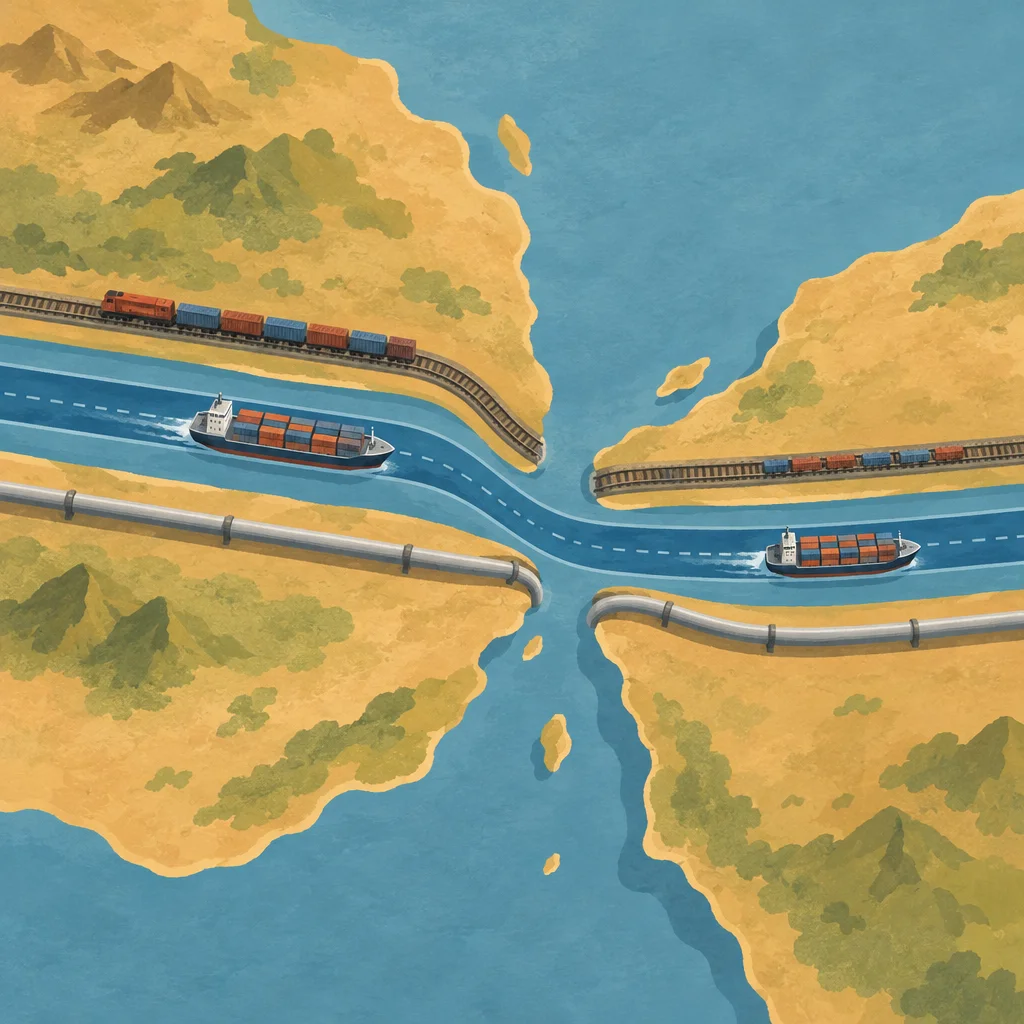
This also connects back to security. A resource that must travel along one vulnerable route can become a strategic liability. A railway or pipeline can increase wealth while making a state depend on a particular neighbour. Development and defence are therefore not separate subjects in Marshall’s account. Both concern the reliability of connections, and both require more than possession of territory.
Illustrated key idea
New tools relocate constraints05
New technology changes where dependence sits
The third idea explains why Marshall does not see modern technology as an escape from geography. A new tool can reduce one obstacle while creating another dependency. Ships need ports. Pipelines cross territory. Advanced weapons need supply and communications systems. Lumina’s interpretation is that the book asks us to follow the whole connection, rather than admire only the device that crosses a barrier.
China is the clearest example. Greater prosperity and international commerce increase its dependence on imported resources and maritime routes. Naval expansion responds to that exposure, but narrow passages, regional island chains and American partnerships complicate access to the open ocean. Economic success creates interests that then require protection.
Ports and overland corridors offer alternatives. The book discusses facilities and routes involving Pakistan, Myanmar and Sri Lanka as ways to widen China’s options. Yet an alternative route is not automatically a secure route. Instability in Baluchistan can obstruct the usefulness of a connection through Pakistan. Infrastructure relocates part of the risk into another political setting.
Marshall also separates equipment from capability. Building ships does not immediately produce an experienced navy. The point is broader than shipbuilding: technical possession, practical skill and sustained economic support are different requirements. A country may acquire one without yet having the others.
The Arctic complicates the argument because the physical setting itself is changing. Retreating ice can lengthen shipping seasons and make resources more accessible. But access comes with difficult operating conditions, high costs and environmental danger. Coastal communities and ecosystems face disruption even as states and businesses see opportunities. The same change can therefore be an economic opening for one actor and a serious loss for another.
The book’s conclusion extends this pattern to space. Marshall presents exploration as an expansion of human possibility that can also carry surveillance, military competition and resource rivalry into new settings. This is not evidence that every future activity must become a conflict. It is his warning that greater reach does not automatically remove distrust.
The boundary is important. If every innovation merely proves that geography still matters, the claim can become too broad to test. The more useful question is specific: which constraint has weakened, which dependency has appeared, and how much freedom has actually increased?
That question preserves the book’s insight without denying real progress. Agricultural technology can improve land. Communications can reduce the need for some forms of physical presence. Law and cooperation can make routes safer. Marshall’s strongest position is not that change is an illusion. It is that each improvement should be judged by the practical conditions it changes, rather than treated as release from all material limits.
06
How the map becomes an argument
Marshall persuades by repeatedly joining a visible feature to a strategic problem. An open plain becomes a question of defence. A navigable river becomes a question of trade. A narrow sea passage becomes a question of interruption. This movement gives large political claims a physical anchor that readers can picture.
His introductory reporting examples do useful work. Weather delaying an advance shows that technical superiority has operating limits. A road in Syria helps reveal how separated territories might become viable connected areas. These are compact demonstrations of a method, not comprehensive explanations of the conflicts involved.
The regional scale then gives that method breadth. Russia’s continental exposure differs from Japan’s island protection. Japan’s seas hinder invasion but also surround an economy dependent on imported resources. Europe’s waterways aid commerce while separate river systems and mountains help explain political fragmentation. A physical feature does not carry one fixed political meaning across every setting.
Lumina’s assessment is that this changing meaning is more persuasive than a simple catalogue of national advantages. It encourages relational thinking: protection from what, access to where, and dependence on whom? It also makes the book useful as an entry point rather than a final answer.
Breadth brings an evidential cost. These regional accounts assemble terrain, historical interpretation and strategic forecasts within a limited space. A clear mechanism is not by itself proof that it outweighed every competing cause. The summaries support analysis of Marshall’s reasoning, but they do not allow independent checking of all the historical and numerical claims behind it.
Time also matters to the craft. Descriptions of naval capabilities, diplomatic relationships and proposed infrastructure belong to the periods discussed. The stalled Nicaragua canal, for example, illustrates the gap between strategic ambition and implementation. It should not become a timeless statement about every future canal proposal.
The best reading stance is therefore active rather than merely receptive. Notice the physical anchor, follow the proposed causal link, and then ask what evidence would distinguish that explanation from another. The book supplies memorable questions. Its wide lens also leaves room for narrower histories and closer scrutiny.
07
When explanation starts sounding like permission
Lumina’s strongest objection is that the book can slide from identifying a powerful incentive to presenting a chosen action as unavoidable. Those are different claims. A reason for wanting something does not establish that one particular means of obtaining it was necessary.
Crimea makes this problem unusually clear. Marshall acknowledges the argument that Putin could have respected Ukraine’s territorial integrity. Yet he presents annexation as a geographical necessity, emphasising defensive depth and Sevastopol. That wording places more weight on compulsion than the book’s general rejection of geographical destiny seems to allow.
The objection is not that Russian security concerns must be ignored. It is that those concerns cannot establish the absence of alternatives merely by being serious. A full necessity claim would need to compare other possible responses and show why they were not genuine options. Describing the value of a naval base does not complete that task.
A related problem concerns scale. State-centred accounts can make populations appear as obstacles, buffers or sources of instability. The book does describe repression, displacement and unequal gains. Still, Lumina’s reading is that readers must actively restore the perspective of people whose homes become strategic assets in someone else’s account.
The strongest reply is that Marshall’s broader framework does leave room for agency. Europe provides a substantial example. American protection, integration and Franco-German cooperation helped contain rivalries that physical geography had not removed. Peace appears as a political achievement requiring continued effort, not as a change in the continent’s terrain.
The Arctic supplies another reply. Shared rescue needs, environmental dangers and legal frameworks can support cooperation alongside territorial competition. The book does not insist that opening access must end in war. It describes conditions under which states might manage their rivalry.
The fair conclusion is neither that geography excuses coercion nor that moral responsibility makes geography irrelevant. Marshall’s framework is most convincing when it explains the problem facing decision-makers. It becomes more contestable when it claims to settle their only possible answer. Keeping that boundary visible allows readers to learn from the book without adopting its strongest language of necessity.
08
Use the map to ask better questions
The book’s ideas connect most productively through the problem of shared dependence. The same river, shipping lane or border can create both common interests and unequal power. Geography does not tell us in advance which side of that relationship will dominate.
Water makes the point clearly. Marshall describes the Indus system as vital to Pakistan, while noting that India and Pakistan maintained their water-sharing treaty through wars. Dependence therefore need not produce immediate breakdown. In the Nile case, Ethiopia’s hydroelectric ambitions and Egypt’s downstream reliance create both development possibilities and bargaining pressure.
Europe and the Arctic extend that connection. Institutions do not remove physical exposure, but they can change how governments respond to it. Cooperation is not an exception that disproves the importance of geography. It is one way political actors manage the problems geography gives them.
Lumina proposes a practical reading habit based on these examples. First identify the material stake: a route, water source, frontier, port or resource. Then ask which actors depend on it and whether their dependence is equal. Finally, examine the institutions and choices that could make the relationship safer or more dangerous.
Consider a clearly imagined example: two neighbouring states depend on one mountain road for essential imports. Building a second road might reduce the risk of a single closure. But if it crosses disputed territory, greater transport capacity could come with greater political exposure. The right question is not simply whether the new road is progress. It is which vulnerability it reduces and which it creates.
This habit also sets a limit on application. A map question is a first check, not a verdict. It should lead toward local history, political institutions and the interests of affected people. Used that way, Marshall’s approach resists two shortcuts at once: the belief that leaders can do anything they choose, and the belief that terrain chooses for them.

Illustrated key idea
Strategic fear often maps onto terrain09
A discussion that can hold two truths
A strong conversation about Prisoners of Geography begins with a qualified claim: physical conditions shape political possibilities, but they do not settle every outcome. That is more accurate than saying the book explains everything through maps, and more useful than dismissing geography because human choices also matter.
Be ready to distinguish three kinds of statement. Marshall describes physical conditions, interprets their political effects, and offers forecasts about future pressures. These claims require different tests. A mountain barrier is not the same kind of evidence as a prediction that competition will intensify.
Lumina suggests discussing one concrete mechanism before making a broad judgement. How does river transport help integrate an economy? Why does a naval route create exposure? How can an alliance change the cost of crossing an otherwise open frontier? Such questions reveal whether the geographical explanation is doing real work.
Disagreement can then become precise. One reader may find Marshall’s security arguments illuminating while resisting his language of necessity. Another may value his attention to institutions yet think the wide survey gives them too little weight. These are possible positions, not documented reader responses. Neither requires denying the importance of land and water, and neither should be presented as a complete account of the original.
What to remember
Identify the pressure before judging the response.
Marshall makes security more concrete by connecting it to frontiers, distance and access. Lumina’s qualification is essential: identifying a real vulnerability explains why leaders worry, but does not prove that coercion, expansion or any other particular response was their only choice.
Ask how an advantage becomes usable power.
Resources, farmland and waterways matter through the connections around them. Transport, investment and institutions affect who benefits. The contrast between American integration, African resource conflicts and Argentina’s unrealised advantages shows why a favourable physical starting point cannot guarantee a favourable political outcome.
Measure progress by the dependencies it changes.
New infrastructure and technology can genuinely reduce geographic obstacles. They may also require stable partners, protected routes and new skills. Lumina’s synthesis is to assess both effects together, rather than treating innovation as either complete liberation or evidence that nothing important has changed.
Bring it into conversation
Talk about the book
What would Marshall need to show before calling a territorial policy geographically necessary?
Lumina’s view is that demonstrating a strategic benefit is not enough. Necessity requires examining credible alternatives, their costs, and the interests of people affected. The book’s general allowance for choice makes its stronger claims worth testing.
Take it further: Would your standard change if a policy improved one state’s security while sharply reducing its neighbour’s?
When does infrastructure create independence, and when does it exchange one dependence for another?
China’s alternative routes and Latin America’s transport barriers suggest that more connections can widen options. Yet financing, political stability and control over access still matter. Lumina would judge independence by the range of reliable choices, not the number of projects.
Take it further: Which matters more: owning a route, having alternatives, or trusting the states along it?
Does cooperation weaken the book’s argument or show geography being managed successfully?
European integration, Arctic cooperation and the endurance of Indus water-sharing suggest that institutions can change behaviour without changing terrain. Lumina reads these as limits on fatalism, while recognising that cooperation needs continued political support.
Take it further: How could we distinguish an institution that genuinely reduces rivalry from one that merely postpones it?
Keep in perspective
This reading draws on accounts of the book, not independent verification of every historical or numerical claim. Strategic assessments and forecasts belong to the periods described, not necessarily the present. No separate critical reviews or documented reader responses were available. The regional breadth supports analysis of Marshall’s framework, but not a complete explanation of any country or conflict.