
The deep dive
Spark
by John J. Ratey with Eric Hagerman
18 min read · Original commentary by Lumina, written with AI
What changes when exercise becomes part of how we understand thinking, rather than a break from it? Spark makes that shift across classrooms, mental health care, and aging. Its most useful argument concerns what movement can make possible—and why learning, treatment, recovery, and social support still have work to do.
Prefer the quick version? Read the main learnings →♫ AI-generated voice · press play below to listen and read along; tap any passage to jump to it
01
The brain belongs to a moving body
Spark is nonfiction with a practical purpose: to make exercise central to discussions of brain health. John J. Ratey with Eric Hagerman connects movement with learning, mood, attention, stress, addiction, hormonal transitions, and aging. The range is broad, but one question holds it together. How does bodily activity affect our ability to respond to experience?
The book approaches that question through biology, research findings, school programs, and individual lives. It explains chemical messengers and cell growth, then considers what those processes might mean for a student or patient. Readers should expect an argument for action, not a single settled theory or an exact prescription.
Its governing distinction is between preparing for change and achieving change. Exercise may help create conditions for learning. It does not provide the lesson. It may support recovery without resolving the illness or circumstances that make recovery difficult.
Lumina’s reading is that this distinction gives the book its deepest value. Spark is not merely asking readers to add workouts. It asks them to reconsider the setting in which thought and feeling happen. That setting includes blood flow, fatigue, bodily arousal, relationships, and opportunities to practice. The mind is not working alone.
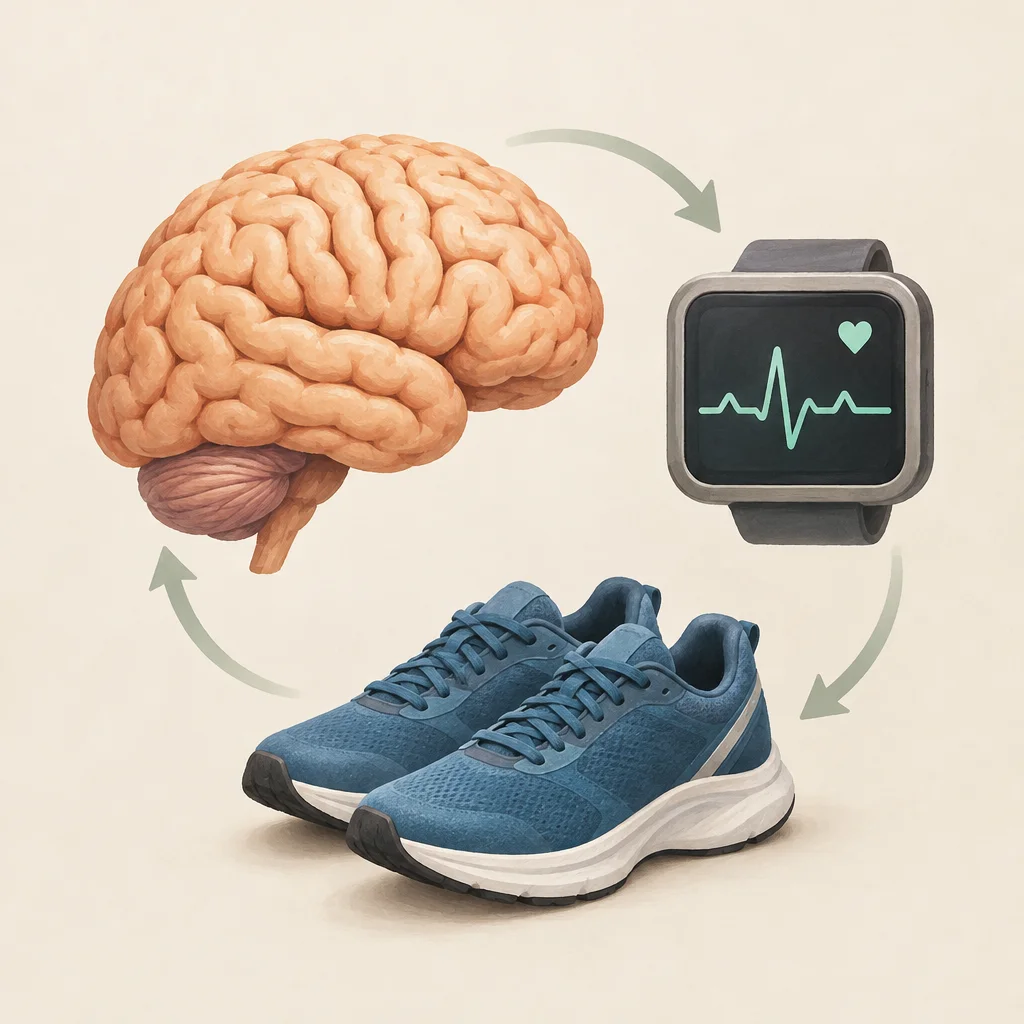
Illustrated key idea
Exercise can ready the brain for learning02
What can movement change—and what must happen next?
The central question is more demanding than whether exercise is good for the brain. Spark asks how movement can become useful within learning and care. A biological effect matters, but its practical value depends on what it enables someone to do afterward.
Naperville’s schools give this question a practical setting. A fast runner is not necessarily trying harder than a slow one. By measuring heart rate, teachers can assess each student’s effort without making sporting talent the standard. The approach also places exercise before lessons for some struggling readers. Over one semester, comprehension gains reached 17 percent in that early-morning group. The comparison group—literacy students whose schedules included ordinary PE—improved by 10.7 percent.
These results invite investigation rather than settle the issue. Wealth and family education could also contribute to Naperville’s academic strengths. The book cannot assign every success to its fitness program. What the example does establish is a different way to frame school time: movement might support instruction instead of merely taking minutes away from it.
The stakes extend into mental health. If movement can help someone tolerate distress, concentrate, or return to ordinary contact, it may strengthen the usefulness of other care. The book therefore makes room for exercise alongside medication, therapy, structure, and support.
Lumina interprets this as an argument about opportunity. A change in bodily state can make a next step more reachable. But an opportunity is not an outcome. Someone still needs instruction, a safe interaction, a workable routine, or appropriate treatment. This keeps the book’s promise substantial without making it unlimited. Its strongest thesis is not that movement solves mental problems. It is that leaving movement out may overlook one way of making learning and recovery more possible.
03
Readiness is not the same as learning
Spark’s first major idea is that exercise supports the brain’s capacity to change. This capacity is called plasticity. It means that experience can alter connections between brain cells, rather than merely pass through a fixed system. Repeated practice can strengthen communication along pathways used for a skill or memory.
The book gives particular attention to brain-derived neurotrophic factor, or BDNF. This protein supports brain cells and their connections. Exercise research links activity with changes in BDNF, blood vessels, and other growth-related processes. The argument is not that one substance explains every benefit. It is that movement can influence several conditions under which learning occurs.
A crucial part of the evidence comes from animals. Running studies show increased production of new neurons in the hippocampus, a region involved in memory. Yet new cells do not automatically become useful. Stimulation and learning help them survive and join existing networks. The book also describes human findings on vocabulary learning, processing speed, and flexible thinking, while leaving important questions about mechanisms unresolved.
Lumina’s interpretation is that the distinction between capacity and use prevents two opposite mistakes. The first is to treat exercise as irrelevant to intellectual work. The second is to treat it as intellectual work in disguise. A workout may support attention and adaptability, but it cannot supply the content of a language lesson or the judgment gained through practice.
An imagined example helps clarify this. A student walks before studying unfamiliar material. The walk does not contain the knowledge. Its possible value lies in improving the state in which the student encounters, practices, and recalls that knowledge. If no study follows, the promised connection remains incomplete. This is Lumina’s illustration, not an episode from the book.
The same reasoning explains the interest in skilled movement. Dancing or a coordination-heavy activity combines exertion with demands on timing, attention, and judgment. Such activities do not merely prepare for challenge; they also contain challenge. Still, Spark does not establish one ideal activity or dose for every learner.
Timing adds another boundary. The book distinguishes being ready to think after exercise from trying to think hard during exhausting effort. Vigorous exertion can temporarily interfere with complex mental work. More strain at the same moment does not necessarily mean more learning.
The implication is precise: movement and meaningful experience should be connected, not confused. Exercise may improve the conditions for practice. Practice gives those conditions a direction. That relationship becomes equally important when the desired change concerns fear, attention, or recovery rather than classroom knowledge.
04
Regulation matters more than perfect calm
A second idea connects the book’s treatment of stress, anxiety, and attention: good functioning requires regulation, not the absence of arousal. The brain must become active when demands arise and settle when they pass. Problems can emerge when activation stays high, becomes frightening, or fails to support the task at hand.
In Spark’s account, a stress response helps us meet a demand. Energy becomes available, and attention shifts toward what needs doing. Cortisol participates in that useful response; labeling it simply harmful misses its role. Duration changes the picture. An alarm that keeps sounding can undermine memory and leave the person more sensitive to threats.
Exercise introduces a different pattern: a bounded physical demand with time to recover. The book proposes that this pattern can strengthen the systems that manage strain and repair damage. But exercise does not escape the problem of excess. A demanding routine without enough rest may add to the burden it was meant to relieve. Recovery belongs inside the explanation of benefit, not outside it as an optional reward.
Anxiety adds a learning problem to this bodily picture. Someone may interpret a pounding heart as evidence of danger. That interpretation heightens alarm and makes the sensation still harder to tolerate. Escaping the situation can feel helpful immediately, while leaving the original fear untested.
The book suggests that movement can sometimes offer another experience of those sensations. A faster pulse during supported exercise may become bearable rather than automatically alarming. This process builds alternative associations; it does not delete the earlier fear. Nor is exercise always reassuring: some participants in the research experienced panic while exercising. Appropriate treatment and individual adjustment remain important.
The attention discussion challenges another easy judgment. A person with ADHD may become absorbed in an exciting task yet struggle to start ordinary work or plan ahead. That contrast need not indicate a lack of concern. The book locates the difficulty in managing several interacting systems, including reward, arousal, and impulse control. It proposes that exercise can help through dopamine, norepinephrine, and links between movement and attention. Organization, coaching, and medication may still be needed.
Lumina’s synthesis is that knowing the right action and being able to take it are different achievements. Bodily state can affect the distance between them. Movement is one possible way to reduce that distance.
This does not collapse stress, anxiety, and ADHD into one condition. Their evidence and treatments differ. The shared insight is narrower: regulation can make more responses available. The goal is not to feel calm forever. It is to respond to a demand without losing the ability to recover and choose a next step.

Illustrated key idea
Exercise can support care without replacing it05
A lasting habit needs more than resolve
The third major idea concerns the conditions that keep exercise possible. Spark argues for personal action, but its examples repeatedly show that action depends on support, access, enjoyment, and structure. Lumina reads this as a productive tension: exercise may build agency, while agency alone may not be enough to begin exercising.
Depression makes the problem clear. Low energy, withdrawal, and reduced initiative can obstruct the very activity proposed as helpful. Spark’s own account of the research is blunt about attrition: in the studies of exercise for depression that the book draws on, about one participant in two drops out. That is not a minor detail beside the treatment argument. It changes what a useful recommendation must include.
If benefits depend on continued activity, then companionship and manageable goals become part of the intervention. Spark recommends supported beginnings and medical care for severe depression. An accompanied walk may be more realistic than an ambitious independent program. The point is not to lower expectations forever, but to make the next step possible.
The addiction discussion extends this reasoning. Spark treats giving up the substance or the compulsive behavior as a beginning rather than a finished recovery. Something has to occupy the ground the habit held: pursuits that carry meaning, goals worth working toward, and a renewed engagement with the rest of life. The book’s practical advice is accordingly concrete about time, recommending that activity be scheduled into the vulnerable periods when idle hours are risky. Exercise may contribute through mood, stress regulation, social contact, and achievement. It can give time a different structure rather than leaving an empty space where a habit used to be.
The Odyssey House example shows both the appeal and the limit of this claim. Reports from the program put treatment stays for dedicated runners at about twice the length observed among residents who were inactive. That difference cannot tell us whether running produced the longer participation. Readiness to commit, or other circumstances, might influence both. The finding raises a worthwhile question about support for recovery; it does not identify a guaranteed route to it.
The book’s school programs offer another angle. When physical education rewards effort rather than athletic superiority, participation no longer requires being good at sport. The design changes who can experience competence. That matters because a routine linked mainly to embarrassment or exclusion may be difficult to sustain.
Spark’s preferred exercise schedule is ambitious, but it also treats walking as a valid beginning. It recommends variety, companionship, gradual progression, and adaptation after setbacks. Its exact brain-specific dose remains unknown.
Lumina’s conclusion is that adherence is not merely a final test of character. It is partly a design problem. Can the activity fit this person’s energy, responsibilities, health, and sources of enjoyment? A plan that ignores those questions may look impressive while producing little durable change. The book’s practical argument is strongest when support and flexibility count as central features, not concessions.
06
How stories and brain science share the argument
Spark persuades by moving between scales. A chemical process gives a possible account of change. A study tests a limited outcome. A school or personal example shows what that change might mean in ordinary life. Lumina’s reading is that the method makes technical material approachable, while creating a need to keep different forms of evidence separate.
The Naperville heart-rate monitor is a strong analytical anchor. It turns an abstract principle—individual effort matters—into a visible teaching practice. The detail supports an argument about inclusion and measurement. It does not, by itself, establish that exercise caused higher academic achievement.
BDNF performs a different role. It gives readers a biological route between movement and brain adaptability. That route makes the argument plausible, but plausibility is not proof of a specific clinical outcome. The depression discussion is careful here: low BDNF has not been established as the cause of depression, and much supporting evidence comes from animals or indirect human measurements.
The Duke SMILE trial helps separate two questions: can exercise help during treatment, and does it have a lasting advantage? The first receives clearer support. By the end of sixteen weeks, around half of the 156 patients had reached remission in each treatment group. Neither adding sertraline to exercise nor using either alone produced a clear advantage in overall improvement, though the drug tended to bring relief sooner. The longer-term picture is harder to interpret. Follow-up results looked better for exercise, but participants had altered their treatments and activity. Those changes prevent a simple verdict of enduring superiority.
Individual accounts serve yet another purpose. They show how symptoms, confidence, relationships, and routines can interact. Their strength is detail about lived experience. Their weakness is that several things may change together, making causes difficult to isolate.
The book’s persuasive range is therefore also its main reading challenge. A finding about a protein, an observed school improvement, and a clinical trial cannot be added together as if they were identical units of proof. Each answers a different question.
The most careful approach is to ask what role each example plays: does it show possibility, association, mechanism, or a tested effect? Spark becomes more useful when these distinctions stay visible. They allow enthusiasm without requiring the reader to treat every vivid account as a universal rule.
07
When a broad promise becomes too broad
Lumina’s strongest objection is that Spark’s breadth can make unequal evidence feel more uniform than it is. Movement appears relevant to learning, depression, attention, addiction, hormonal transitions, and aging. Even with local cautions, the repeated pattern may suggest that one habit reliably addresses nearly every mental difficulty.
That inference would go beyond the supplied evidence. A small human study does not settle treatment across a population. An animal result does not establish the same outcome in people. People who remain active may differ from inactive people in ways that also affect health. Several changes in someone’s life can accompany a new exercise routine.
There is also an ethical risk. A message about influencing one’s biology can become a message of blame. If movement is presented as accessible and powerful, someone unable to sustain it may feel responsible for remaining unwell. This concern is especially sharp when the condition itself reduces energy, confidence, or capacity to plan.
The strongest reply, also Lumina’s interpretation, is that the book’s qualified position is narrower than that objection assumes. Spark repeatedly allows for medication, therapy, medical guidance, social support, and individual variation. It recognizes dropout, severe depression, uncertainty about dose, and harmful exercise dependence. These are not details that can be removed without changing its practical claim.
There remains a genuine tension between an ambitious regimen and an uncertain optimum. The proposed schedule can offer direction, but readers should not mistake its precision for proof that it is best for every brain. A recommendation and an established threshold are different things.
The fair judgment is therefore conditional. Spark makes a substantial case for taking movement seriously within education and care. It makes a weaker case for any sweeping promise about replacement treatment or disease prevention. Its own cautions often support that distinction.
A responsible reading preserves both sides: exercise can deserve a larger place without deserving the whole stage. The question is not whether its benefits are real enough to discuss. It is which benefit, for whom, under what conditions, and with what remaining need for support.
08
Design the next opportunity, not just the workout
The book’s ideas connect most clearly when movement is placed beside something else worth doing. In learning, that partner is instruction or practice. In anxiety care, it may be supported contact with a feared situation. In recovery, it can be a meaningful routine. In aging, it includes social involvement and continued mental challenge.
Lumina’s practical interpretation is to ask two questions together: what might activity support, and what opportunity will use that support? This avoids measuring success only by completed exercise. It directs attention toward participation, learning, or independence without promising that every session produces a visible gain.
Aging shows why this matters. Strength and balance can help preserve the mobility needed to remain engaged. Walking may support fitness and mood, while social and intellectual activities supply further demands and meaning. The book treats these as connected supports, not substitutes. Evidence of better cognitive performance does not guarantee dementia prevention.
Hormonal transitions make a complementary point about variation. The book describes differences in sensitivity to hormonal change and uneven evidence for particular symptoms. Exercise may support mood and general health without reliably relieving hot flashes, for example. Pregnancy requires individual obstetric guidance. A broad principle must be adapted to the person and the outcome under discussion.
At an institutional level, the same reasoning shifts attention from exhortation to opportunity. A school can schedule movement near instruction. Families can address the practical barriers that displace postpartum activity. Care settings can help people participate safely rather than simply issue advice.
These applications do not require pretending the uncertainties have disappeared. They require matching the claim to the purpose. A manageable activity, appropriate care, and a meaningful next opportunity can form a coherent plan. The book’s lesson is strongest when no single element is expected to do everything.
Illustrated key idea
Stress helps only when people recover09
Keep the benefit and the boundary in the same sentence
A useful discussion of Spark starts with its exact claim. It argues that exercise supports conditions for learning, emotional regulation, and brain health. It does not establish that movement automatically produces knowledge, resolves every illness, or replaces treatment.
Then choose an example and name its evidentiary role. Naperville makes a school design visible, while leaving causal questions open. The depression trial offers a treatment comparison with limits in timing and follow-up. The biological material proposes pathways, some supported chiefly by animal research. These examples belong in the same conversation without proving the same thing.
Thoughtful disagreement can concern emphasis. One reader may value the book’s push toward action. Another may worry that its broad scope makes uncertainty harder to remember. Both positions can be reasonable if they address the qualified argument rather than an exaggerated version.
The most productive follow-up is concrete: what additional support would make the proposed benefit more likely? That question connects biology to teaching, therapy, scheduling, and access. It also reveals why the original book remains worth exploring. Its cases and explanations invite closer examination of how possible effects become useful changes in a life—not merely whether exercise belongs on a list of healthy habits.
What to remember
Prepare the brain, then give it something meaningful to do.
Spark links exercise with conditions that support brain change. Study, practice, and experience still direct that change. Lumina’s synthesis is to connect movement with opportunities for learning or engagement, rather than mistake a favorable biological state for an achieved skill.
Agency does not mean doing recovery alone.
The book presents exercise as one way to influence functioning, not proof that illness yields to effort. Medication, therapy, coaching, companionship, and medical guidance remain important. A supported beginning can better fit the argument than an ambitious plan someone cannot sustain.
A durable routine is a design achievement.
Enjoyment, inclusion, recovery, and flexibility help make continued activity possible. Spark offers a demanding template but no established brain-specific optimum. Lumina’s interpretation is that adapting activity to changing capacity protects the commitment better than treating one schedule as a universal standard.
Bring it into conversation
Talk about the book
What would show that movement improves readiness to learn, rather than merely accompanying a successful school?
Naperville offers a promising comparison, but family advantages and other features complicate attribution. Lumina’s view is that its design and its causal claims deserve separate judgments. Inclusive, effort-based physical education can be interesting even when academic effects remain uncertain.
Take it further: Which outcome would you want examined most closely: attention, comprehension, participation, or longer-term learning?
How can a clinician recommend exercise without turning difficulty starting into personal failure?
Spark recognizes that depression and low energy can obstruct action. Its emphasis on support suggests that the recommendation should include help with participation, not just a target. Lumina would judge the plan partly by whether it addresses those barriers.
Take it further: What practical support would make the advice meaningfully different from simply telling someone to exercise?
Does the book’s wide scope strengthen its argument or make it easier to overstate?
Several possible pathways could explain benefits across different problems. Yet shared plausibility does not establish equal evidence for every condition. Lumina’s position is that breadth helps generate questions, while each treatment or prevention claim still needs its own assessment.
Take it further: Where would you draw the line between a reasonable practical recommendation and a claim requiring stronger proof?
Keep in perspective
This reading draws on supplied accounts of the book, not a close examination of its full prose or underlying research papers. It cannot establish current medical guidance, independent replication, author biography, or critical reception. The studies and mechanisms discussed here retain the qualifications reported in those accounts. Lumina’s interpretations connect the book’s ideas; they do not add new clinical evidence.