
The deep dive
Ultra-Processed People
by Chris van Tulleken
18 min read · Original commentary by Lumina, written with AI
What if eating problems begin partly with products and markets, rather than failures of restraint? Chris van Tulleken connects appetite, industrial food design and commercial pressure. This deep dive examines his strongest evidence, the uncertainty around specific mechanisms, and the difficult task of protecting choice without creating more food anxiety.
Prefer the quick version? Read the main learnings →♫ AI-generated voice · press play below to listen and read along; tap any passage to jump to it
01
A food investigation, not another diet plan
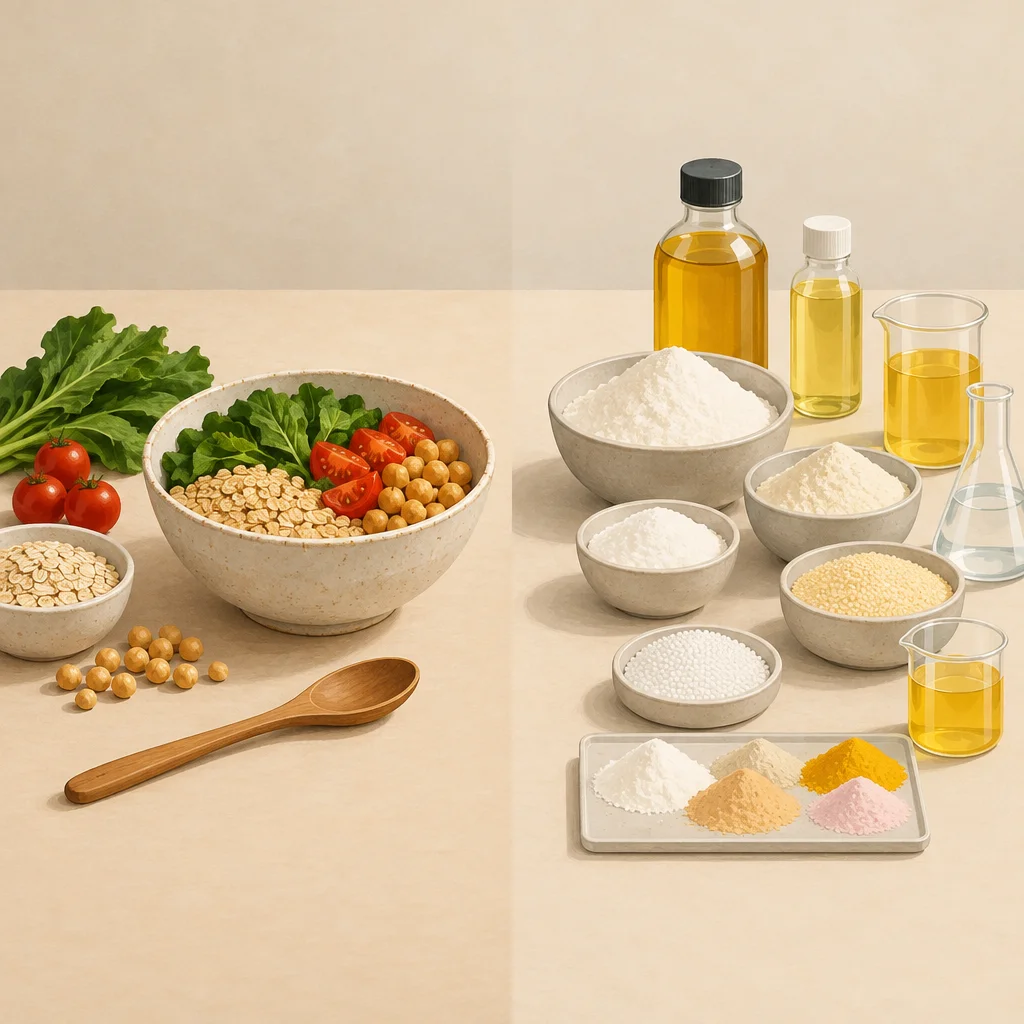
Ultra-Processed People is nonfiction that joins scientific explanation, reporting, personal experience and public-health argument. Its subject is ultra-processed food, or UPF. These are industrial formulations whose production often involves modified ingredients and substances uncommon in domestic cooking. Their design serves shelf life, distribution, cost and repeat purchasing, alongside taste.
Van Tulleken asks readers to look beyond familiar arguments about fat, sugar and discipline. He does not deny that nutrients or energy balance matter. He argues that they cannot fully explain how food affects eating, or why some diets become difficult to regulate.
Expect an investigation rather than a simple shopping guide. The book moves between appetite biology, food technology, corporate incentives and unequal access. Its practical advice allows different approaches and does not promise weight loss. It also rejects the idea that body weight straightforwardly measures health.
Lumina’s reading is that the book’s deepest subject is constrained freedom. People make decisions, but products, prices and bodily signals shape what those decisions involve. The intellectual question is therefore larger than whether an ingredient is safe. It is whether the modern food environment supports the regulation of eating, or repeatedly makes that regulation harder.
Illustrated key idea
UPF is an industrial pattern, not ordinary cooking02
What does a calorie count leave unexplained?
The book’s central question begins with a distinction: describing weight gain is not the same as explaining it. Taking in more energy than the body uses describes an imbalance. It does not explain why someone becomes hungrier, eats faster or finds restraint harder than someone else.
Van Tulleken argues that explanations centred on conscious choice often stop at this point. They treat intake as a decision that people should simply alter. His alternative asks what shapes intake before conscious intention enters the picture. Hunger signals, food structure, learned cues, stress and price all belong in that account.
Kevin Hall’s feeding experiment puts this distinction to a controlled test. Its important feature was that the same twenty adults tried both diets during a four-week stay at a research centre. For half that time, their menu relied mainly on UPF; for the other half, it excluded UPF. Researchers balanced the food available across several measures: sugar, fibre, salt and fat. They did not prescribe how much participants had to eat. Yet intake differed by roughly 500 calories a day, with more consumed during the UPF phase. Weight moved upward during that phase and downward during the other.
That result matters because a nutrient-focused description did not predict the difference in consumption. Yet the trial was small and short. It tested two dietary packages, not every product or proposed mechanism. It cannot establish all the long-term illnesses discussed elsewhere in the book.
Lumina interprets the book’s approach as connecting three levels of explanation. Food has physical properties. Bodies respond through systems that operate largely without conscious direction. Markets influence which foods become cheap, familiar and available. The stakes are both scientific and moral: an incomplete explanation can produce ineffective advice while assigning blame to the people who struggle most.
The challenge is to connect these levels without making UPF a catch-all explanation for every dietary harm.
03
Food is a structure, not just an ingredient list
The first major idea is that food’s physical arrangement can matter alongside its nutrient content. Van Tulleken challenges a habit of treating foods as containers for measurable substances. Two products may contain similar amounts of fibre, fat or sugar yet produce different experiences of eating.
The food matrix means the way a food’s components are held together: its cells, water, fibre and other material. Disrupting that arrangement can change the body’s response. Consider the book’s account of an experiment involving ten people and three forms of apple. Compared with juice or purée, eating the fruit intact kept hunger away for longer and limited fluctuations in blood sugar. The purée still contained fibre. That detail matters: retaining one component did not recreate the effects of the original structure.
This example supports a limited but important claim. An ingredient list cannot tell the whole physiological story. It does not prove that every broken-down food is harmful, or that an intact structure is always preferable. Ordinary cooking and grinding also change structure. The book explicitly treats such processing as part of human eating, not a departure from it.
The broader concern is the combination of features common in UPF. Softness reduces chewing. Low water content can increase calorie density. Together, these properties can deliver substantial energy quickly. A food may therefore be easy to consume before signals that help end a meal have much effect. In Hall’s trial, participants ate the UPF diet faster, even though they rated the diets as similarly enjoyable.
Lumina’s interpretation is that this changes the useful unit of attention. Instead of asking only what a food contains, ask how it behaves during eating. How much chewing does it require? How quickly does it deliver energy? What has happened to its original structure? These questions add to nutrient information rather than making it worthless.
NOVA, the classification developed by Carlos Monteiro, extends this inquiry to industrial formulation and purpose. Monteiro developed it after observing obesity rise in Brazil while industrial products displaced traditional meals, even as purchases of cooking oil and sugar declined. Examining whole eating patterns made that displacement visible. The scheme sorts food by how it was made and why: minimally processed foods and culinary ingredients at one end, processed foods in between, and ultra-processed products at the other. Membership of the last group turns on make-up and aim. Such products are typically built from substances that industry has extracted or altered, additives included, and the definition asks what commercial purpose the formulation serves. Whether a food has undergone any processing at all is not the test.
The boundary remains difficult. An unfamiliar additive can be a clue without settling the classification. Required flour fortification and some preservatives complicate quick rules. Home use of xanthan gum does not automatically reproduce industrial ultra-processing.
This idea leads into the next one: if a food’s form changes eating speed and fullness, consumption cannot be understood only as a decision about quantity. The product helps shape the conditions under which the decision occurs. But the book’s strongest evidence concerns dietary patterns, not a reliable verdict on every item on a supermarket shelf.
04
Appetite changes the meaning of self-control
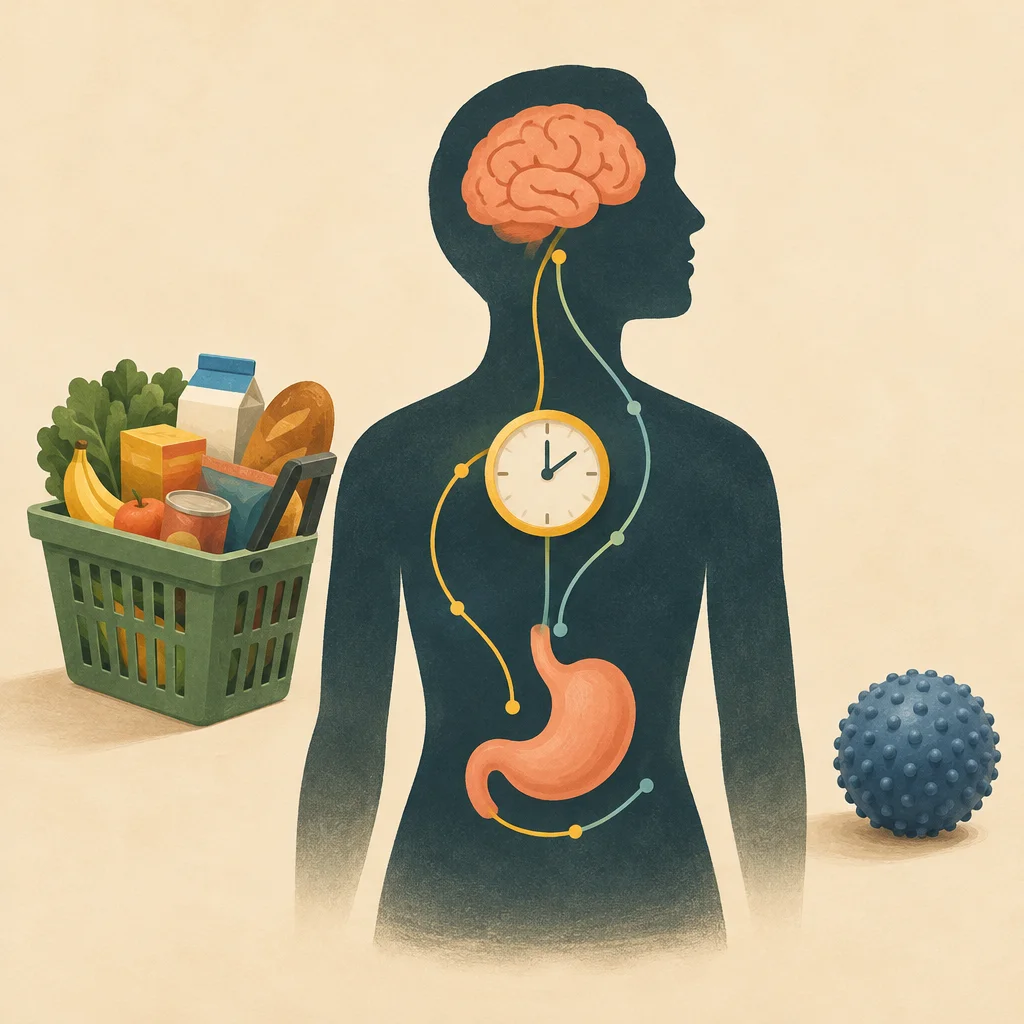
The second idea concerns agency: people choose what they eat, but they do not choose the strength of every impulse involved. Van Tulleken describes appetite as a network of bodily signals, learned responses and environmental pressures. Conscious intention works within that network rather than commanding it from outside.
Leptin provides one concrete anchor. This hormone, released by fat tissue, helps communicate information about energy stores. Falling levels can encourage eating. It operates alongside signals involving the gut, nerves, other organs and the brain. Restricting intake can therefore provoke resistance from the systems that regulate the body.
The book also presents Hall’s developing hypothesis that UPF may interfere with regulation itself. This differs from saying that delicious food merely defeats an otherwise reliable stopping signal. It suggests that the signals, or their interpretation, may be altered. The distinction matters, but the precise mechanisms remain unresolved.
Genetics and circumstances further complicate moral judgments. The book describes inherited differences that influence appetite and eating behaviour. It also examines poverty, stress, advertising and ready access to cheap products. These factors can reinforce one another. A household facing uncertain income may reasonably prioritise food that lasts, requires little preparation and is unlikely to be rejected.
Lumina’s interpretation is that the argument separates responsibility from blame. People can still make changes, seek support and express preferences. But difficulty changing does not establish weak character. Someone who rarely feels hungry and someone who experiences persistent hunger are not performing the same task when declining food.
The distinction between wanting and enjoyment sharpens this account. Van Tulleken describes craving products even as his pleasure in them declines. The book considers whether some UPF consumption can be understood through addiction: persistent urges, reduced control and continued use despite harm. That framing may help some people explain their experience without shame.
Its boundary is crucial. The book acknowledges disagreement about what is addictive and differences between products and people. Its later material takes a firmer position than earlier discussions. Readers should not turn that development into a claim that all UPF affects everyone alike, or diagnose addiction from preference alone.
The implication is practical but not prescriptive. Support may matter more than pressure, and different people may prefer moderation or avoidance. The next step in the book’s reasoning is outward: if appetite depends partly on exposure and circumstances, then meaningful choice also depends on who designs those circumstances.
Illustrated key idea
Appetite is not just a choice made in the head05
Good intentions do not cancel sales pressure
The third idea moves from bodies to institutions. For van Tulleken, harmful outcomes do not require a company staffed by people who wish customers ill. A business needs buyers to return. Its staff can care about those buyers while facing demands that push sales upward.
Interviews across the food trade help him develop this distinction. The people involved do not all hold the same power or perform the same task. But decisions about crops, recipes, supermarket space and investment are connected by the need to earn money. Turning a commodity into a branded formulation can create more opportunities for profit. Competition then helps determine which formulations reach consumers and remain available.
Lumina reads this as an explanation of incentives, not a verdict on everyone’s character. A firm that accepts fewer sales for public-health reasons may surrender business to a rival. Good intentions cannot, by themselves, change that competitive setting. This is why the book treats voluntary commitments with doubt.
The ice-cream investigation makes the distinction concrete. A texture that survives temperature changes helps a manufacturer distribute goods over greater distances. Substituting cheaper materials can also lower production costs. These changes may work very well for their commercial purpose. But success at moving and selling food does not demonstrate a benefit to the person eating it. The two questions require different evidence.
Price creates a related tension. Inexpensive food offers immediate, genuine help to households under pressure. The book nevertheless asks whether the price captures all the costs. Waste, damaged ecosystems and burdens on public services can remain outside the transaction. A bargain for the buyer can still leave other people paying part of the bill.
The proposed response is to change the rules around selling food. Van Tulleken wants clearer warnings, limits on promotion aimed at children, improved meals in public institutions and measures against poverty. He also separates hearing a company’s practical advice from accepting its money to develop policy. Knowledge about production does not remove a financial stake in the outcome.
This argument has boundaries. An incentive to increase sales cannot establish that a specific food causes disease. A funding conflict is a reason for scrutiny, not automatic proof that a statement is wrong. Nor does the case for regulation settle which regulation works.
The Chilean example illustrates that last limit. The book describes purchasing shifts after a package of labels and restrictions. That is encouraging, but lasting effects on obesity are not yet established. Lumina’s interpretation is that responsibility must extend beyond the shopper, while policy itself must remain open to testing. Reform also needs to preserve access for people who currently rely on cheap UPF.
06
A vivid narrator and an uneven ladder of proof
Contains plot details — open to read
The book persuades by moving between scales. A familiar food opens into manufacturing. A bodily experience opens into appetite science. An industry interview opens into questions about regulation. This gives abstract systems a visible point of entry without requiring readers to begin with technical knowledge.
Lumina’s assessment is that its most effective device is to make ordinary products newly puzzling. Ice cream that retains its shape in warmth becomes a question about texture, distribution and substitution. The analytical value lies not in strangeness alone, but in following a product feature back to the problem it solves for its maker.
The personal experiment adds urgency, but carries different evidential weight. After a UPF-free period, van Tulleken spends a month obtaining about 80 per cent of his calories from UPF without deliberately overeating. He gains six kilograms and reports disturbed sleep, constipation, anxiety and nighttime eating. Tests record changes in appetite signalling and an inflammatory marker.
These observations can generate questions and convey experience. They cannot establish a universal response. The experiment involves one person without a controlled comparison, and stress or sleep may complicate attribution. Brain scans show changes in functional connections, not demonstrated permanent structural damage.
A careful reading therefore keeps several kinds of support apart. Controlled trials test effects under specified conditions. Observational studies identify associations across populations but cannot establish causation alone. Animal experiments can suggest mechanisms without proving equivalent human effects. Interviews illuminate practices and incentives without independently measuring their health consequences.
The book’s handling of uncertainty is not perfectly uniform. Its earlier additive discussions stress limits, including the difficulty of applying mouse findings to humans. The afterword uses firmer language about some harms. Lumina would preserve the narrower evidential distinction rather than let confident phrasing settle it.
The result is an investigation whose force comes from several lines of inquiry, not one decisive demonstration. Reading the original offers the fuller experience of these encounters and changes of mind. The critical task is to notice when narrative vividness helps explain evidence, and when it risks feeling stronger than the evidence warrants.
07
Can a blurry category guide clear action?
The strongest fair objection, in Lumina’s interpretation, is that UPF may be too broad to bear all the weight placed on it. Products differ in structure, nutritional value, use and likely effects. Industrial purpose is also harder to infer than sugar content. A category that helps explain population patterns may frustrate an individual trying to choose lunch.
This objection becomes stronger when uncertain mechanisms accumulate. Softness, sensory mismatch, additives, reward cues and microbial changes are not interchangeable explanations. Some have more direct support than others. Presenting them together can create the impression that every possible pathway has been established.
The strongest reply is that an imperfect classification can still identify a useful pattern. Hall’s trial supports looking beyond several matched nutrients. Observational associations add breadth, although not independent proof of causation. The book need not prove every additive dangerous to argue that high-UPF diets deserve concern.
That reply is strongest when it stays at the appropriate scale. A dietary pattern can be worth changing without each item receiving the same judgment. The FAQs acknowledge that UPFs are not equally harmful and that one serving is not poison. This qualification is central, not a minor escape clause.
A second tension concerns freedom. Labels and marketing restrictions can support informed choice. Taxes or prohibitions can also burden people whose alternatives are limited. Van Tulleken responds by opposing blanket bans and taxes on essential staples, while supporting affordability and poverty measures.
There is also a tension between reducing stigma and increasing fear. An addiction framework may relieve self-blame, but rigid avoidance may be unhelpful or risky for some readers, including those with eating disorders. The book acknowledges food-related anxiety, though acknowledgment does not settle how every reader will respond.
Lumina’s balanced reading is that the book offers a strong reason to investigate and reform a food system, not permission to treat uncertainty as resolved. Its fair-minded reader can accept the broad concern while asking harder questions about individual products, specific mechanisms and policy design.
08
From a food label to the conditions of choice
The book’s ideas connect most usefully when applied at three levels: product, person and setting. At the product level, examine structure and formulation alongside nutrients. At the personal level, recognise differences in appetite and circumstances. At the setting level, ask which options money, time and infrastructure make possible.
Consider an imagined example created by Lumina. Two households buy the same packaged meal. One has time, storage and nearby shops, and uses it occasionally. The other relies on it because work schedules and limited cooking facilities leave few alternatives. The product is identical, but advice to replace it makes different demands on each household.
This illustrates why the book joins personal change to public provision. Better school or hospital meals can change access without asking each person to become a food specialist. Restrictions on child-directed marketing address exposure rather than blaming children for responding. Poverty measures can expand the options that dietary advice assumes already exist.
The same reasoning connects nutrition to environmental cost. If price excludes some costs of production and disposal, individual purchasing decisions cannot by themselves reveal the full consequences. The book’s environmental discussion broadens responsibility, but it does not establish that every traditional or premium product has better sourcing.
For an individual reader, the most faithful application is inquiry without a purity test. Notice patterns of reliance and products that seem difficult to stop eating. Consider what replacement would require before treating it as a simple matter of resolve. Seek appropriate support when eating feels compulsive or distressing.
These are options, not a treatment plan. Avoiding UPF does not guarantee weight loss, and non-UPF foods are not unlimited by definition. Lumina’s synthesis is that useful change should increase practical freedom: more workable alternatives, less pressure and better information, rather than a longer list of reasons to feel at fault.

Illustrated key idea
The strongest evidence is about whole diets09
How to discuss the book without overstating it
A strong conversation starts with the book’s shift in explanation: from judging individual restraint to examining how products and environments shape eating. Then distinguish the question being asked. Is the discussion about overeating, long-term illness, a specific additive, or a policy? Evidence for one does not automatically answer the others.
If someone objects that all food is processed, explain that van Tulleken distinguishes ordinary preparation from industrial formulation and purpose. If someone concludes that every additive is dangerous, point back to the book’s qualifications and its focus on whole diets.
Disagreement becomes more productive when it identifies the level of doubt. A person might accept Hall’s finding while questioning NOVA’s boundaries. Another might support marketing restrictions but doubt taxes. Those are not the same disagreement, and neither requires dismissing the entire investigation.
Lumina’s suggested stance is firm about distinctions and modest about certainty. The evidence supports concern without supplying a complete risk ranking. The policy argument supports independent oversight without proving every proposed measure effective.
You can discuss these ideas from this deep dive without claiming familiarity with every encounter in the original. A useful closing question is what evidence or practical change would alter each participant’s view.
What to remember
Ask how food behaves, not only what it contains.
The book connects structure, chewing, energy density and eating speed to intake. Nutrient information remains useful, but cannot describe every effect. This supports looking at whole dietary patterns without assuming that every industrial ingredient or individual product carries the same risk.
Less blame does not mean less agency.
Appetite, inherited vulnerability and difficult circumstances can make restraint unequal work. Recognising those pressures can support more realistic choices and better help. The book allows different personal approaches rather than treating moderation, abstinence or weight loss as a universal test of success.
Match the strength of action to the strength of evidence.
Concern about high-UPF diets need not wait for every mechanism to be settled. But claims about particular additives and policies still require scrutiny. The book’s case for independent oversight is strongest when paired with affordable alternatives and clear acknowledgment of uncertain outcomes.
Bring it into conversation
Talk about the book
When is an imperfect food category useful enough to guide action?
NOVA can reveal patterns that nutrient labels miss, yet its boundaries complicate individual choices. Lumina’s view is that usefulness depends on the task: studying diets and judging one product require different levels of precision.
Take it further: Would you demand clearer boundaries for a warning label than for a public-health study, and why?
Does describing some eating as addictive expand freedom or narrow it?
The framing may explain persistent craving and reduce shame. It may also encourage rigid rules or suggest that different people need the same response. The book supports varied approaches, while its later material expresses greater confidence about addiction.
Take it further: What would supportive language sound like for someone who prefers moderation rather than avoidance?
Which reform best turns formal choice into a realistic option?
Labels improve information, but information cannot create cooking time or affordable alternatives. Better institutional meals, marketing limits and poverty measures address different constraints. Purchasing changes alone also do not establish lasting health improvements.
Take it further: Which intervention would you prioritise, and what outcome would show that it helped without unfairly burdening people?
Keep in perspective
This reading draws on accounts of the book’s arguments and examples, not an independent assessment of the underlying studies. No separate reviews or documented reader responses were provided. Claims about mechanisms, product differences and long-term policy effects remain unevenly supported. Where later material speaks more firmly than earlier discussions, this analysis preserves the distinction between the author’s confidence and the evidence described.