
The deep dive
Why Zebras Don’t Get Ulcers
by Robert M. Sapolsky
17 min read · Original commentary by Lumina, written with AI
- Topic: Psychology
Stress is not simply a bad feeling, and calm is not a cure for everything. Robert M. Sapolsky explains how emergency biology can become a lasting burden. The harder lesson is learning to connect thoughts, bodies, and social conditions without making stress an explanation for every illness—or blaming people who become sick.
Prefer the quick version? Read the main learnings →♫ AI-generated voice · press play below to listen and read along; tap any passage to jump to it
01
A survival response with a scheduling problem
Why Zebras Don’t Get Ulcers is explanatory nonfiction about the meeting point of physiology and everyday experience. Its starting contrast is simple: an animal facing immediate danger needs rapid bodily action. Humans can call up similar changes while remembering a conflict or anticipating financial trouble. The threat need not be physically present for the body to respond.
Sapolsky follows that response across metabolism, circulation, digestion, immunity, memory, and other systems. He also considers depression, addiction, relationships, and inequality. Readers should expect a broad account of connected processes, not a single diagnostic test or a guaranteed stress-management method.
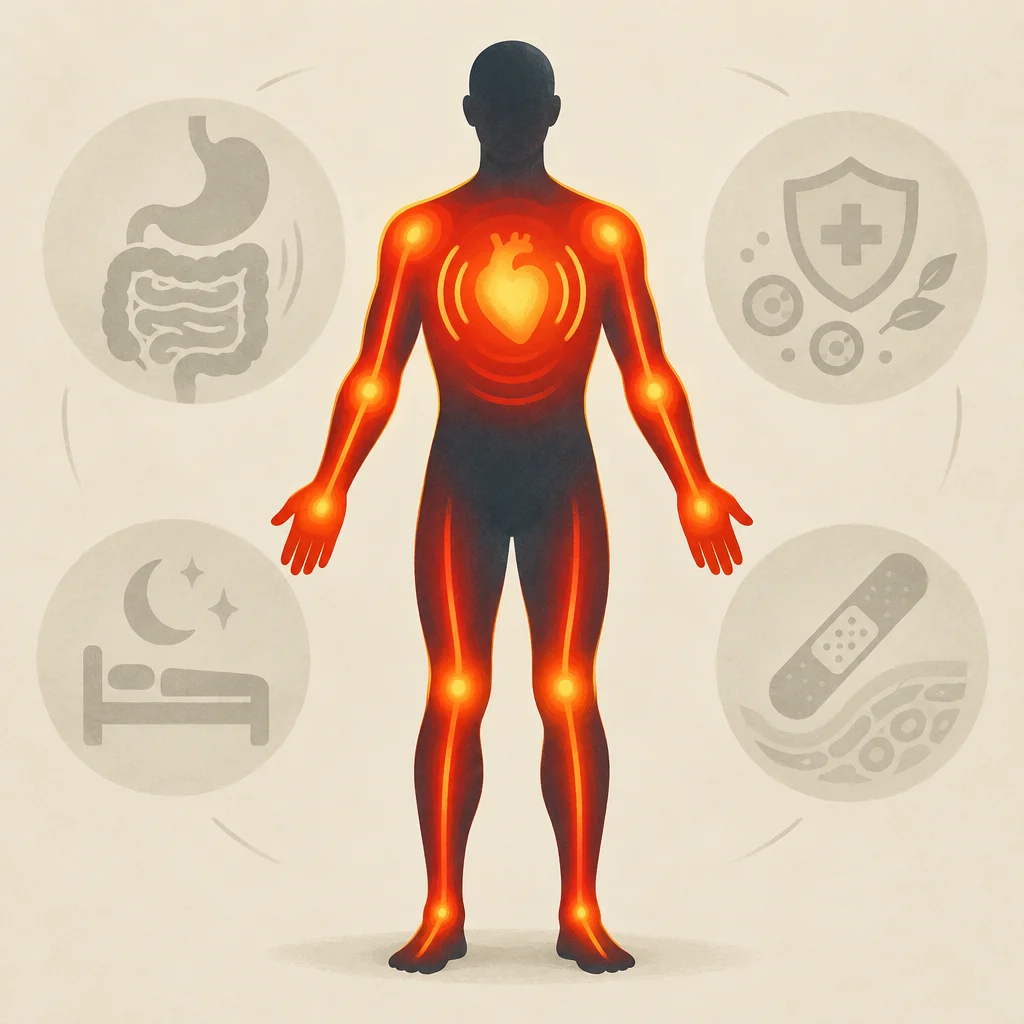
The central distinction is between a useful response and its costly repetition. A racing heart is not inherently a malfunction. Releasing stored energy is not inherently harmful. Both may be essential during danger. Trouble develops when activation persists, returns too often, or ends without adequate recovery.
Lumina’s reading is that the book asks us to replace a blunt question—whether stress is bad—with several more useful ones. What demand is the body meeting? How long does the response last? What other risks are present? What chances exist for recovery? Those questions make the book more demanding than a wellness prescription. They also explain its value: it offers a way to reason about health without reducing illness to either biology alone or attitude alone.
Illustrated key idea
A rescue system can wear the body down02
How can a thought become a bodily cost?
The book’s central question concerns translation: how can an expected setback become a change in blood pressure, appetite, sleep, or immune activity? Sapolsky answers through physical pathways rather than treating mind and body as separate worlds.
The brain can mobilize the body through autonomic nerves and circulating hormones. Sympathetic activity produces rapid changes. A slower chain runs from the hypothalamus through the pituitary to the adrenal glands, which release glucocorticoids. These are hormones with many roles in energy use and stress regulation. Their effects unfold on different timescales from the rapid emergency signals.
That timing matters because the body is coordinating competing needs. It cannot give equal priority to escape, digestion, repair, growth, and reproduction at every moment. During danger, some tasks wait. The question becomes what happens when the emergency setting keeps winning priority.
Sapolsky uses allostasis to describe regulation through adjustment. Health does not require every bodily measure to remain fixed. It requires coordinated changes that fit changing demands, sometimes before those demands arrive. Allostatic load names the accumulated burden when those adjustments become frequent, prolonged, or poorly controlled.
The stakes extend beyond proving that thoughts have physical effects. A biological pathway does not establish that a particular worry caused a particular disease. Nor does it show that changing thoughts can reverse established damage. The book repeatedly separates a possible mechanism from evidence of actual illness.
Lumina interprets this as the book’s governing discipline: explain the connection, then limit the conclusion. Without the connection, psychological suffering can look medically irrelevant. Without the limit, every illness can become evidence of failed coping. Sapolsky’s approach resists both errors. It treats mental experience as biologically consequential while preserving the roles of infection, inherited vulnerability, behavior, treatment, and social circumstances.
03
The problem is not activation, but the wrong pattern
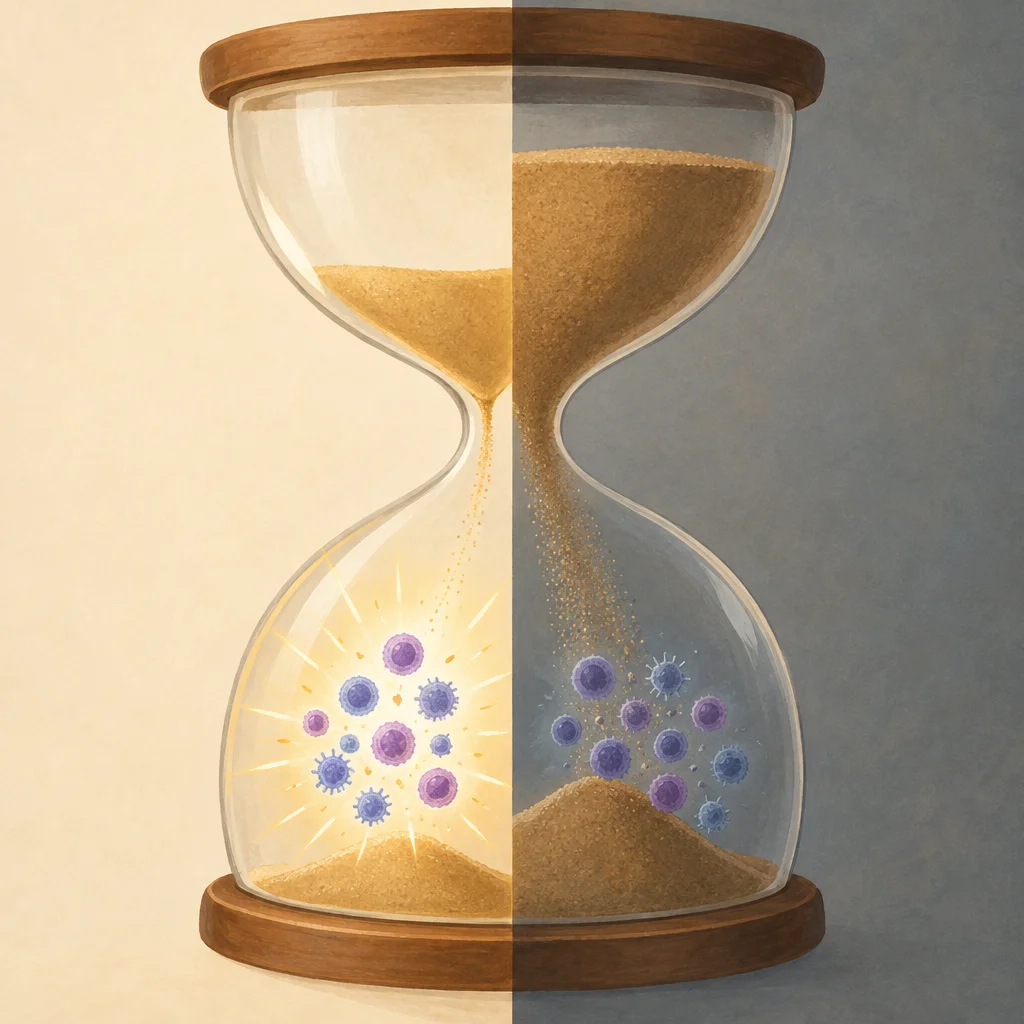
The first major idea is that stress cannot be judged by its presence alone. Its effects depend on intensity, duration, timing, and recovery. Sapolsky presents a system that can protect and damage the same organism under different conditions.
Consider energy. Insulin normally helps cells take up nutrients and build reserves. During an emergency, stress hormones work against storage and make fuel available for action. This is useful when muscles need immediate energy. Repeated mobilization, however, can leave more glucose and fats circulating and worsen insulin resistance in susceptible people. The issue is not that the body has chosen a senseless response. It has given an urgent task priority too often.
Circulation shows a related pattern. Faster, stronger heartbeats and higher pressure help support physical effort. Repeated activation can contribute to hypertension and arterial damage. Existing disease changes the stakes further: an acute emotional surge may become dangerous in an already vulnerable heart. Thus a brief response is not automatically safe, just as a strong response is not automatically harmful.
Memory makes the pattern still less tidy. Brief, moderate arousal can improve aspects of remembering. Severe or prolonged stress can impair retrieval and flexible thinking. The book describes this as a rough inverted-U: some arousal helps, but more does not keep helping. This is not a formula for calculating an ideal stress level. Different tasks and memory systems respond differently.
Appetite adds another complication. Early signals may suppress hunger, while longer-lasting hormonal effects can encourage eating during recovery. Two people who eat differently under strain need not contradict the same biological account. They may experience different patterns of exposure, timing, and hormonal response.
Lumina’s interpretation is that the book replaces a simple good-versus-bad model with a question of fit. Does the response fit the demand, and can it stop afterward? This also makes recovery an active part of regulation rather than an empty interval between challenges. Sleep matters partly because it normally creates periods of reduced stress-system activity. Fragmented sleep can interfere with that opportunity.
The boundary is important. These patterns do not allow readers to diagnose their hormones from hunger, fatigue, or forgetfulness. Nor does the book support eliminating all arousal. An inadequate emergency response can be dangerous. Even uncertainty can feel pleasurable when it is brief and safely contained. The aim is not permanent stillness. It is a system able to mobilize when needed and recover when the demand passes.
04
A contributing cause is not the whole cause
The second major idea concerns causal reasoning. Sapolsky argues that stress often changes vulnerability or disease severity rather than acting as a sufficient cause. That qualification is not a minor disclaimer. It determines what the book’s explanations can reasonably mean.
Ulcers provide a clear anchor. Helicobacter pylori transformed their treatment, but infection does not fully explain which people develop ulcers. Sapolsky examines ways stress might weaken protection, alter blood supply, interfere with repair, or amplify other risks. The point is not to restore emotion as a rival to bacteria. It is to explain why a biological threat can have different outcomes in different bodies.
Several mechanisms may operate together, and their relative importance remains uncertain. That uncertainty matters. A plausible pathway can explain how something might happen without proving how much it contributes in ordinary life. Likewise, showing that stress affects a laboratory measure does not automatically show that it causes clinically important disease.
The immune discussion makes this distinction concrete. An early stress response can mobilize or redistribute immune cells. Later hormonal restraint may reduce activity. A lower cell count in blood can therefore mean movement elsewhere, not simply weaker protection. Before interpreting a measurement, readers need to know what was measured, when, and what else changed.
Cancer marks a firmer boundary. The book does not find convincing support for the broad claim that stress causes human cancer. Experimental tumor findings cannot simply be carried over to human disease. Psychological support can relieve distress even when evidence for longer survival is inconsistent. Its value does not depend on becoming a cancer treatment.
Lumina reads this as an ethical consequence of careful science. If emotional state were treated as a master cause, illness could become an accusation: the patient worried too much, failed to stay hopeful, or lacked the right outlook. Sapolsky rejects that move. A person can benefit from support without being responsible for producing a cure through attitude.
The same reasoning applies when illness itself creates stress. Unsuccessful fertility treatment can increase distress, making an association between distress and treatment failure difficult to interpret. Cause and consequence may run both ways, or share another source.
The implication is a more useful kind of health literacy. Ask whether a claim concerns a mechanism, an association, an altered risk, or a treatment outcome. Those are different claims requiring different evidence. The boundary is that uncertainty should not become dismissal. Weak proof for one sweeping claim does not erase better-supported links elsewhere, including controlled evidence connecting stress with susceptibility to colds.
Illustrated key idea
The same response can help or hurt05
Control and support belong to situations, not just personalities
The third major idea moves from what bodies do to the conditions under which they do it. Sapolsky argues that physical circumstances alone cannot predict the full stress response. Predictability, meaningful control, trusted relationships, and the sense that conditions are improving can change how a challenge is experienced.
This does not mean people can simply decide that hardship is harmless. Some stress responses occur without conscious appraisal. More importantly, the resources that shape appraisal are not equally available. Knowing when a difficulty will end differs from trying to think positively about an indefinite threat.
The book’s animal examples help separate rank from the conditions attached to rank. Subordination can bring harassment and little control. Yet an unstable hierarchy can also make dominance costly. Supportive group life can protect lower-ranking animals. Position matters through the pressures, relationships, and opportunities it carries, rather than through a universal biological rule about being at the top or bottom.
The human argument extends beyond extreme poverty. The book describes health differences across successive socioeconomic levels. Material hazards, access to care, and health behaviors explain part, but not all, of this pattern. Sapolsky identifies chronic stress as another contributor while acknowledging that some evidence is indirect. Poverty can combine exposure to hardship with fewer chances to prepare, escape, recover, or obtain help.
Lumina’s interpretation is that control works here as a bridge between psychology and social organization. A person may experience limited control internally, but the limitation can be real and external. Coping advice becomes unfair when it treats that condition as merely a mistaken belief.
Even genuinely helpful resources have limits. Warnings can increase distress when they offer no useful preparation. A belief in control can produce guilt after an unavoidable tragedy. Determined effort against severe structural barriers can itself carry health costs. Social contact also differs from support: being surrounded by people does not guarantee safety or understanding.
An additional moral complication appears in displaced aggression. Harming a weaker animal may lower the aggressor’s stress. Physiological benefit therefore cannot be the sole standard for judging a coping strategy. A practice can help one body while worsening another’s conditions.
The implication is that stress management has both personal and shared responsibilities. Relationships, choice, and practical relief matter alongside habits. The boundary is equally clear: the book does not establish that inequality affects health identically everywhere. Associations vary across societies. Nor does explaining a social pathway identify one policy that will remove it. The argument supports taking social conditions seriously, not pretending that their health effects are simple.
06
How the book makes complexity readable
Sapolsky’s broad explanatory design moves between bodily mechanisms and recognizable experiences. A reader can connect an abstract hormonal process with appetite, a sleepless night, or an anxious memory. This movement gives physiology practical meaning without requiring every reader to begin with technical knowledge.
One strong analytical anchor is the contrast between immediate usefulness and delayed cost. It provides a recurring question across very different systems: what problem does this response solve now, and what happens if it continues? Lumina sees this as the book’s main organizing tool. It helps readers carry a principle from circulation to metabolism without assuming those systems work identically.
A second anchor is the correction of an appealing explanation. The older idea that chronic stress generally harms by exhausting hormone supplies gives way to the costs of excessive activation itself. Yet the pain discussion preserves a limited role for depletion in temporary stress-induced pain relief. The larger framework therefore has an exception rather than swallowing every case.
A third anchor is the distinction between animal findings and human conclusions. Animal research can reveal possible mechanisms and allow controlled comparisons. Human findings often face harder questions about prior illness, later experience, and competing explanations. The aging discussion, for example, considers the hippocampus, a brain region involved in memory. It also helps restrain glucocorticoid release through feedback signals. Damage there may weaken that restraint, allowing hormone levels to rise and potentially cause further damage. This proposed loop has stronger support in rats than in people.
The book also uses failures of reasoning as evidence about how knowledge should be assessed. Its account of mistaken standards for infant thymus size shows the danger of treating an unhealthy comparison group as normal. The lesson is not merely that one conclusion was wrong. The starting reference point shaped what investigators believed they were seeing.
This method has a cost. The same accessible emergency-response model travels across many fields, while the evidence beneath each application varies. Readers must keep track of where the book offers controlled evidence, associations, or unresolved proposals. Lumina’s assessment is that the qualifications are part of the intellectual work, not obstacles to it. Reading only for the memorable mechanism risks missing the standard of proof that should govern its use.
07
Does a broad explanation become too broad?
The strongest fair objection, in Lumina’s view, is that stress threatens to explain too much. It appears in discussions of blood vessels, pain, growth, mood, addiction, aging, and social inequality. A reader might leave with one versatile answer to nearly every health question, even though the book warns against doing so.
That objection becomes sharper when feedback loops enter the account. Stress can impair sleep, while poor sleep increases stress activity. Illness can produce distress, while distress can worsen aspects of illness. These loops may be real, but naming a loop does not reveal where it began, which link matters most, or where intervention will work. Explanatory reach can exceed practical precision.
The strongest reply is also within the book. Sapolsky repeatedly narrows the claims that his broad framework might encourage. He distinguishes laboratory changes from disease, animal mechanisms from human findings, and relief of suffering from improved survival. He also describes variation within depression and uncertainty about human aging. On this reading, stress is not a replacement diagnosis. It is one set of interacting processes that deserves investigation.
A second tension concerns the practical ending. After describing unequal exposure and structural barriers, advice about exercise, relationships, and small choices might seem too modest. It could make a social problem sound like a private project.
The strongest reply is not that modest habits solve inequality. It is that personal relief need not wait for every external condition to improve. Sapolsky explicitly limits claims about control and warns against victim-blaming. Lumina interprets the practical position as two responsibilities held together: improve available ways to cope, and do not confuse them with removal of the source.
Neither reply closes the debate. Readers can reasonably ask whether the balance gives enough weight to shared change, or whether the biological breadth makes confidence levels hard to retain. The useful disagreement is about scope and emphasis. It need not force a choice between denying mind–body connections and treating those connections as universal explanations.
08
Match the response to what can actually change
The book’s practical ideas become clearer when linked to its biology. If harm depends partly on repeated activation and poor recovery, coping should not be judged only by whether it produces an immediate feeling of relief. It should also be judged by its longer pattern, its costs, and its fit with the situation.
Comfort eating illustrates that distinction within the book. It may dampen stress responses while creating metabolic costs. Displaced aggression offers another warning: relief for one individual can impose stress on someone else. Neither immediate comfort nor a lower stress measure is a complete account of benefit.
Consider a brief imagined example created by Lumina. A worker faces unpredictable schedule changes. Relaxation may help with the evening’s arousal. A reliable schedule would address a source of repeated anticipation. A trusted colleague might provide support, while meaningful input into scheduling could increase actual control. These are different kinds of help, not competing explanations of the same problem.
The example also shows why advice must be specific. More information helps only if it is timely and useful. More effort helps only where effort can change something. When an outcome cannot be reversed, support and emotional adjustment may be more fitting than demands for greater mastery.
For personal use, the book suggests a modest test: what is changeable here, what helps recovery, and what creates another cost? Sustainable voluntary exercise, genuine relationships, and manageable choices can matter. Meditation may help, but the book is more cautious about lasting benefits and claims that one method is superior.
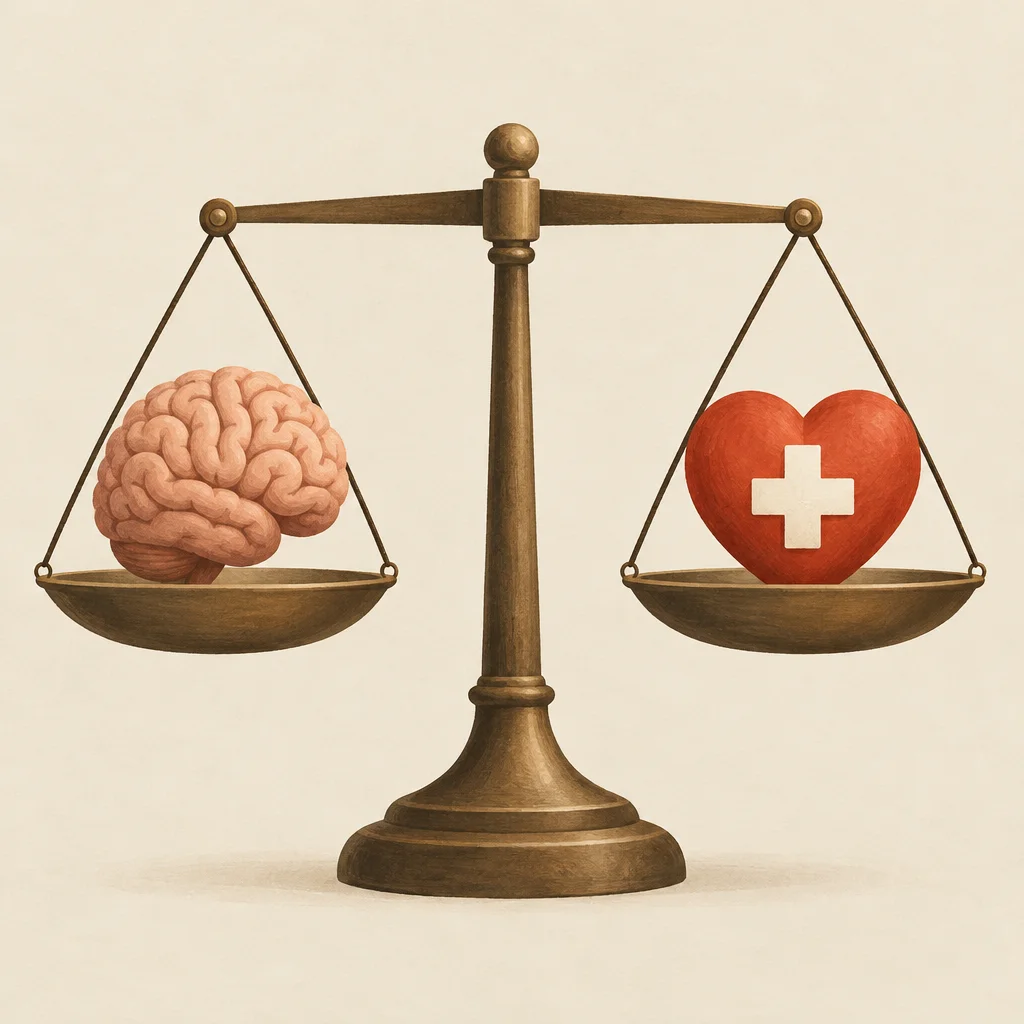
These are not instructions to manage a disease without care. Persistent pain is not imaginary because emotion affects it. Major depression is not ordinary sadness because experience helps shape it. The practical connection is complementary: take psychological experience seriously while preserving medical treatment and attention to external conditions.
Illustrated key idea
Mind–body links are real, but blame is wrong09
A discussion that keeps the qualifications intact
A useful conversation about this book begins with its precise claim: repeated or poorly regulated stress responses can alter health risks, but stress does not determine every outcome. That formulation leaves room to discuss biology without claiming that a person’s illness reveals their emotional history.
Three distinctions can sustain the conversation. First, a helpful emergency response can become costly without being a defective system. Second, a possible mechanism is not proof of a particular disease outcome. Third, a coping resource may depend on real circumstances, not simply a better outlook.
If someone says the book proves worry causes illness, the next question is which illness and what evidence supports the link. If someone says bacterial ulcers disprove psychological influence, the next question is whether infection alone explains vulnerability. If someone recommends more control, ask whether control is available and what happens when it is not.
Lumina’s overall reading is that the book teaches calibrated explanation: take the connection seriously, then ask how far it reaches. Readers can disagree about its breadth or practical emphasis while sharing that discipline. This deep dive supports those questions, but the original remains the place to encounter the fuller development of its physiological explanations, examples, and unresolved problems.
What to remember
Ask about the pattern, not just the presence, of stress.
Sapolsky’s account turns on timing, intensity, repetition, and shutdown. A response that supports immediate survival can become costly when repeatedly called up. Recovery is therefore part of the explanation, while eliminating every challenge is neither the book’s goal nor a sensible reading of it.
Keep biological influence separate from personal blame.
Stress can affect bodily processes without explaining an individual diagnosis. Support can reduce suffering without proving a cure or longer survival. The book’s cautions about cancer show why acknowledging mind–body connections must not make patients responsible for overcoming disease through their emotional outlook.
Evaluate coping by fit, fairness, and lasting costs.
Control, information, exercise, and relationships are not universal remedies. Their value depends on what is possible and useful. Lumina’s synthesis adds an ethical test grounded in the book: relief should not be judged only by one person’s immediate benefit when it burdens someone else.
Bring it into conversation
Talk about the book
Does the emergency-response model clarify chronic stress, or make different conditions seem too similar?
Lumina sees its strength in explaining how useful responses acquire costs. Its weakness is that a shared framework can obscure differences in evidence and mechanism across diseases.
Take it further: Which distinction best protects against overreach: duration, existing vulnerability, the kind of evidence, or the specific outcome being explained?
When does encouraging control become an unfair demand?
The book presents meaningful choice as protective but warns that imagined control can create guilt. Lumina reads this as a reason to distinguish actual opportunities from pressure to feel more capable.
Take it further: How would you tell whether advice expands someone’s options or merely makes them responsible for tolerating unchanged conditions?
What makes psychological support worthwhile if it does not extend life?
Sapolsky’s cancer discussion separates relief of distress from uncertain survival benefits. That distinction allows support to matter without requiring an exaggerated medical promise.
Take it further: How might care change if comfort, connection, and reduced suffering were treated as worthwhile outcomes rather than evidence that a person is fighting disease correctly?
Keep in perspective
This account follows the supplied descriptions of the book, not an independent assessment of its underlying studies. They support its main mechanisms and qualifications, but not a study-by-study audit or an update on later evidence. No documented reception or broader biographical context was provided. The practical discussion explains the book’s reasoning; it is not individualized medical advice.