1.The Birth of Chaos Theory
Gleick chronicles the emergence of chaos theory as a legitimate scientific field in the late 20th century, showing how it upended the Newtonian expectation that nature is fundamentally predictable. Through the stories of pioneers like Edward Lorenz, he illustrates how small changes in initial conditions can lead to wildly divergent outcomes, a concept that reshaped thinking in physics, mathematics, biology, and beyond.
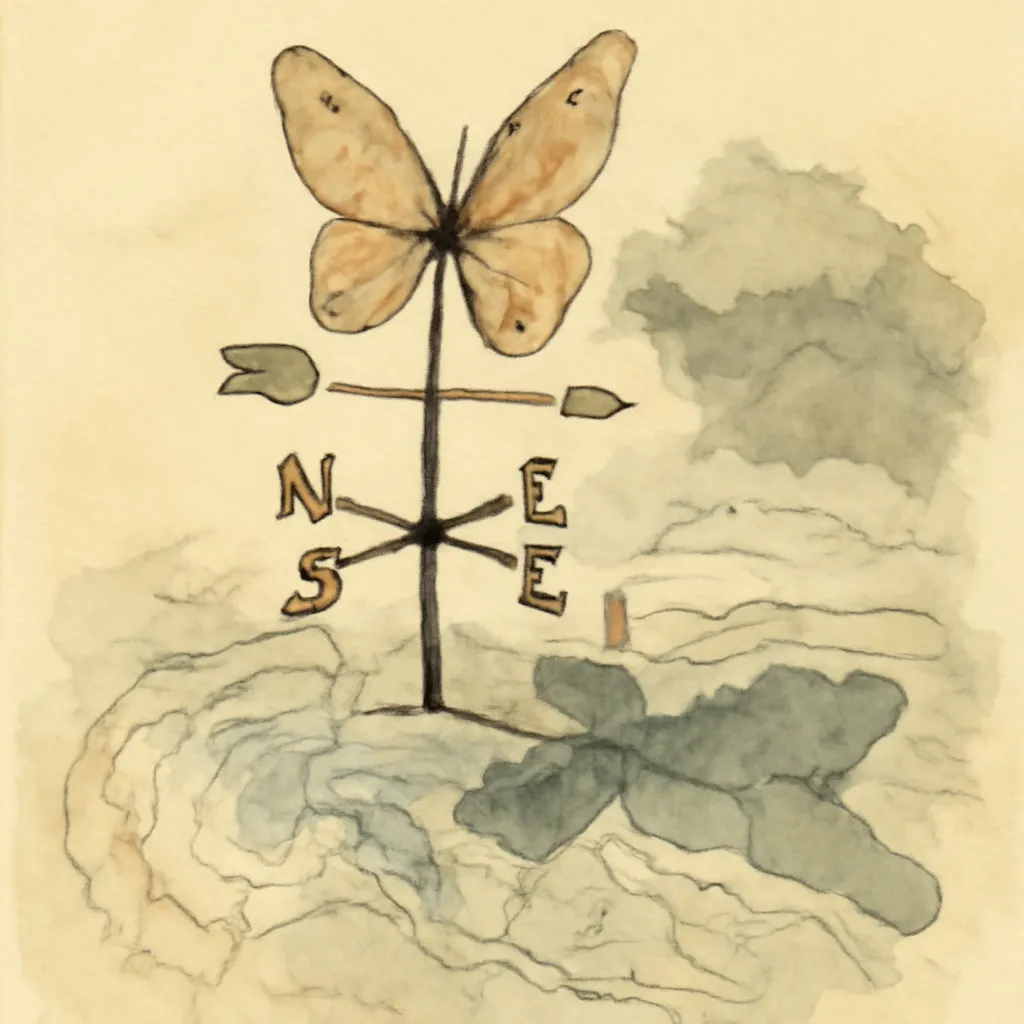
2.The Butterfly Effect
One of the most famous insights from chaos theory is the Butterfly Effect: the idea that tiny, seemingly insignificant variations can have massive, unpredictable impacts on complex systems. Gleick explains how Lorenz’s weather models revealed this sensitivity, challenging the hope for perfect prediction and highlighting the limits of scientific control.
3.Nonlinearity and Unpredictability
Unlike linear systems, where cause and effect are proportionate, nonlinear systems can amplify small causes into large effects. Gleick makes clear that most natural systems are nonlinear, and their behavior can be counterintuitive. This realization forced scientists to develop new mathematical tools and abandon the illusion of simple, clockwork predictability.
4.Fractals and Self-Similarity
Benoit Mandelbrot’s work on fractals revealed that many chaotic systems display self-similarity—patterns that repeat at different scales. Gleick shows how fractals provide a language for describing the complexity of coastlines, clouds, and even financial data, bridging the gap between order and disorder in nature.
5.Strange Attractors and Order in Chaos
Chaos is not pure randomness; it often contains hidden order in the form of ‘strange attractors’—geometric structures that describe the long-term behavior of chaotic systems. Gleick explains how these attractors help scientists understand why chaotic systems can be both unpredictable and bounded, revealing a new kind of order within apparent disorder.
6.Interdisciplinary Impact
Gleick emphasizes how chaos theory broke down barriers between disciplines. Insights from meteorology, biology, physics, and mathematics converged, leading to new collaborations and a broader understanding of complex systems. This interdisciplinary approach has influenced fields as diverse as ecology, economics, and even philosophy.