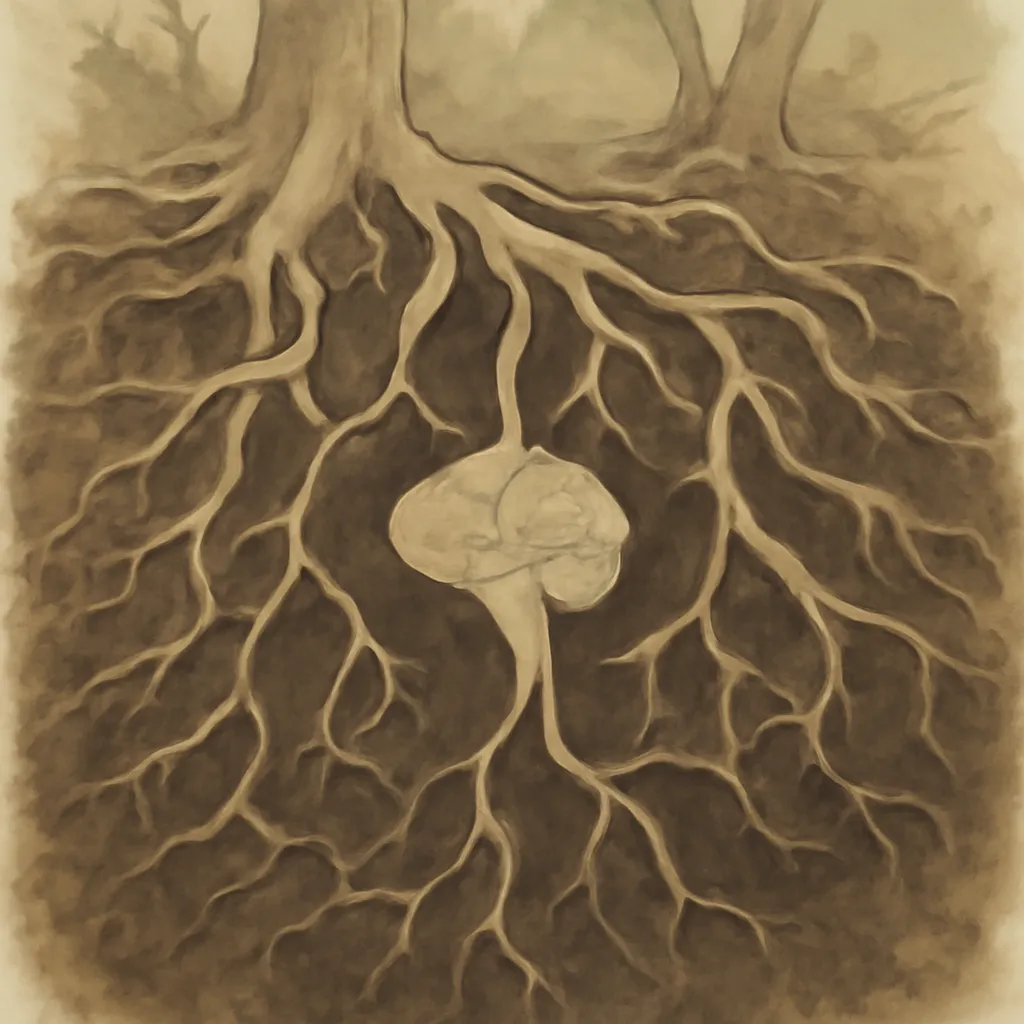
1.Emotion as the Root of Consciousness
Solms argues that consciousness emerges primarily from our feelings, not our thoughts. Unlike traditional views that place higher cognitive functions at the center, he draws on neuroscience and clinical cases to show that the core of consciousness lies in affect—our basic, bodily feelings. These primal emotions, generated deep within the brainstem, are what make subjective experience possible. This reframing has profound implications for understanding mental life, mental illness, and even artificial intelligence.
2.The Brainstem, Not the Cortex, is Central
Contrary to the popular belief that the cortex is the seat of consciousness, Solms presents evidence that the brainstem—an ancient, evolutionarily conserved structure—is crucial. Patients with severe cortical damage can still display signs of consciousness if their brainstem is intact, while damage to the brainstem abolishes consciousness entirely. This challenges the 'higher brain equals higher mind' assumption and redirects the search for consciousness’s origins to the neural machinery governing basic needs and emotions.
3.The Predictive Brain and Free Energy Principle
Solms incorporates the 'predictive processing' model, suggesting the brain is fundamentally a prediction machine that seeks to minimize surprise or 'free energy.' Our feelings signal how well (or poorly) we are meeting our biological needs, guiding behavior to restore equilibrium. This approach connects subjective experience to the brain’s constant drive to reduce uncertainty and maintain homeostasis, offering a unifying framework for mind and brain.
4.Subjectivity and the Importance of First-Person Data
A major theme is Solms’s insistence on valuing subjective, first-person experience as legitimate scientific data. He critiques the tendency in neuroscience to ignore or downplay the inner, felt aspect of consciousness. By integrating patient reports, psychoanalytic insights, and neurobiological evidence, Solms argues for a more holistic science of mind—one that doesn’t shy away from the mystery of subjectivity.
5.Implications for Mental Health and Artificial Intelligence
Solms’s theory has real-world consequences for psychiatry and the quest to build conscious machines. If consciousness is rooted in feeling, then mental disorders must be understood as disruptions in affective processes, not just faulty thinking. For AI, it suggests that true artificial consciousness would require machines to have something like feelings—not just information processing power.
6.Bridging Psychoanalysis and Neuroscience
Drawing on his background in both neuroscience and psychoanalysis, Solms argues that Freud’s insights about the unconscious and emotional drives are compatible with modern brain science. He positions his theory as a bridge between the subjective richness of psychoanalysis and the empirical rigor of neuroscience, offering a more complete account of the mind.