
Big ideas · from the full text
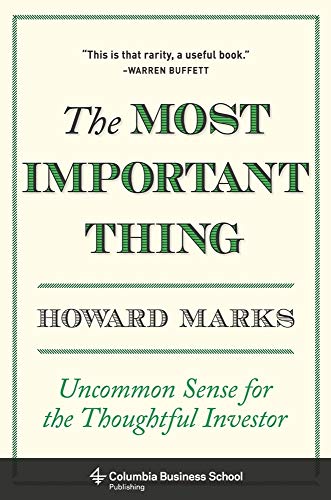
The Most Important Thing
by Howard Marks · 3 min read · Lumina’s commentary, written with AI
About this book
This book explains the keys to successful investment and the pitfalls that can destroy capital or ruin a career. Utilizing passages from his memos to illustrate his ideas, Marks teaches by example, detailing the development of an investment philosophy that fully acknowledges the complexities of investing and the perils of the financial world. Brilliantly applying insight to today's volatile markets, Marks offers a volume that is part memoir, part creed, with a number of broad takeaways.
As an Amazon Associate, Lumina earns from qualifying purchases. How this works
♫ AI-generated voice · press play below to listen and read along; tap any passage to jump to it
A good asset can be a bad purchase

In The Most Important Thing, Howard Marks separates an asset’s quality from the price you pay. A respected company or security can still be a poor investment if its price already assumes too much optimism. That is why the book starts with an estimate of value and then asks whether today’s price leaves room for error—some protection if you turn out to be wrong.
Why it matters
This keeps investors from confusing popularity, growth, or reputation with a sensible buying price.
An example
The Nifty Fifty show that admired growth companies could still hurt buyers when prices became too high.
Keep in mind
Value estimates can be wrong, and a cheap-looking asset can stay cheap for longer than an investor can endure.
Risk can rise when confidence rises

In The Most Important Thing, Howard Marks defines risk as the chance of permanent loss, not day-to-day volatility. When investors feel safe, they may push prices up, accept thinner protections, and settle for lower future returns. That can make the situation riskier even while it feels calm. The book also notes that higher risk does not guarantee higher return; it just widens possible outcomes.
Why it matters
The idea warns readers to look for danger when calm markets make risk seem absent.
An example
Before 2007, easy credit, weaker lending terms, and more leverage pointed to rising danger without showing the exact crisis path.
Keep in mind
The book does not claim that investors can know the exact moment when risk will become loss.
Contrarian thinking needs a reason

In The Most Important Thing, Howard Marks values skepticism but rejects contrarianism as a reflex. Disagreeing with the market is not enough; to beat a widely held view, an investor needs a clear reason the crowd is wrong. The book also emphasizes patience, because the crowd can appear right for a while. Being alone is different from being correct or wise.
Why it matters
This turns contrarian investing into disciplined analysis rather than a habit of opposing everyone.
An example
Neglected, controversial, or distressed investments may offer bargains, but only after their specific risks are examined.
Keep in mind
Unpopular investments are not automatically attractive; some are avoided because the risks are real.
Cycles test discipline

In The Most Important Thing, Howard Marks links market cycles to emotion. Rising prices and easy credit can make people careless; losses can swing them into fear and reluctance to buy. The book says these swings often reverse, but their timing and size can’t be known precisely. That uncertainty is why discipline is hard: it can feel wrong exactly when it is most demanded by the environment.
Why it matters
It explains why investors need memory, patience, and support before markets become extreme.
An example
The technology bubble joined real innovation with return expectations that prices could not support.
Keep in mind
The summary supports the cycle pattern, but not a tool for calling exact tops or bottoms.
Survival is part of performance

In The Most Important Thing, Howard Marks emphasizes defense because investors must stay able to act after markets fall. The book highlights low purchase prices, limited leverage, diversification, stable funding, and spare capital as ways to reduce forced selling. The goal is not to avoid every loss. It is to lose less in hard times and still be positioned to buy when bargains appear.
Why it matters
An investor who survives stress can use chances that forced sellers cannot use.
An example
Leveraged loan selling in 2008 created unusually attractive prices for prepared investors with capital and stability.
Keep in mind
Defense has a cost; too much caution can also cause investors to miss good opportunities.
Liked the ideas? Read The Most Important Thing in full.
The big ideas are free on Lumina. The complete book is available from:
As an Amazon Associate, Lumina earns from qualifying purchases. How this works