
Soziale Evolution · Evolution · Évolution sociale
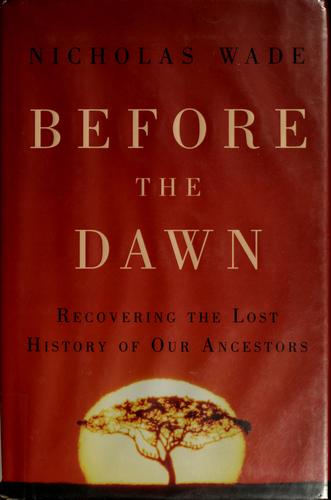
Before the Dawn by Nicholas Wade — Summary, Key Ideas & Quotes
2006313 pages✦ 3-min Big ideas★ 4.0 (5)
Rate it
Nicholas Wade's articles are a major reason why the science section has become the most popular, nationwide, in the New York Times. In his groundbreaking Before the Dawn, Wade reveals humanity's origins as never before—a journey made possible only recently by genetic science, whose incredible findings have answered such questions as: What was the first human language like? How large were the first societies, and how warlike were they? When did our ancestors first leave Africa, and by what route did they leave? By eloquently solving these and numerous other mysteries, Wade offers nothing less than a uniquely complete retelling of a story that began 500 centuries ago.
Wade argues that the sequencing of the human genome has revolutionized our ability to reconstruct prehistory. Unlike traditional archaeology, which relies on artifacts and fossils, genetics can reveal migrations, population splits, and interbreeding events invisible to other disciplines. By analyzing genetic markers, scientists can estimate when groups diverged, track ancient migrations, and even infer aspects of early human behavior. This new genetic evidence often challenges or enriches established narratives, offering a more nuanced picture of our origins.
A central theme is the journey of modern humans out of Africa roughly 50,000 years ago. Wade details the genetic evidence supporting a single exodus, followed by the rapid spread of Homo sapiens across the globe. He discusses how genetic diversity decreases with distance from Africa, supporting the idea of a founder effect as small groups branched off and settled new lands. This migration shaped not only our physical traits but also the genetic basis for cultural and behavioral differences among populations.