What is Compilers: Principles, Techniques, and Tools about?
This book covers topics related to the functionality and design of compilers, including:
- Compiler structure
- Lexical analysis (including regular expressions and finite automata)
- Syntax analysis (including context-free grammars, LL parsers, bottom-up parsers, and LR parsers)
- Syntax-directed translation
- Type checking (including type conversions and polymorphism)
- Run-time environment (including parameter passing, symbol tables, and storage allocation)
- Code generation (including intermediate code generation)
- Code optimization
A glimpse inside
The Compiler as a Multi-Stage Translator
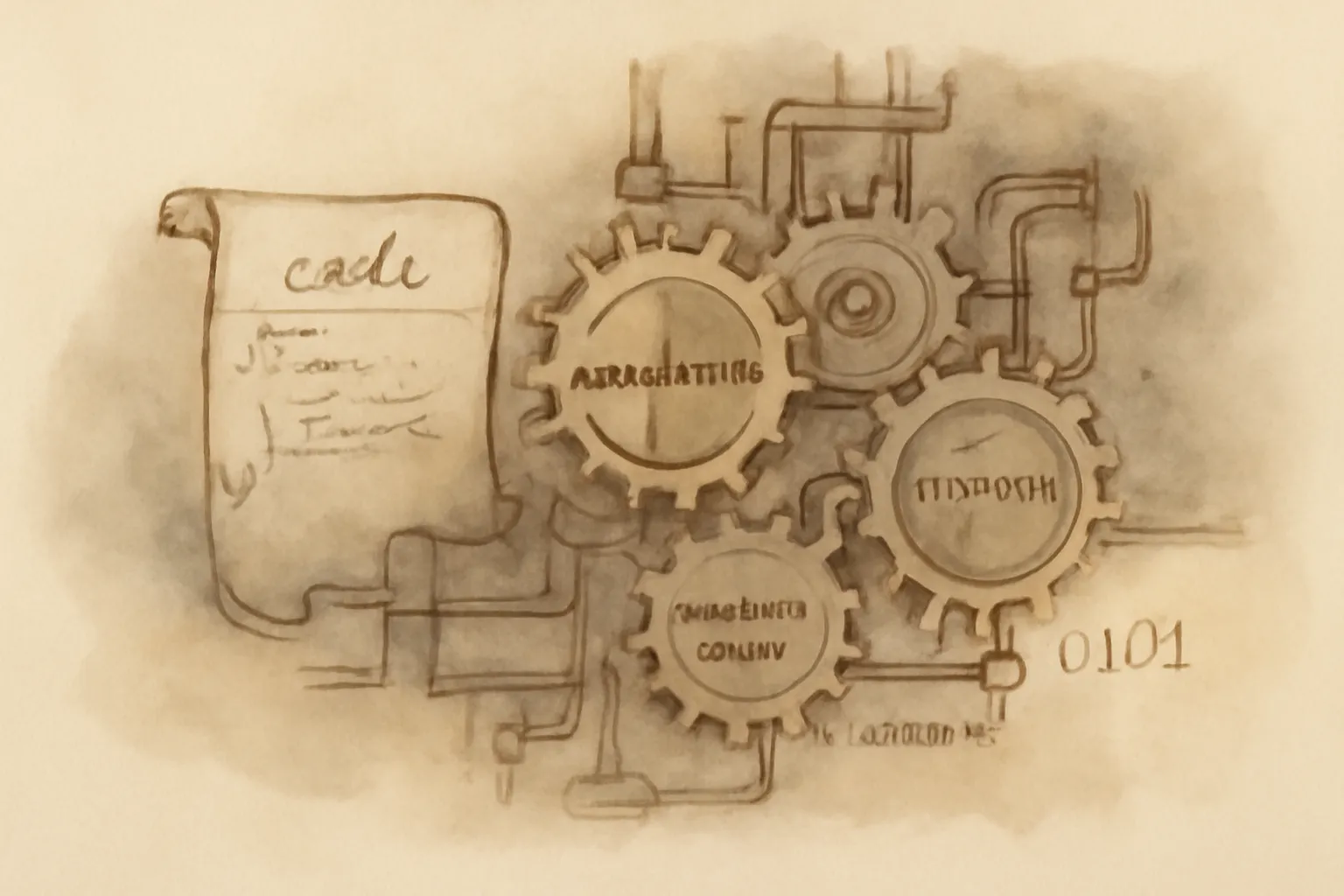
The book frames the compiler as a pipeline of distinct, interdependent stages—lexical analysis, syntax analysis, semantic analysis, optimization, and code generation. Each stage transforms the program closer to executable code, with clear interfaces and responsibilities. Understanding this modular structure is crucial for both building compilers and appreciating how programming languages are implemented. The book’s approach encourages readers to see compilers not as monolithic black boxes but as orchestrated systems where each part can be studied, improved, or replaced.
Lexical and Syntax Analysis: From Text to Structure
Aho et al. rigorously explain how raw program text is converted into structured data. Lexical analysis uses regular expressions and finite automata to break input into tokens, while syntax analysis applies context-free grammars and parsing algorithms (like LL and LR parsers) to build parse trees. These foundational techniques not only power compilers but are also widely applicable in text processing, interpreters, and language design.
Popular quotes from Compilers: Principles, Techniques, and Tools
“A compiler is a program that reads a program written in one language—the source language—and translates it into an equivalent program in another language—the target language.”
Frequently asked
This book covers topics related to the functionality and design of compilers, including:
- Compiler structure
- Lexical analysis (including regular expressions and finite automata)
- Syntax analysis (including context-free grammars, LL parsers, bottom-up parsers, and LR parsers)
- Syntax-directed translation
- Type checking (including type conversions and polymorphism)
- Run-time environme