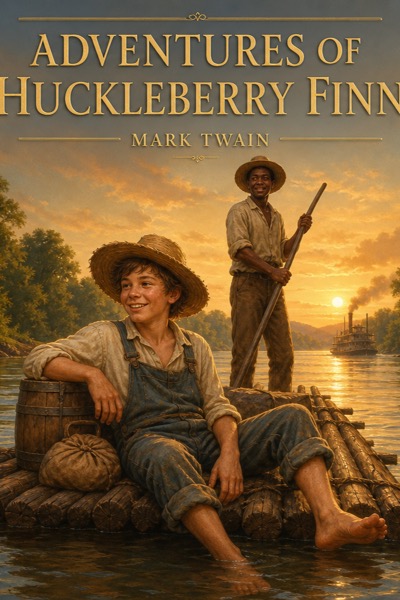

The Adventures of Huckleberry Finn is a profound exploration of freedom, morality, and friendship against the backdrop of a racially divided America
Read full overviewShow less›
Mark Twain's 'The Adventures of Huckleberry Finn' follows the journey of a young boy, Huck, as he flees from his abusive father and the constraints of society. Set in the pre-Civil War South, the novel is a rich tapestry of adventure, humor, and social commentary. Through Huck's eyes, readers encounter the complexities of race, identity, and morality as he travels down the Mississippi River with a runaway slave named Jim. This book challenges the reader to reflect on the values of friendship and freedom while revealing the deep-seated prejudices of the time. It is not just a story about a boy and his raft; it is a journey into the heart of what it means to be human.
Mark Twain's 'The Adventures of Huckleberry Finn' is a rich and complex narrative that delves into the themes of freedom, friendship, and morality. Through Huck's journey down the Mississippi River, readers are invited to confront their own beliefs about race and society. The novel's enduring legacy lies in its ability to provoke thought and discussion about the moral choices we face in our own lives. As Huck grapples with his conscience and the societal norms of his time, he ultimately emerges as a symbol of personal integrity and growth. Twain's masterful storytelling not only entertains but also challenges readers to reflect on their values and the world around them.

Ratings at a glance
- 1The Quest for Freedom
- 2Friendship Across Boundaries
- 3The Satire of Society
- 4The Complexity of Morality
- 5The Role of Nature
A glimpse inside

Huck Finn's journey is fundamentally about the quest for freedom. At the outset, Huck is trapped in a life he finds stifling, dominated by the Widow Douglas's attempts to… Read moreHuck Finn's journey is fundamentally about the quest for freedom. At the outset, Huck is trapped in a life he finds stifling, dominated by the Widow Douglas's attempts to 'sivilize' him. His desire to escape is not just a physical one; it symbolizes a deeper yearning to break free from societal norms and expectations. As he travels down the Mississippi River, Huck's bond with Jim, a runaway slave, becomes a powerful representation of freedom. Their adventures highlight the stark contrasts between the constraints of civilization and the liberating nature of life on the river. Huck's internal conflict regarding his friendship with Jim and the societal belief that he should turn Jim in illustrates the moral dilemmas faced by individuals seeking true freedom. Show less
The relationship between Huck and Jim serves as the emotional core of the novel. Initially, Huck views Jim as merely a slave, a social construct that he has been taught t… Read moreThe relationship between Huck and Jim serves as the emotional core of the novel. Initially, Huck views Jim as merely a slave, a social construct that he has been taught to accept. However, as they face various challenges together, Huck begins to see Jim as a friend and an equal. This evolution is crucial in understanding the themes of loyalty and friendship that transcend societal boundaries. For instance, when Huck grapples with the decision to help Jim escape, he ultimately chooses loyalty to his friend over the prejudices instilled in him by society. This pivotal moment reflects Twain's critique of the racial attitudes of the time and emphasizes the importance of personal relationships in shaping one's moral compass. Show less
Read the full text — free
About the author
Mark Twain has 10 works free to read on Lumina, including A Connecticut Yankee in King Arthur’s Court, Following the Equator: A Journey Around the World, Life on the Mississippi