
Politics and government · Political culture · Social conditions
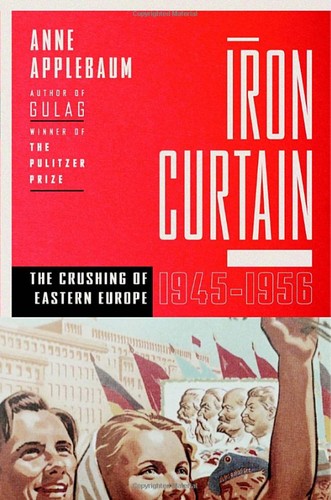
Iron Curtain: The Crushing of Eastern Europe, 1944–1956 by Anne Applebaum — Summary, Key Ideas & Quotes
2012627 pages✦ 3-min Big ideas★ 4.0 (2)
Rate it
In the follow-up to her previous book "Gulag," the author, a journalist delivers a history of how Communism took over Eastern Europe after World War II and transformed in frightening fashion the individuals who came under its sway. At the end of World War II, the Soviet Union, to its surprise and delight, found itself in control of a huge swath of territory in Eastern Europe. Josef Stalin and his secret police set out to convert a dozen radically different countries to Communism, a completely new political and moral system. In this book, the author describes how the Communist regimes of Eastern Europe were created and what daily life was like once they were complete. She draws on newly opened East European archives, interviews, and personal accounts translated for the first time to portray in detail the dilemmas faced by millions of individuals trying to adjust to a way of life that challenged their every belief and took away everything they had accumulated. Today the Soviet Bloc is a lost civilization, one whose cruelty, paranoia, bizarre morality, and strange aesthetics is captured in the pages of this book.
Applebaum meticulously details the step-by-step process by which the Soviet Union established control over Eastern European countries. This was not a sudden, monolithic imposition, but a calculated, multi-pronged campaign involving propaganda, manipulation of local institutions, infiltration of security services, and the systematic elimination of opposition. The book demonstrates how the Soviets adapted their tactics to local conditions, exploiting postwar chaos and uncertainty to gradually close off alternatives to communist rule.
One of the book’s central themes is the deliberate destruction of civil society—churches, youth groups, charities, and independent organizations—that might have offered alternative sources of identity or resistance. Applebaum shows how the communist regimes sought not just to control politics, but to reshape society from the ground up, making individuals dependent on the state and suspicious of each other. This atomization was key to maintaining power.
