Les Misérables · Victor Hugo
CHAPTER IV—GAVROCHE’S EXCESS OF ZEAL
Chapter 293 of 359 · 18 min read
In the meantime, Gavroche had had an adventure.
Gavroche, after having conscientiously stoned the lantern in the Rue du Chaume, entered the Rue des Vieilles-Haudriettes, and not seeing “even a cat” there, he thought the opportunity a good one to strike up all the song of which he was capable. His march, far from being retarded by his singing, was accelerated by it. He began to sow along the sleeping or terrified houses these incendiary couplets:—
“L’oiseau médit dans les charmilles, Et prétend qu’hier Atala Avec un Russe s’en alla. Où vont les belles filles, Lon la.
“Mon ami Pierrot, tu babilles, Parce que l’autre jour Mila Cogna sa vitre et m’appela, Où vont les belles filles, Lon la.
“Les drôlesses sont fort gentilles, Leur poison qui m’ensorcela Griserait Monsieur Orfila. Où vont les belles filles, Lon la.
“J’aime l’amour et les bisbilles, J’aime Agnès, j’aime Paméla, Lise en m’allumant se brûla. Où vont les belles filles, Lon la.
“Jadis, quand je vis les mantilles De Suzette et de Zéila, Mon âme à leurs plis se mêla, Où vont les belles filles, Lon la.
“Amour, quand dans l’ombre où tu brilles, Tu coiffes de roses Lola, Je me damnerais pour cela. Où vont les belles filles, Lon la.
“Jeanne à ton miroir tu t’habilles! Mon cœur un beau jour s’envola. Je crois que c’est Jeanne qui l’a. Où vont les belles filles, Lon la.
“Le soir, en sortant des quadrilles, Je montre aux étoiles Stella, Et je leur dis: ‘Regardez-la.’ Où vont les belles filles, Lon la.”56
Gavroche, as he sang, was lavish of his pantomime. Gesture is the strong point of the refrain. His face, an inexhaustible repertory of masks, produced grimaces more convulsing and more fantastic than the rents of a cloth torn in a high gale. Unfortunately, as he was alone, and as it was night, this was neither seen nor even visible. Such wastes of riches do occur.
All at once, he stopped short.
“Let us interrupt the romance,” said he.
His feline eye had just descried, in the recess of a carriage door, what is called in painting, an ensemble, that is to say, a person and a thing; the thing was a hand-cart, the person was a man from Auvergene who was sleeping therein.
The shafts of the cart rested on the pavement, and the Auvergnat’s head was supported against the front of the cart. His body was coiled up on this inclined plane and his feet touched the ground.
Gavroche, with his experience of the things of this world, recognized a drunken man. He was some corner errand-man who had drunk too much and was sleeping too much.
“There now,” thought Gavroche, “that’s what the summer nights are good for. We’ll take the cart for the Republic, and leave the Auvergnat for the Monarchy.”
His mind had just been illuminated by this flash of light:—
“How bully that cart would look on our barricade!”
The Auvergnat was snoring.
Gavroche gently tugged at the cart from behind, and at the Auvergnat from the front, that is to say, by the feet, and at the expiration of another minute the imperturbable Auvergnat was reposing flat on the pavement.
The cart was free.
Gavroche, habituated to facing the unexpected in all quarters, had everything about him. He fumbled in one of his pockets, and pulled from it a scrap of paper and a bit of red pencil filched from some carpenter.
He wrote:—
“French Republic.”
“Received thy cart.”
And he signed it: “GAVROCHE.”
That done, he put the paper in the pocket of the still snoring Auvergnat’s velvet vest, seized the cart shafts in both hands, and set off in the direction of the Halles, pushing the cart before him at a hard gallop with a glorious and triumphant uproar.
This was perilous. There was a post at the Royal Printing Establishment. Gavroche did not think of this. This post was occupied by the National Guards of the suburbs. The squad began to wake up, and heads were raised from camp beds. Two street lanterns broken in succession, that ditty sung at the top of the lungs. This was a great deal for those cowardly streets, which desire to go to sleep at sunset, and which put the extinguisher on their candles at such an early hour. For the last hour, that boy had been creating an uproar in that peaceable arrondissement, the uproar of a fly in a bottle. The sergeant of the banlieue lent an ear. He waited. He was a prudent man.
The mad rattle of the cart, filled to overflowing the possible measure of waiting, and decided the sergeant to make a reconnaisance.
“There’s a whole band of them there!” said he, “let us proceed gently.”
It was clear that the hydra of anarchy had emerged from its box and that it was stalking abroad through the quarter.
And the sergeant ventured out of the post with cautious tread.
All at once, Gavroche, pushing his cart in front of him, and at the very moment when he was about to turn into the Rue des Vieilles-Haudriettes, found himself face to face with a uniform, a shako, a plume, and a gun.
For the second time, he stopped short.
“Hullo,” said he, “it’s him. Good day, public order.”
Gavroche’s amazement was always brief and speedily thawed.
“Where are you going, you rascal?” shouted the sergeant.
“Citizen,” retorted Gavroche, “I haven’t called you ‘bourgeois’ yet. Why do you insult me?”
“Where are you going, you rogue?”
“Monsieur,” retorted Gavroche, “perhaps you were a man of wit yesterday, but you have degenerated this morning.”
“I ask you where are you going, you villain?”
Gavroche replied:—
“You speak prettily. Really, no one would suppose you as old as you are. You ought to sell all your hair at a hundred francs apiece. That would yield you five hundred francs.”
“Where are you going? Where are you going? Where are you going, bandit?”
Gavroche retorted again:—
“What villainous words! You must wipe your mouth better the first time that they give you suck.”
The sergeant lowered his bayonet.
“Will you tell me where you are going, you wretch?”
“General,” said Gavroche “I’m on my way to look for a doctor for my wife who is in labor.”
“To arms!” shouted the sergeant.
The master-stroke of strong men consists in saving themselves by the very means that have ruined them; Gavroche took in the whole situation at a glance. It was the cart which had told against him, it was the cart’s place to protect him.
At the moment when the sergeant was on the point of making his descent on Gavroche, the cart, converted into a projectile and launched with all the latter’s might, rolled down upon him furiously, and the sergeant, struck full in the stomach, tumbled over backwards into the gutter while his gun went off in the air.
The men of the post had rushed out pell-mell at the sergeant’s shout; the shot brought on a general random discharge, after which they reloaded their weapons and began again.
This blind-man’s-buff musketry lasted for a quarter of an hour and killed several panes of glass.
In the meanwhile, Gavroche, who had retraced his steps at full speed, halted five or six streets distant and seated himself, panting, on the stone post which forms the corner of the Enfants-Rouges.
He listened.
After panting for a few minutes, he turned in the direction where the fusillade was raging, lifted his left hand to a level with his nose and thrust it forward three times, as he slapped the back of his head with his right hand; an imperious gesture in which Parisian street-urchindom has condensed French irony, and which is evidently efficacious, since it has already lasted half a century.
This gayety was troubled by one bitter reflection.
“Yes,” said he, “I’m splitting with laughter, I’m twisting with delight, I abound in joy, but I’m losing my way, I shall have to take a roundabout way. If I only reach the barricade in season!”
Thereupon he set out again on a run.
And as he ran:—
“Ah, by the way, where was I?” said he.
And he resumed his ditty, as he plunged rapidly through the streets, and this is what died away in the gloom:—
“Mais il reste encore des bastilles, Et je vais mettre le holà Dans l’ordre public que voilà. Où vont les belles filles, Lon la.
“Quelqu’un veut-il jouer aux quilles? Tout l’ancien monde s’écroula Quand la grosse boule roula. Où vont les belles filles, Lon la.
“Vieux bon peuple, à coups de béquilles, Cassons ce Louvre où s’étala La monarchie en falbala. Où vont les belles filles, Lon la.
“Nous en avons forcé les grilles, Le roi Charles-Dix ce jour-là, Tenait mal et se décolla. Où vont les belles filles, Lon la.”57
The post’s recourse to arms was not without result. The cart was conquered, the drunken man was taken prisoner. The first was put in the pound, the second was later on somewhat harassed before the councils of war as an accomplice. The public ministry of the day proved its indefatigable zeal in the defence of society, in this instance.
Gavroche’s adventure, which has lingered as a tradition in the quarters of the Temple, is one of the most terrible souvenirs of the elderly bourgeois of the Marais, and is entitled in their memories: “The nocturnal attack by the post of the Royal Printing Establishment.”
[THE END OF VOLUME IV “SAINT DENIS”]
VOLUME V JEAN VALJEAN
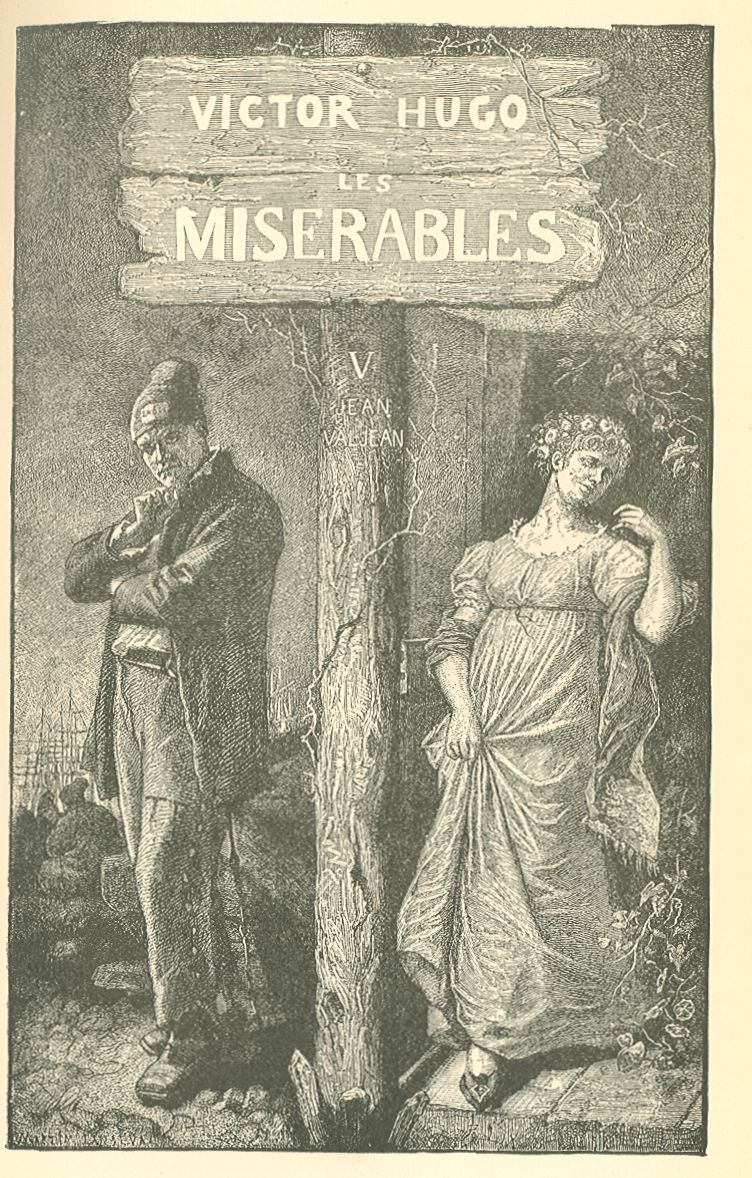
BOOK FIRST—THE WAR BETWEEN FOUR WALLS
CHAPTER I—THE CHARYBDIS OF THE FAUBOURG SAINT ANTOINE AND THE SCYLLA OF THE FAUBOURG DU TEMPLE
The two most memorable barricades which the observer of social maladies can name do not belong to the period in which the action of this work is laid. These two barricades, both of them symbols, under two different aspects, of a redoubtable situation, sprang from the earth at the time of the fatal insurrection of June, 1848, the greatest war of the streets that history has ever beheld.
It sometimes happens that, even contrary to principles, even contrary to liberty, equality, and fraternity, even contrary to the universal vote, even contrary to the government, by all for all, from the depths of its anguish, of its discouragements and its destitutions, of its fevers, of its distresses, of its miasmas, of its ignorances, of its darkness, that great and despairing body, the rabble, protests against, and that the populace wages battle against, the people.
Beggars attack the common right; the ochlocracy rises against demos.
These are melancholy days; for there is always a certain amount of night even in this madness, there is suicide in this duel, and those words which are intended to be insults—beggars, canaille, ochlocracy, populace—exhibit, alas! rather the fault of those who reign than the fault of those who suffer; rather the fault of the privileged than the fault of the disinherited.
For our own part, we never pronounce those words without pain and without respect, for when philosophy fathoms the facts to which they correspond, it often finds many a grandeur beside these miseries. Athens was an ochlocracy; the beggars were the making of Holland; the populace saved Rome more than once; and the rabble followed Jesus Christ.
There is no thinker who has not at times contemplated the magnificences of the lower classes.
It was of this rabble that Saint Jerome was thinking, no doubt, and of all these poor people and all these vagabonds and all these miserable people whence sprang the apostles and the martyrs, when he uttered this mysterious saying: “Fex urbis, lex orbis,”—the dregs of the city, the law of the earth.
The exasperations of this crowd which suffers and bleeds, its violences contrary to all sense, directed against the principles which are its life, its masterful deeds against the right, are its popular coups d’état and should be repressed. The man of probity sacrifices himself, and out of his very love for this crowd, he combats it. But how excusable he feels it even while holding out against it! How he venerates it even while resisting it! This is one of those rare moments when, while doing that which it is one’s duty to do, one feels something which disconcerts one, and which would dissuade one from proceeding further; one persists, it is necessary, but conscience, though satisfied, is sad, and the accomplishment of duty is complicated with a pain at the heart.
June, 1848, let us hasten to say, was an exceptional fact, and almost impossible of classification, in the philosophy of history. All the words which we have just uttered, must be discarded, when it becomes a question of this extraordinary revolt, in which one feels the holy anxiety of toil claiming its rights. It was necessary to combat it, and this was a duty, for it attacked the republic. But what was June, 1848, at bottom? A revolt of the people against itself.
Where the subject is not lost sight of, there is no digression; may we, then, be permitted to arrest the reader’s attention for a moment on the two absolutely unique barricades of which we have just spoken and which characterized this insurrection.
One blocked the entrance to the Faubourg Saint Antoine; the other defended the approach to the Faubourg du Temple; those before whom these two fearful masterpieces of civil war reared themselves beneath the brilliant blue sky of June, will never forget them.
The Saint-Antoine barricade was tremendous; it was three stories high, and seven hundred feet wide. It barred the vast opening of the faubourg, that is to say, three streets, from angle to angle; ravined, jagged, cut up, divided, crenelated, with an immense rent, buttressed with piles that were bastions in themselves throwing out capes here and there, powerfully backed up by two great promontories of houses of the faubourg, it reared itself like a cyclopean dike at the end of the formidable place which had seen the 14th of July. Nineteen barricades were ranged, one behind the other, in the depths of the streets behind this principal barricade. At the very sight of it, one felt the agonizing suffering in the immense faubourg, which had reached that point of extremity when a distress may become a catastrophe. Of what was that barricade made? Of the ruins of three six-story houses demolished expressly, said some. Of the prodigy of all wraths, said others. It wore the lamentable aspect of all constructions of hatred, ruin. It might be asked: Who built this? It might also be said: Who destroyed this? It was the improvisation of the ebullition. Hold! take this door! this grating! this penthouse! this chimney-piece! this broken brazier! this cracked pot! Give all! cast away all! Push this roll, dig, dismantle, overturn, ruin everything! It was the collaboration of the pavement, the block of stone, the beam, the bar of iron, the rag, the scrap, the broken pane, the unseated chair, the cabbage-stalk, the tatter, the rag, and the malediction. It was grand and it was petty. It was the abyss parodied on the public place by hubbub. The mass beside the atom; the strip of ruined wall and the broken bowl,—threatening fraternization of every sort of rubbish. Sisyphus had thrown his rock there and Job his potsherd. Terrible, in short. It was the acropolis of the barefooted. Overturned carts broke the uniformity of the slope; an immense dray was spread out there crossways, its axle pointing heavenward, and seemed a scar on that tumultuous façade; an omnibus hoisted gayly, by main force, to the very summit of the heap, as though the architects of this bit of savagery had wished to add a touch of the street urchin humor to their terror, presented its horseless, unharnessed pole to no one knows what horses of the air. This gigantic heap, the alluvium of the revolt, figured to the mind an Ossa on Pelion of all revolutions; ’93 on ’89, the 9th of Thermidor on the 10th of August, the 18th of Brumaire on the 11th of January, Vendemiaire on Prairial, 1848 on 1830. The situation deserved the trouble and this barricade was worthy to figure on the very spot whence the Bastille had disappeared. If the ocean made dikes, it is thus that it would build. The fury of the flood was stamped upon this shapeless mass. What flood? The crowd. One thought one beheld hubbub petrified. One thought one heard humming above this barricade as though there had been over their hive, enormous, dark bees of violent progress. Was it a thicket? Was it a bacchanalia? Was it a fortress? Vertigo seemed to have constructed it with blows of its wings. There was something of the cesspool in that redoubt and something Olympian in that confusion. One there beheld in a pell-mell full of despair, the rafters of roofs, bits of garret windows with their figured paper, window sashes with their glass planted there in the ruins awaiting the cannon, wrecks of chimneys, cupboards, tables, benches, howling topsyturveydom, and those thousand poverty-stricken things, the very refuse of the mendicant, which contain at the same time fury and nothingness. One would have said that it was the tatters of a people, rags of wood, of iron, of bronze, of stone, and that the Faubourg Saint Antoine had thrust it there at its door, with a colossal flourish of the broom making of its misery its barricade. Blocks resembling headsman’s blocks, dislocated chains, pieces of woodwork with brackets having the form of gibbets, horizontal wheels projecting from the rubbish, amalgamated with this edifice of anarchy the sombre figure of the old tortures endured by the people. The barricade Saint Antoine converted everything into a weapon; everything that civil war could throw at the head of society proceeded thence; it was not combat, it was a paroxysm; the carbines which defended this redoubt, among which there were some blunderbusses, sent bits of earthenware bones, coat-buttons, even the casters from night-stands, dangerous projectiles on account of the brass. This barricade was furious; it hurled to the clouds an inexpressible clamor; at certain moments, when provoking the army, it was covered with throngs and tempest; a tumultuous crowd of flaming heads crowned it; a swarm filled it; it had a thorny crest of guns, of sabres, of cudgels, of axes, of pikes and of bayonets; a vast red flag flapped in the wind; shouts of command, songs of attack, the roll of drums, the sobs of women and bursts of gloomy laughter from the starving were to be heard there. It was huge and living, and, like the back of an electric beast, there proceeded from it little flashes of lightning. The spirit of revolution covered with its cloud this summit where rumbled that voice of the people which resembles the voice of God; a strange majesty was emitted by this titanic basket of rubbish. It was a heap of filth and it was Sinai.
As we have said previously, it attacked in the name of the revolution—what? The revolution. It—that barricade, chance, hazard, disorder, terror, misunderstanding, the unknown—had facing it the Constituent Assembly, the sovereignty of the people, universal suffrage, the nation, the republic; and it was the Carmagnole bidding defiance to the Marseillaise.
Immense but heroic defiance, for the old faubourg is a hero.
The faubourg and its redoubt lent each other assistance. The faubourg shouldered the redoubt, the redoubt took its stand under cover of the faubourg. The vast barricade spread out like a cliff against which the strategy of the African generals dashed itself. Its caverns, its excrescences, its warts, its gibbosities, grimaced, so to speak, and grinned beneath the smoke. The mitraille vanished in shapelessness; the bombs plunged into it; bullets only succeeded in making holes in it; what was the use of cannonading chaos? and the regiments, accustomed to the fiercest visions of war, gazed with uneasy eyes on that species of redoubt, a wild beast in its boar-like bristling and a mountain by its enormous size.
A quarter of a league away, from the corner of the Rue du Temple which debouches on the boulevard near the Château-d’Eau, if one thrust one’s head bodily beyond the point formed by the front of the Dallemagne shop, one perceived in the distance, beyond the canal, in the street which mounts the slopes of Belleville at the culminating point of the rise, a strange wall reaching to the second story of the house fronts, a sort of hyphen between the houses on the right and the houses on the left, as though the street had folded back on itself its loftiest wall in order to close itself abruptly. This wall was built of paving-stones. It was straight, correct, cold, perpendicular, levelled with the square, laid out by rule and line. Cement was lacking, of course, but, as in the case of certain Roman walls, without interfering with its rigid architecture. The entablature was mathematically parallel with the base. From distance to distance, one could distinguish on the gray surface, almost invisible loopholes which resembled black threads. These loopholes were separated from each other by equal spaces. The street was deserted as far as the eye could reach. All windows and doors were closed. In the background rose this barrier, which made a blind thoroughfare of the street, a motionless and tranquil wall; no one was visible, nothing was audible; not a cry, not a sound, not a breath. A sepulchre.
The dazzling sun of June inundated this terrible thing with light.
It was the barricade of the Faubourg of the Temple.
As soon as one arrived on the spot, and caught sight of it, it was impossible, even for the boldest, not to become thoughtful before this mysterious apparition. It was adjusted, jointed, imbricated, rectilinear, symmetrical and funereal. Science and gloom met there. One felt that the chief of this barricade was a geometrician or a spectre. One looked at it and spoke low.
From time to time, if some soldier, an officer or representative of the people, chanced to traverse the deserted highway, a faint, sharp whistle was heard, and the passer-by fell dead or wounded, or, if he escaped the bullet, sometimes a biscaïen was seen to ensconce itself in some closed shutter, in the interstice between two blocks of stone, or in the plaster of a wall. For the men in the barricade had made themselves two small cannons out of two cast-iron lengths of gas-pipe, plugged up at one end with tow and fire-clay. There was no waste of useless powder. Nearly every shot told. There were corpses here and there, and pools of blood on the pavement. I remember a white butterfly which went and came in the street. Summer does not abdicate.
In the neighborhood, the spaces beneath the portes-cochères were encumbered with wounded.
One felt oneself aimed at by some person whom one did not see, and one understood that guns were levelled at the whole length of the street.
Massed behind the sort of sloping ridge which the vaulted canal forms at the entrance to the Faubourg du Temple, the soldiers of the attacking column, gravely and thoughtfully, watched this dismal redoubt, this immobility, this passivity, whence sprang death. Some crawled flat on their faces as far as the crest of the curve of the bridge, taking care that their shakos did not project beyond it.
The valiant Colonel Monteynard admired this barricade with a shudder.—“How that is built!” he said to a Representative. “Not one paving-stone projects beyond its neighbor. It is made of porcelain.”—At that moment, a bullet broke the cross on his breast, and he fell.
“The cowards!” people said. “Let them show themselves. Let us see them! They dare not! They are hiding!”
The barricade of the Faubourg du Temple, defended by eighty men, attacked by ten thousand, held out for three days. On the fourth, they did as at Zaatcha, as at Constantine, they pierced the houses, they came over the roofs, the barricade was taken. Not one of the eighty cowards thought of flight, all were killed there with the exception of the leader, Barthélemy, of whom we shall speak presently.
The Saint-Antoine barricade was the tumult of thunders; the barricade of the Temple was silence. The difference between these two redoubts was the difference between the formidable and the sinister. One seemed a maw; the other a mask.
Admitting that the gigantic and gloomy insurrection of June was composed of a wrath and of an enigma, one divined in the first barricade the dragon, and behind the second the sphinx.
These two fortresses had been erected by two men named, the one, Cournet, the other, Barthélemy. Cournet made the Saint-Antoine barricade; Barthélemy the barricade of the Temple. Each was the image of the man who had built it.
Cournet was a man of lofty stature; he had broad shoulders, a red face, a crushing fist, a bold heart, a loyal soul, a sincere and terrible eye. Intrepid, energetic, irascible, stormy; the most cordial of men, the most formidable of combatants. War, strife, conflict, were the very air he breathed and put him in a good humor. He had been an officer in the navy, and, from his gestures and his voice, one divined that he sprang from the ocean, and that he came from the tempest; he carried the hurricane on into battle. With the exception of the genius, there was in Cournet something of Danton, as, with the exception of the divinity, there was in Danton something of Hercules.
Barthélemy, thin, feeble, pale, taciturn, was a sort of tragic street urchin, who, having had his ears boxed by a policeman, lay in wait for him, and killed him, and at seventeen was sent to the galleys. He came out and made this barricade.
Later on, fatal circumstance, in London, proscribed by all, Barthélemy slew Cournet. It was a funereal duel. Some time afterwards, caught in the gearing of one of those mysterious adventures in which passion plays a part, a catastrophe in which French justice sees extenuating circumstances, and in which English justice sees only death, Barthélemy was hanged. The sombre social construction is so made that, thanks to material destitution, thanks to moral obscurity, that unhappy being who possessed an intelligence, certainly firm, possibly great, began in France with the galleys, and ended in England with the gallows. Barthélemy, on occasion, flew but one flag, the black flag.