
Translations into English · English fiction · Polish Science fiction
Solaris by Stanislaw Lem — Summary, Key Ideas & Quotes
1961229 pages✦ 3-min Big ideas★ 3.9 (28)
Rate it
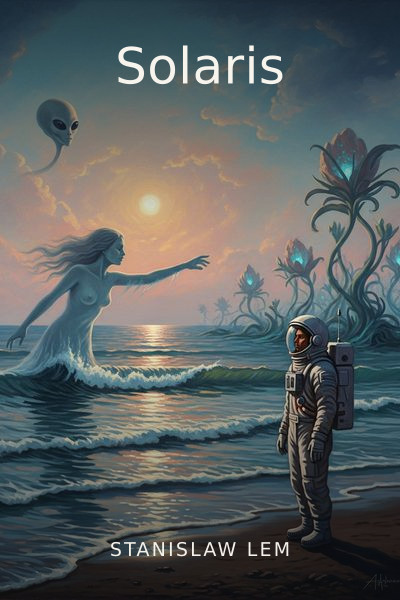
The cult-classic by Stanislaw Lem that spawned the movie is now available for your Kindle! Until now the only English edition was a 1970 version, which was translated from French and which Lem himself described as a "poor translation." This wonderful new English translation (by Bill Johnston) of Lem's classic Solaris is a must-have for fans of Lem's classic novel. Telling of humanity's encounter with an alien intelligence on the planet Solaris, the 1961 novel is a cult classic, exploring the ultimate futility of attempting to communicate with extra-terrestrial life. When Kris Kelvin arrives at the planet Solaris to study the ocean that covers its surface, he finds a painful, hitherto unconscious memory embodied in the living physical likeness of a long-dead lover. Others examining the planet, Kelvin learns, are plagued with their own repressed and newly corporeal memories. The Solaris ocean may be a massive brain that creates these incarnate memories, though its purpose in doing so is unknown, forcing the scientists to shift the focus of their quest and wonder if they can truly understand the universe without first understanding what lies within their hearts.

At the heart of Solaris is the idea that some forms of intelligence may be so fundamentally different from our own that genuine communication is impossible. The sentient ocean of Solaris does not respond to human attempts at contact in any recognizable way; instead, it creates physical manifestations from the scientists’ subconscious minds. This challenges the assumption that the universe is ultimately knowable and that human logic or language can bridge every gap. Lem uses this premise to question the anthropocentric bias of science fiction and to suggest that the truly alien may remain forever beyond our grasp.
The scientists on Solaris station are trained to observe, measure, and explain, yet they are utterly confounded by the planet’s phenomena. Their theories about the ocean’s motives and mechanisms continually fall short, exposing the limits of empirical inquiry when faced with something that defies categorization. Lem critiques the overconfidence of scientific rationalism, suggesting that some mysteries resist reduction to data or theory, and that humility is essential when confronting the unknown.