Philosophy · Juvenile literature · Philosophy, juvenile literature
The Philosophy Files by Stephen Law — Summary, Key Ideas & Quotes
2000224 pages✦ 3-min Big ideas
Rate it
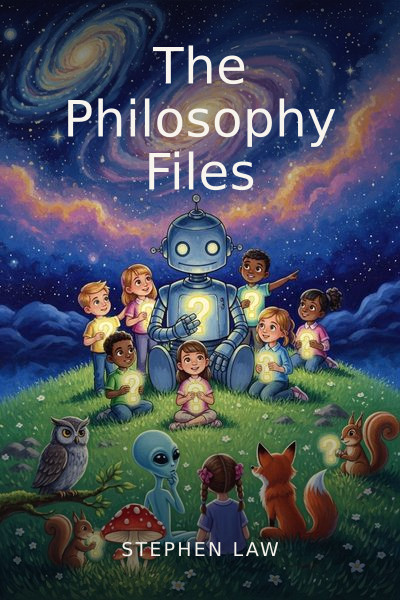
Is there a God? Should I eat meat? Where does the universe come from? Could I live forever as a robot? These are the questions readers will wrestle with in this book. Dipping into any chapter, children will find lively scenarios and dialogues which take them through philosophical puzzles ancient and modern, involving virtual reality, cloning, science fiction and a host of characters from this and other planets. The text is interspersed on every page with lively cartoons, and there is a useful list of philosophical jargon at the end.
Law demonstrates that philosophy isn't just an academic pursuit but a way of thinking about everyday issues. By presenting dilemmas about God, ethics, and reality in familiar or imaginative settings, he shows that anyone can engage philosophically. The book encourages readers to question assumptions, spot contradictions, and see the hidden logic (or illogic) in what we take for granted. This approach demystifies philosophy and frames it as a toolkit for clearer, more independent thinking.
Central to the book are vivid thought experiments—stories and scenarios that help readers test their intuitions. From the classic 'brain in a vat' to futuristic ideas about cloning and robots, Law uses these mental exercises to show how our beliefs can be challenged or clarified. These experiments are not just abstract puzzles; they reveal how philosophical questioning underpins debates in science, technology, and personal identity.