
The deep dive
The Silk Roads
by Peter Frankopan
18 min read · Original commentary by Lumina, written with AI
- Topic: History
What changes when Europe stops being the default centre of world history? Peter Frankopan follows the connections across Eurasia to challenge familiar accounts of wealth, belief and power. The result invites a harder question: not simply whether societies connect, but who controls those connections and who pays for them.
Prefer the quick version? Read the main learnings →♫ AI-generated voice · press play below to listen and read along; tap any passage to jump to it
01
A different place to stand
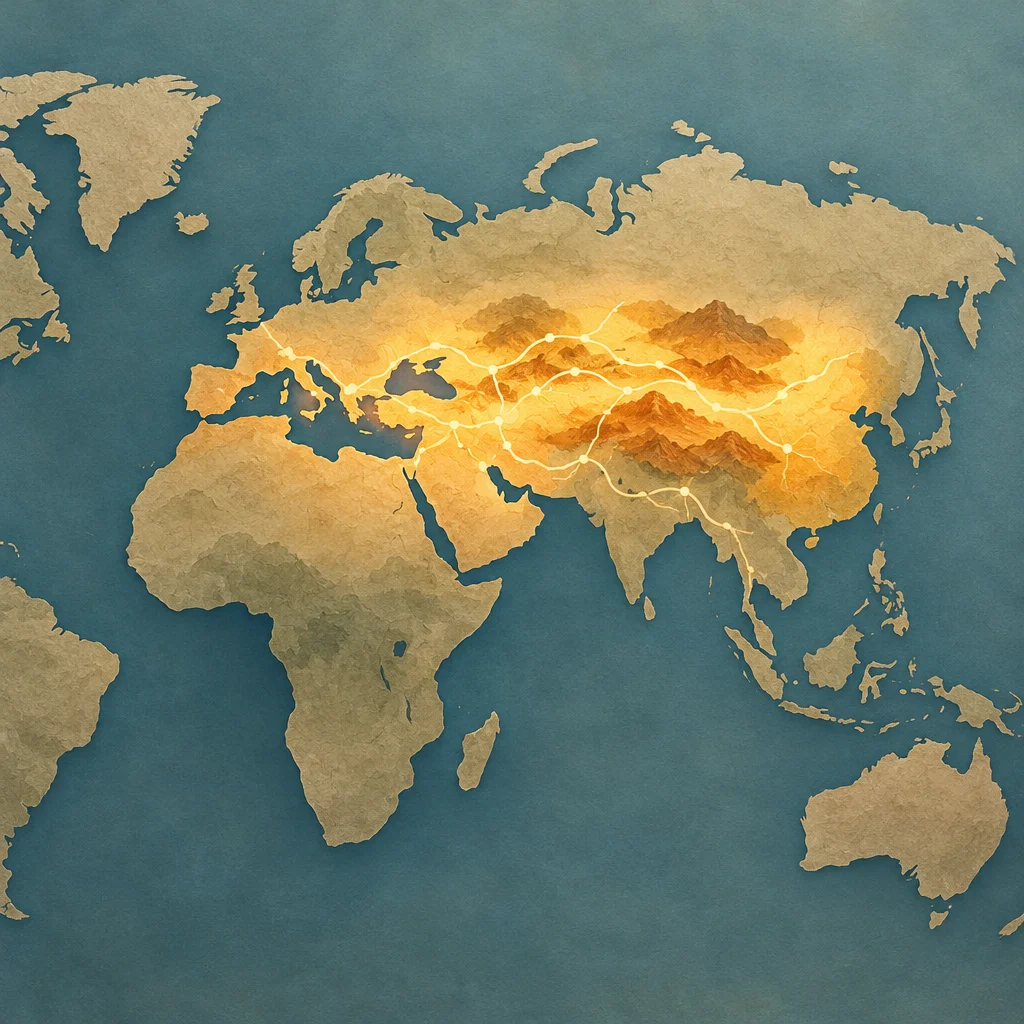
The Silk Roads is a wide-ranging work of nonfiction, moving from ancient empires to modern struggles over resources and influence. Its organising subject is not one road. It is the shifting web of routes linking the Mediterranean with Persia, Central Asia, India and China, and eventually with a wider global economy.
Frankopan asks readers to change their starting point. Instead of treating these lands as the background to Europe’s development, he presents them as major centres of demand, learning, religious life and political ambition. Europe becomes one participant in this history, sometimes peripheral, later unusually powerful, but never self-sufficient.
Expect a connected argument rather than a close study of one society. Merchants, rulers, missionaries and armies matter because their activities join distant places. Silk and silver share the frame with enslaved people, fuel and food. The subject is therefore both exchange and domination.
Lumina’s reading is that the book offers a change of scale as much as a change of map. Events that look separate within national histories become linked through markets, supply routes and imperial fears. The central intellectual question is whether this wider frame explains history more fully without flattening important local differences. That question should remain open throughout the reading.
Illustrated key idea
Recenter history on the lands between02
Who gets to call themselves the centre?
Frankopan challenges a story in which European leadership appears to grow naturally from ancient cultural inheritance. His alternative is material and relational: power depends on access to wealth, the ability to move it, and the means to command other people’s labour and territory. A region cannot explain its position by looking only inside its own borders.
This does not mean geography alone determines events. The book follows choices about conquest, taxation, religious sponsorship, borrowing and trade. Routes become valuable because societies build institutions around them, seek particular goods and compete for access. Their importance can also fade when military needs, transport systems or political arrangements change.
The stakes are larger than adding neglected places to an existing timeline. If Europe’s rise depended on distant resources and relationships, then explanations based only on European achievement become incomplete. Cultural confidence may follow new wealth rather than explain its arrival. A city’s splendour may depend on extraction far beyond the world visible to its residents.
The book approaches this problem through connections across distance. Roman demand supports eastern intermediaries. American silver expands purchases of Asian goods. Britain’s concern for India shapes its dealings with Russia. These links ask readers to follow consequences beyond the place where an event first appears to belong.
Lumina’s interpretation is that the most useful shift concerns dependence, not prestige. The question is not which civilisation deserves the largest share of admiration. It is how one society’s opportunities rest on other societies’ production, decisions and vulnerability.
There is an important boundary here. Showing that a connection mattered does not establish how much it mattered compared with every other cause. The book’s large frame is strongest when it changes the questions readers ask. Its wider claims still need to be tested against the specific evidence of each case.
03
Power is made through dependence, not inherited
The first central idea is that historical power has to be explained through relationships. Frankopan’s Europe does not rise in isolation and then enter the world. It gains strength through engagement with already valuable markets, through access to overseas wealth, and through institutions able to turn those advantages into force.
The ancient material establishes this approach. Persia’s importance rests partly on administration, irrigation and roads. Han expansion combines security concerns with demand for horses. Rome’s purchasing power stimulates trade with India and markets farther east. These are not self-contained civilisations meeting only at their edges. Their demands and ambitions help shape one another.
Intermediaries matter within this picture. A trading centre can gain importance because it links buyers and sellers who cannot easily reach each other. Its strength need not come from producing every valuable good itself. This makes the route between major powers part of the explanation, not empty space between the main actors.
The later silver economy provides a sharper test. In Frankopan’s account, American bullion expands Europe’s capacity to buy Asian products. Manila creates a direct connection between American silver and Asian merchandise, bypassing Europe. That detail matters because it prevents the global economy from appearing as a system with Europe automatically at every junction.
Lumina reads this as a distinction between possessing wealth and producing the goods that wealth can purchase. Precious metals increase buying power, but they do not make other economies irrelevant. Asian producers and markets remain essential. Europe’s growing reach therefore reveals dependence as well as dominance.
The same distinction helps explain why riches alone do not secure lasting supremacy. The book describes Spain’s military costs, borrowing and taxation, while northern European competitors develop shipping, pooled investment and stronger access to credit. Frankopan’s account includes organisation and finance alongside conquest. His challenge is not that institutions never mattered, but that their effects cannot be separated from warfare and global extraction.
The implication is a less comfortable account of cultural achievement. Patronage and consumption can flourish because wealth has arrived through coercive systems elsewhere. Recognising that connection does not make art unreal or erase human skill. It changes the account of what made such achievement possible and who shared its benefits.
The boundary is equally important. Dependence does not make every participant equally powerful or equally responsible. An empire extracting revenue and a producer selling into its markets occupy different positions. Nor does the account prove that overseas wealth explains every European innovation. Its strongest claim is that any explanation excluding these relationships leaves too much outside the frame.
04
Connection has no built-in moral direction
Contains plot details — open to read
The second idea qualifies the first. If networks help create wealth and power, that does not make wider connection an automatic good. Frankopan repeatedly places learning and commerce beside enslavement, persecution and disease. The same system can offer opportunity to some people while exposing others to severe harm.
Religious history makes this especially clear. Buddhism and Christianity spread through merchants, translators, institutions and political support. Beliefs do not travel as sealed packages. People render them into new languages and explain them through familiar ideas. Eastern Christian missions, for example, sometimes used Buddhist concepts when presenting their teachings.
This suggests that exchange can change what is being exchanged. Translation is not merely delivery. It requires choices about meaning and audience. Lumina’s interpretation is that the book makes religious identity look historically formed through contact, without requiring readers to dismiss the spiritual commitments involved.
Political sponsorship, however, brings a different kind of connection. Constantine’s support strengthens Christianity within Rome, while his claim to protect Christians beyond its borders helps make Persian Christians appear suspect. Support from a powerful ruler can therefore endanger people elsewhere who share the same faith. The effects depend on their position within rival political systems.
Northern commerce supplies a more direct challenge to an uplifting story of exchange. Demand from wealthy markets helps connect forests and steppes with wider commercial life. Yet the book identifies enslaved people as a crucial source of profit for Rus’ traders. Urban growth and imported luxuries cannot be understood apart from the people seized and sold to help finance them.
The point is not simply that trade sometimes has unpleasant side effects. In this example, coercion is part of the transaction itself. Calling the result prosperity without naming its human basis describes the winners’ experience as though it were everyone’s.
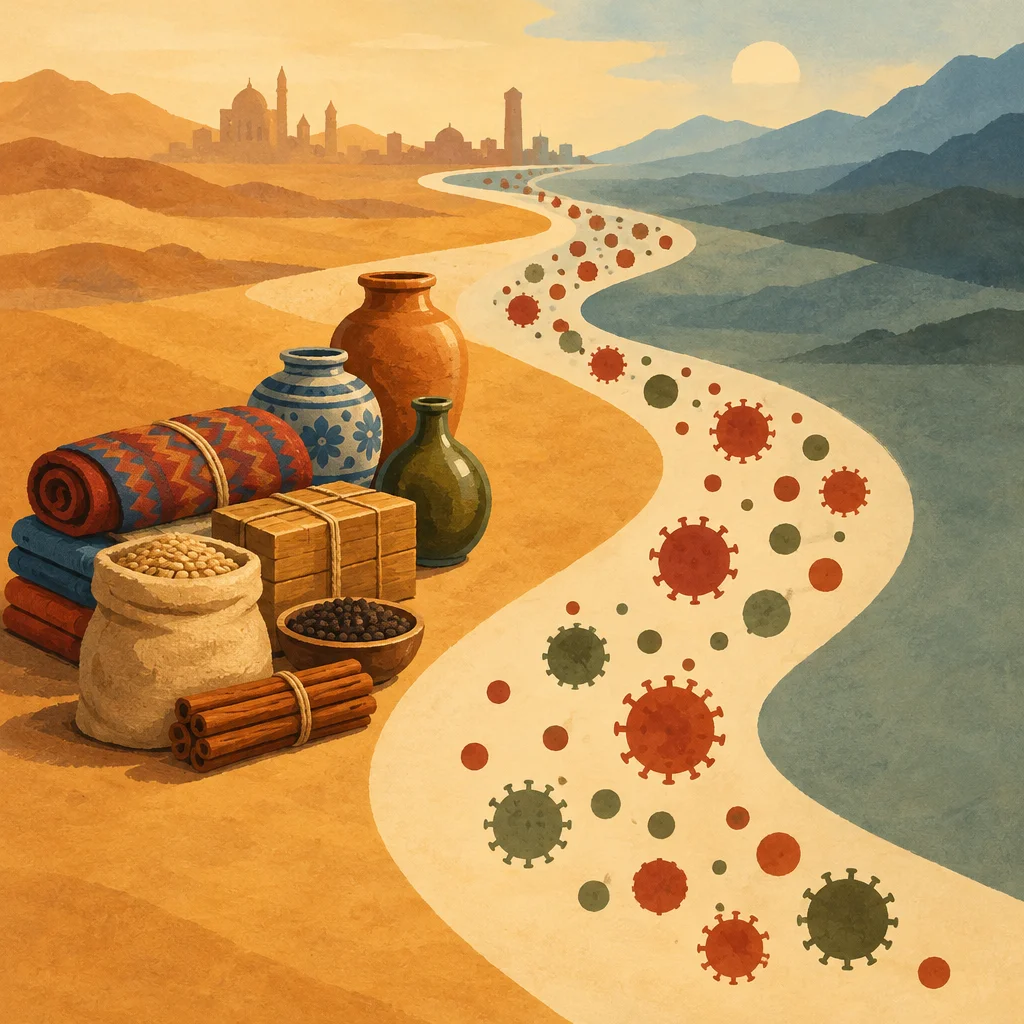
Mongol-era exchange adds another distinction. Protected routes, administration and religious accommodation support commerce. Those connections also help transmit plague. Unlike slave trafficking, disease transmission does not require the intention to exploit its victims. The book thus brings together harms with different causes: deliberate coercion, political suspicion and danger carried through movement.
The implication is a more exact way to judge connection. Ask what moves, under whose authority, with whose consent, and at whose risk. More movement is not enough to answer whether lives improve.
There is also a boundary against moral flattening. Translation, forced labour and epidemic spread are not versions of one identical process. Lumina’s reading is that the network frame helps place them in relation, but responsible discussion must preserve their different forms of agency. Otherwise, an argument against simple progress becomes an equally simple claim that all contact is destructive.
Illustrated key idea
Contact carries benefits and dangers together05
A resource becomes political when someone else needs it
Contains plot details — open to read
The third idea moves from exchange to sovereignty: a state’s ability to make decisions about its own territory and political future. Frankopan’s later history repeatedly asks who controls resources, who needs them, and how that need becomes a claim to interfere.
Oil shows the mechanism clearly. A private search for Persian deposits becomes tied to British naval strategy. Once fuel offers military advantages, a commercial venture acquires the language and machinery of national security. Britain’s investment in Anglo-Persian and arrangements for naval supplies make Persian production part of British strategic planning.
The key change is not simply that oil becomes valuable. An outside power’s dependence gives it a reason to seek lasting influence over the place supplying it. From the supplier’s perspective, however, such security can mean restricted freedom. What one government calls dependable access, another may experience as control over its future.
Lumina sees this as one of the book’s most useful reversals of perspective. A pipeline is both a means of transport and a relationship of power. It connects production with customers, but it also raises questions about routes, protection, payments and authority. Infrastructure does not settle politics; it gives politics a durable physical form.
Local rulers are not merely passive in this account. Persia’s cancellation of its oil concession leads to improved terms in 1933. That episode shows that producing states can bargain when foreign interests depend on continued access. The book later traces stronger collective leverage among oil producers, while also describing how revenues can support authoritarian rule and major arms purchases.
This prevents sovereignty from becoming a simple moral solution. Greater control by a state does not guarantee fair distribution within that state. Reducing outside domination and improving citizens’ lives are related goals, but they are not the same achievement.
The overthrow of Mossadegh gives the conflict sharper political stakes. Frankopan presents nationalisation as a challenge to unequal oil arrangements and treats British-American intervention as resistance to nationalist control, not merely a response to communist danger. His argument asks readers to examine the commercial interests beneath strategic explanations.
Yet the book’s wider account also requires attention to local choices. Regional governments seek rival partners, exploit superpower competition and pursue their own ambitions. They cannot be explained solely as instruments of outside powers.
The implication is that durable access and political legitimacy may pull in different directions. Supporting a compliant ruler can secure immediate cooperation while deepening distrust. The boundary is that resources do not explain everything. Religious movements, repression, ideology and leadership retain causal force. The strongest version of Frankopan’s argument shows how these forces interact with material dependence, rather than replacing them with oil.
06
How a wide-angle history makes its case
Contains plot details — open to read
Frankopan persuades partly by changing the unit of explanation. Instead of remaining inside one nation or reign, he follows something across borders: a commodity, a belief, a strategic fear or a demand for supplies. This allows consequences to emerge at a distance from their apparent starting point.
One analytical anchor is the connection between Bengal and British America. The account links the East India Company’s territorial extraction and financial crisis with policies that intensified American resistance. Its force comes from making histories often treated separately part of one imperial problem. Lumina’s assessment is that this approach works best when readers can identify the intervening steps, rather than merely notice that events happened around the same time.
A second technique is to place admirable outcomes beside their material costs. Scholarship appears alongside taxation and patronage. Cultural splendour appears alongside extraction. This pairing challenges selective moral accounting without requiring the claim that intellectual or artistic achievements were worthless.
The breadth also creates a risk: a memorable connection can feel more complete than it is. An example may establish that distant events were linked without measuring the strength of that link. Readers should distinguish an illuminating association from a full explanation.
The supplied account records important cautions within the book. Early Islamic chronology and identities remain disputed. Some reports of Mongol casualties may be exaggerated. Plague origins are uncertain. Climatic effects are sometimes presented as possible contributions, not settled causes. These qualifications matter because they show that the narrative does not operate at one uniform level of certainty.
Its treatment of evidence also asks who produced an account and why. Conversion stories can serve religious advocacy; hostile observers can misrepresent unfamiliar societies. The useful habit is to separate an event from later claims about its meaning.
On the available evidence, the book’s craft is strongest as an exercise in reframing and linking. The sources support discussion of that architecture and its cautions. They do not allow a page-by-page assessment of the original prose, documentation or handling of every scholarly dispute.
07
Does one grand story replace another?
Contains plot details — open to read
Lumina’s strongest objection is that a corrective can grow too large. A history designed to challenge Europe’s assumed centrality might make Eurasian routes and resources seem like the master explanation for almost everything. Moving the centre does not by itself remove the limits of centre-based history.
This matters most when material needs meet ideology. The book links Nazi expansion to food and oil, and failed resource expectations to escalating murder. Those connections demand care. Economic pressures must not make deliberate extermination sound unavoidable, nor turn racial hatred into a surface expression of shortages.
The strongest reply is that Frankopan’s account, as supplied, does not make that substitution. It joins resource planning to established antisemitism, racial domination and a prior willingness to accept mass death. Material objectives help explain the form and direction of policy; they do not excuse it or erase ideological commitment.
A second tension concerns continuity. Ancient routes and modern pipelines connect some of the same broad territories, but they belong to different political and technical worlds. Shared geography does not prove an unbroken system. Nor does earlier importance guarantee future leadership.
The fair reply is that the book describes repeated reorganisations, not a single route operating unchanged. Maritime expansion weakens some overland connections. New infrastructure creates fresh dependencies. The conclusion also names repression, conflict and economic uncertainty rather than promising a settled future. Lumina therefore reads renewed centrality as a historical argument and an unsettled forecast, not a law.
A third tension concerns whose lives the large scale brings into view. States and merchants leave visible traces through conquest, revenues and infrastructure. People who suffer within those systems can appear mainly as consequences. The book counters this by including enslavement, famine, coercion and civilian hardship. Still, naming suffering is not the same as recovering individual experience.
The best defence of the wide frame is not that it can do everything. It is that some dependencies remain hard to see at a smaller scale. The best criticism asks where that frame reaches its limits. A strong reading needs both positions: follow the connection, then ask what it leaves unexplained.
08
Read a route as a relationship
The book’s ideas connect into a practical method of inquiry. Begin with dependence: what does a society need from elsewhere? Then ask how that need is met, who controls access, and how the gains and risks are divided. This method links the ancient trade material with the later history of resources without claiming that all periods are alike.
Lumina offers an imagined illustration, not an episode from the book. Suppose two states build a railway linking a mine with a port. Freight rises and both governments announce success. A network-based reading asks further questions. Who owns the track? Can the supplier choose other buyers? Which communities bear the costs? Could access be restricted during a political dispute?
The point is not to assume the railway is harmful. It is to recognise that physical connection alone cannot answer questions about bargaining power or consent. This reasoning follows the book’s treatment of pipelines as sources of both exchange and vulnerability.
The religious material adds another useful connection. Access to a route does not guarantee that an idea will spread unchanged. Translation, local institutions and political acceptance shape its reception. Movement and influence are therefore different things. A message may travel widely while being understood in several ways.
The imperial material adds a final warning about interpretation. A government’s stated concern may be real without being complete. Security, commercial advantage and prestige can operate together. The task is to examine their relationship, not choose automatically between sincere belief and cynical interest.
These habits do not turn the book into a policy manual. They make it a prompt for better questions. Its historical examples encourage readers to examine the organisation of connection before treating either openness or independence as an adequate description of how power works.

Illustrated key idea
Europe’s dominance as a constructed outcome09
Disagree about causes, not just the map
A useful conversation can begin by separating three claims: Eurasian connections mattered greatly; Europe’s rise depended on wider relationships; and renewed connections may shift future power. The book supports these claims through different kinds of argument. Accepting one does not require accepting all with equal confidence.
When discussing an example, explain the mechanism. Do not stop at saying that trade mattered. Identify the demand, the route, the people able to control it and the resulting change. Then ask what evidence would distinguish that explanation from a rival account.
Disagreement can also concern scale. One reader might find the wide frame essential for exposing hidden dependence. Another might think it compresses local motives. Both positions become more useful when tied to a specific case rather than a general preference for global or national history.
You can discuss these arguments without claiming to have examined every detail of the original. A responsible formulation distinguishes Frankopan’s position from your own judgment and names uncertainties where they matter.
The most productive closing question is not whether the book has found history’s true centre. It is which relationships become visible from this position, and which still require a closer look.
What to remember
Explain strength through relationships.
Frankopan makes power depend on access, institutions and the ability to command resources beyond a society’s borders. Lumina’s synthesis is that cultural confidence cannot serve as a complete explanation of dominance when the wealth supporting it comes through wider systems.
Judge the terms of connection.
The book treats exchange as a process with unequal effects, not a guarantee of progress. Ask who can participate freely, who controls movement and who bears risk. This preserves the distinction between creating wealth and distributing its benefits fairly.
Separate access from authority.
Needing another region’s resources does not settle who should govern them. Frankopan’s resource history exposes that conflict. Lumina’s further distinction is that national control and public benefit also require separate scrutiny: stronger bargaining power alone does not ensure fair domestic outcomes.
Bring it into conversation
Talk about the book
What would make decentring Europe an explanation rather than just a change of emphasis?
Lumina suggests testing whether the new frame reveals a causal link that an inward-looking account misses. Adding locations is less important than showing how demand, money or strategic dependence changes the interpretation.
Take it further: Which connection would you investigate more closely before accepting the wider claim?
When does the language of exchange hide unequal power?
Lumina’s view is that exchange remains useful only if its terms stay visible. The freedom to refuse, access to alternatives and control over rules all matter. A profitable system need not benefit its participants on comparable terms.
Take it further: Can you distinguish unequal bargaining from outright coercion without treating either as harmless?
How far can historical patterns support a forecast about future power?
Frankopan treats resources and renewed infrastructure as signs of changing importance. Lumina would separate evidence of stronger connections from evidence of stable leadership. Investment can create influence while also creating exposure to political and economic shocks.
Take it further: What would you need to know about a new route before calling it a lasting shift?
Keep in perspective
This discussion draws on summaries of the book, not a full examination of its prose, notes or underlying scholarship. They support its broad arguments and several stated uncertainties, but cannot resolve contested historical claims. No independent reviews or author biography were supplied. The account of renewed Eurasian connections is treated as the book’s outlook, not an updated assessment of current affairs.