1.The Nature of Natural Sciences

The study of natural sciences, which includes chemistry, is rooted in the need to categorize the vast complexities of nature into manageable segments. Chemistry and physics, for instance, are closely intertwined, focusing on inanimate matter and the changes it undergoes. McPherson highlights that while these disciplines are often viewed in isolation, a comprehensive understanding of one often necessitates knowledge of the other. A botanist, for example, must be familiar with animal life as well as plant life, reflecting the interconnectedness of different sciences. This interconnectedness is vital for students who aim to grasp the broader scientific landscape, as the principles of chemistry frequently apply to biological processes and physical phenomena. By understanding this relationship, students can appreciate how chemical reactions influence everything from biological functions to physical properties of materials, and how advancements in one scientific field can lead to breakthroughs in another.
2.Defining Physical and Chemical Changes

McPherson delineates between physical and chemical changes, a fundamental concept in chemistry that helps students understand how matter interacts. Physical changes, such as breaking a lump of coal or dissolving sugar in water, do not alter the composition of the substance; the original material remains intact in a different form. In contrast, chemical changes involve the transformation of substances, resulting in new materials with distinct properties, such as the combustion of coal which produces ashes and gases. This distinction is not merely academic; it has practical implications for various applications in industrial processes and laboratory experiments. Understanding this difference is crucial for students as they begin to analyze various reactions and processes. It sets the stage for examining more complex reactions and laws governing chemical behavior, reinforcing the importance of recognizing how and why substances change. By grasping these concepts, students are better equipped to predict outcomes in experiments and understand the rationale behind chemical reactions.
3.The Discovery and Importance of Oxygen

Oxygen, one of the most critical elements in chemistry, was first recognized by chemists like Priestley and Lavoisier. McPherson highlights the historical context of oxygen's discovery, noting its role in supporting combustion and respiration. As the most abundant element, oxygen is not only a key component of the Earth's atmosphere but also vital for life, constituting a significant percentage of water and organic matter. The methods for preparing oxygen in the laboratory, such as decomposing mercuric oxide or water, showcase practical applications of chemical principles. The discovery of oxygen transformed scientific understanding, leading to advancements in various fields like medicine and environmental science. Understanding oxygen's properties and its role in various reactions lays the groundwork for studying more complex compounds and reactions, illustrating how foundational concepts lead to more advanced chemical understanding. Oxygen's significance extends beyond the laboratory; it is essential for cellular respiration in all aerobic organisms, highlighting its importance in biology.
4.The Significance of Hydrogen

Hydrogen, identified as a distinct element by Cavendish, plays a crucial role in both chemistry and the universe at large. McPherson explains hydrogen's prevalence in organic compounds and its unique properties, such as its low density and high reactivity. The preparation of hydrogen, through methods such as electrolysis and reactions with metals, illustrates the practical aspects of chemical experimentation. Its role as a fundamental building block in water and organic molecules emphasizes its importance in biological systems. The study of hydrogen also introduces students to concepts like bonding and molecular structure. By examining hydrogen's behavior in reactions, such as its reaction with oxygen to form water, students can observe firsthand the principles of conservation of mass and energy. Hydrogen's properties enable it to act as an energy carrier, making it a focal point in discussions about renewable energy and sustainability, reinforcing its relevance in contemporary scientific discourse.
5.Water: The Universal Solvent

Water, long considered an element, is now understood as a compound of hydrogen and oxygen, a revelation attributed to Cavendish and Lavoisier. McPherson discusses water's unique properties, including its role as a solvent in biological and chemical processes. The determination of water's composition through analysis and synthesis illustrates fundamental laboratory techniques that students must grasp. Water's ability to dissolve a wide range of substances makes it essential for life, acting as a medium for biochemical reactions. The exploration of water's characteristics not only covers its solvent properties but also its physical states and the implications for chemical kinetics. For example, the way water can transport nutrients and waste in biological systems showcases its importance. Additionally, understanding solutions, concentrations, and the behavior of solutes in water lays the groundwork for students to comprehend more complex interactions. This foundational knowledge is critical for further studies in chemistry, biology, and environmental science, where water plays a central role.
6.The Atomic Theory: Foundation of Chemistry

The atomic theory, articulated by Dalton, transforms our understanding of matter by positing that all substances are composed of atoms, which combine in fixed ratios. McPherson outlines three fundamental laws of matter: the conservation of mass, the law of definite composition, and the law of multiple proportions. These principles are critical for students to comprehend the structure of matter and the behavior of elements in reactions. The law of conservation of mass, for instance, asserts that matter cannot be created or destroyed, which is foundational for balancing chemical equations. The law of definite composition states that a given compound always has the same proportion of elements, while the law of multiple proportions allows for elements to combine in different ratios to form different compounds. This understanding equips students with a framework for predicting how substances will react with each other. The atomic theory not only provides a basis for chemical calculations but also opens the door to concepts like molecular structure and chemical bonding, which are essential for advanced studies in chemistry.
7.Chemical Equations: The Language of Chemistry
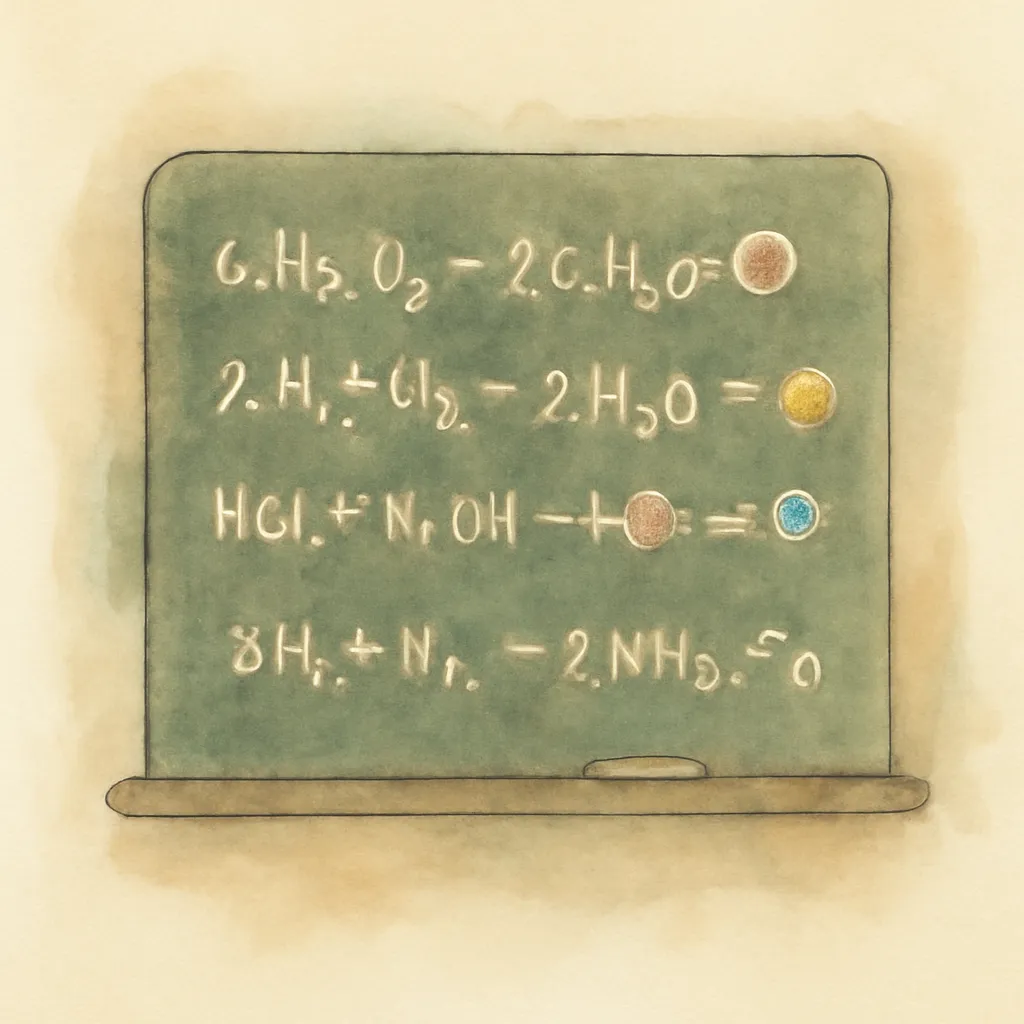
Chemical equations serve as a shorthand for representing chemical reactions, allowing chemists to communicate complex information succinctly. McPherson emphasizes the importance of understanding formulas and equations, such as H₂O for water and CO₂ for carbon dioxide. The process of balancing equations is introduced as a crucial skill, enabling students to accurately depict the conservation of mass in chemical reactions. For instance, the equation for the decomposition of mercuric oxide illustrates how reactants transform into products while maintaining mass. This skill is not only fundamental for academic success in chemistry but also essential for practical applications in laboratory settings, where precise measurements and calculations are critical. Through practice, students learn to manipulate equations, predict the outcomes of reactions, and understand the stoichiometric relationships between reactants and products. This knowledge is crucial for experimental design and understanding how chemical reactions can be harnessed for technological innovations, including pharmaceuticals and materials science.
8.The Role of Nitrogen and the Atmosphere

Nitrogen, discovered by Rutherford, comprises a significant portion of the atmosphere, making it essential for life and various chemical processes. McPherson discusses the methods for isolating nitrogen from air, highlighting its properties and uses in fertilizers and biological systems. The understanding of nitrogen's role in organic compounds underscores its importance in agriculture, where it is a key component of amino acids and proteins. The composition of the atmosphere, including other gases like oxygen and carbon dioxide, is examined, showing how these elements interact to support life. This exploration of atmospheric chemistry emphasizes the delicate balance of gases necessary for sustaining ecosystems and the implications of anthropogenic changes, such as pollution and climate change. By studying nitrogen and atmospheric composition, students gain a holistic view of the chemical environment in which life exists, emphasizing the interconnectedness of chemical elements and their impact on global systems.
9.Acids, Bases, and Salts: The Core of Chemical Reactions

Acids, bases, and salts form the cornerstone of many chemical reactions, and McPherson categorizes these compounds based on their properties and behaviors in solutions. Acids are defined by their ability to produce hydrogen ions in solution, while bases yield hydroxide ions. This classification is crucial for understanding neutralization reactions, where acids and bases react to form salts and water. McPherson provides examples of common acids, like hydrochloric and sulfuric acid, highlighting their significance in various industrial and biological processes. The exploration of pH, indicators, and the strengths of different acids and bases is essential for understanding chemical equilibria. Furthermore, the study of salts and their formation from acid-base reactions illustrates the practical implications of these concepts in everyday life, such as in cooking and medicine. By mastering the properties and behaviors of these compounds, students can predict the outcomes of chemical reactions and develop a deeper appreciation for the role of chemistry in everyday life.
10.The Periodic Law: Organizing Elements

The periodic law, which organizes elements based on their atomic structure and properties, is a key concept in chemistry that simplifies the study of elements. McPherson illustrates how elements are grouped into families, with similar characteristics, facilitating easier understanding of their behavior. For example, the alkali metals and alkaline-earth metals exhibit distinct properties that can be predicted based on their positions in the periodic table. This organization not only aids in learning but also provides insights into the relationships between different elements, allowing for the prediction of chemical reactions and compound formation. By exploring the periodic law, students can connect various concepts in chemistry and appreciate the systematic nature of the discipline. The periodic table serves as a powerful tool for chemists, guiding research and innovation by highlighting trends in reactivity, electronegativity, and atomic size, which are essential for developing new materials and understanding biochemical processes.