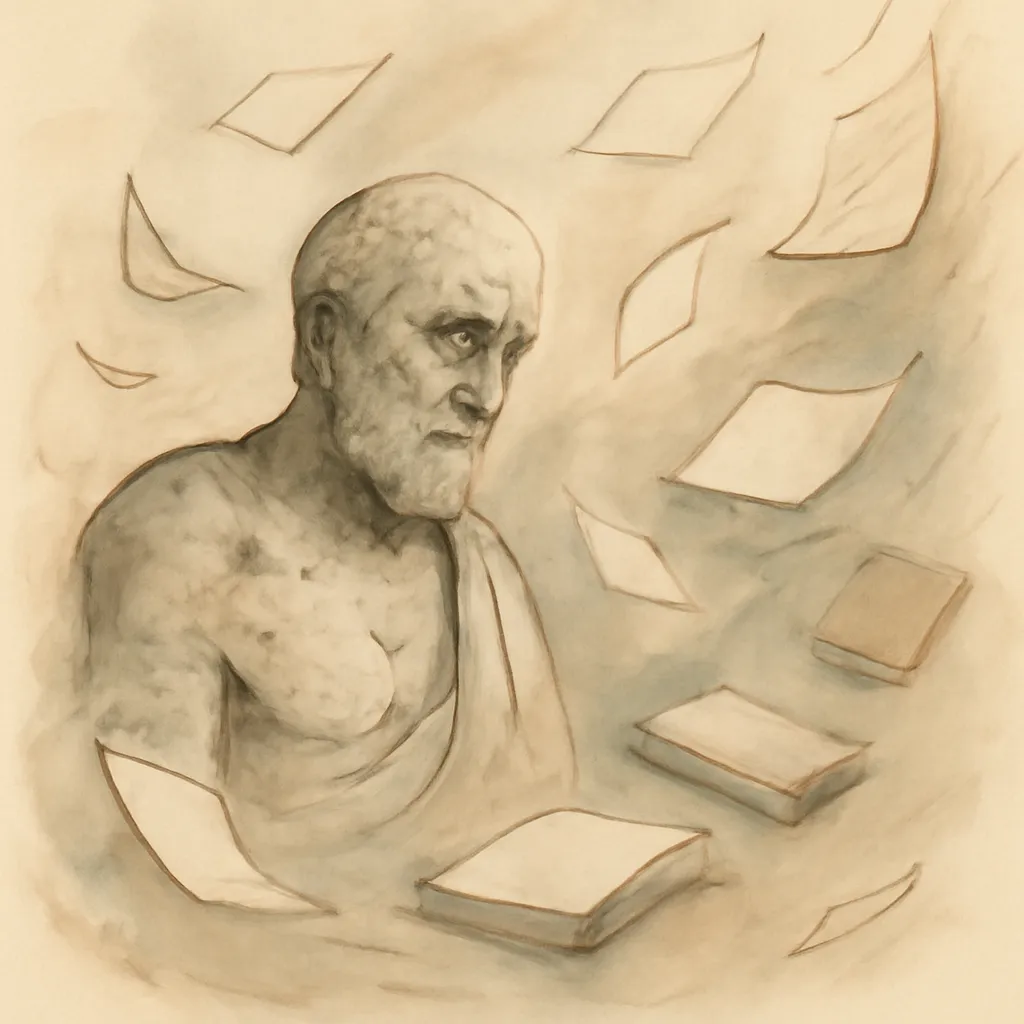
1.Radical Doubt as a Starting Point
Descartes famously advocates for doubting everything that can possibly be doubted, in order to discover what, if anything, is absolutely certain. By systematically questioning all beliefs, he aims to strip away falsehoods and reach bedrock truths. This approach not only challenges inherited dogmas but also lays the groundwork for a new, more rigorous method of inquiry that would shape the future of philosophy and science.
2.Cogito, Ergo Sum
The most famous result of Descartes’ method is the realization that the act of doubting itself proves the existence of the doubter: 'I think, therefore I am.' This becomes the first principle of his philosophy, an indubitable truth from which further knowledge can be built. It marks a shift from reliance on external authorities to the primacy of individual reason and self-awareness.
3.A Method for Clear Thinking
Descartes outlines four rules for guiding thought: accept nothing as true without evidence, divide problems into parts, start with the simplest elements, and review thoroughly. These steps anticipate the scientific method and encourage disciplined, logical analysis. The emphasis is on clarity, order, and methodical progression from simple to complex.
4.The Role of Mathematics
Mathematics serves as Descartes’ model for certainty and clarity. He believes that mathematical reasoning, with its precision and logical structure, should inform all fields of knowledge. This conviction leads him to apply mathematical methods to philosophy and science, seeking universal principles that can be demonstrated with certainty.
5.Separation of Mind and Body
Descartes introduces the idea that mind and body are distinct substances: the mind is a thinking, non-material entity, while the body is material and extended in space. This dualism has profound implications for psychology, medicine, and theology, and it sets the stage for centuries of debate about the nature of consciousness and the relationship between mental and physical phenomena.
6.Personal Intellectual Autonomy
Descartes encourages readers to rely on their own reason rather than tradition, authority, or custom. He models intellectual independence, recounting his own journey from received opinions to self-discovered truths. This spirit of autonomy is a cornerstone of Enlightenment thinking and continues to inspire critical inquiry today.