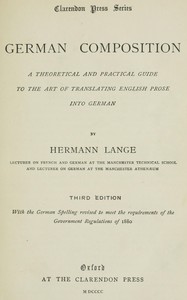
Master the Art of Translating English Prose into Idiomatic German
Read full overviewShow less›
‘German Composition’ serves as a comprehensive guide for students eager to translate English prose into the German language. It effectively bridges the gap between theoretical knowledge and practical application, enabling learners with a foundational understanding of German to refine their translation skills. The book is structured to accompany existing materials, making it accessible to those who have completed preliminary lessons. Throughout its pages, readers will encounter a carefully curated selection of English prose that exemplifies various writing styles and subjects, providing a rich context for translation practice. With biographical sketches and insightful notes, this guide not only enhances linguistic proficiency but also enriches cultural understanding.
‘German Composition’ stands as a vital resource for students aspiring to master the art of translation. By emphasizing the interplay between theory and practice, the book equips learners with the tools necessary to navigate the complexities of language. Through a focus on contextual understanding, idiomatic expressions, and syntactical nuances, students can develop a nuanced approach to translation. The integration of cultural insights and varied writing styles further enriches the learning experience, making it both comprehensive and engaging. Ultimately, the skills honed through this guide will empower students to produce translations that are not only accurate but also resonate with the essence of the original prose, fostering a deeper appreciation for both languages and their respective cultures.

- 1The Importance of Context in Translation
- 2Compound Nouns: A Unique Feature of German
- 3Understanding Verb Tenses and Their Implications
- 4Idiomatic Expressions: Beyond Literal Translation
- 5Analyzing Sentence Structure: The Role of Syntax
A glimpse inside

Translation is not merely about substituting words from one language to another; it is deeply rooted in context. In the first chapter of ‘German Composition’, the author… Read moreTranslation is not merely about substituting words from one language to another; it is deeply rooted in context. In the first chapter of ‘German Composition’, the author stresses that when translating English prose into German, the nuances of meaning can shift dramatically based on the surrounding text. For example, the phrase 'to take possession' can imply different nuances depending on whether it refers to acquiring land, ideas, or even emotions. Understanding the context helps translators choose the appropriate words that convey the original intent and tone. This principle is emphasized throughout the book, urging students to consider the broader narrative when making translation choices. Exercises are provided where students must analyze sentences in context, picking the right German equivalents that maintain the original message while adhering to German idiomatic expressions. This deep dive into context not only strengthens translation skills but also enriches the student’s understanding of both languages. Show less
One of the distinct characteristics of the German language is its ability to create compound nouns, allowing for concise expression. Read moreOne of the distinct characteristics of the German language is its ability to create compound nouns, allowing for concise expression. In ‘German Composition’, students learn that many English phrases requiring multiple words can be encapsulated in a single German term. For instance, 'beast of burden' translates to ‘Lasttier’, illustrating how German can convey complex ideas succinctly. The author elaborates on how this linguistic feature enables speakers to avoid redundancy while enriching the language. This characteristic is particularly useful for learners who might struggle with verbosity in translation; by practicing compound noun formation, students can develop a more elegant and effective style. The book provides numerous examples and structured exercises that challenge learners to practice forming compound nouns, reinforcing their grammatical understanding and expanding their vocabulary. Emphasis is placed on creativity, inviting students to experiment with forming new compound terms, thereby internalizing the flexibility of the German language. Show less
Read the full text — free
About the author
Read Hermann Lange's work free on Lumina — the complete text plus an 8-minute summary and key ideas, no account needed