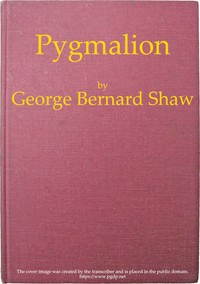

A phonetics professor wagers he can pass a flower girl off as a duchess — a witty comedy of class, language, and transformation.
Read full overviewShow less›
In 'Pygmalion', George Bernard Shaw explores the fluidity of identity and the power of language as a tool for social transformation. At its core, the story follows Eliza Doolittle, a flower girl with a strong Cockney accent, who dreams of elevating her social status through proper speech. The play delves into themes of class, identity, and the superficial nature of social distinctions, all while showcasing the transformative journey of Eliza under the tutelage of Henry Higgins, a phonetics expert. Readers will encounter a rich tapestry of character dynamics, societal critique, and the poignant question of whether true transformation is possible when the external changes may not reflect internal realities. Shaw's sharp wit and keen observations on human behavior make this work a timeless exploration of the intersection between language and identity.
George Bernard Shaw's 'Pygmalion' remains a powerful exploration of language, identity, and social mobility. Through the journey of Eliza Doolittle, the play challenges audiences to reconsider the impact of language on personal identity and social standing. It prompts critical reflections on the nature of transformation—questioning whether external changes can lead to genuine self-discovery. Shaw's sharp commentary on class, gender, and societal expectations invites readers to engage with the complexities of identity in their own lives. Ultimately, 'Pygmalion' is not just a story about a flower girl’s ascent to high society; it is a timeless examination of the human condition, emphasizing the importance of choice, agency, and the pursuit of authenticity in a world defined by rigid social structures.
- 1The Power of Language as a Social Tool
- 2Class Distinctions and Social Mobility
- 3The Role of Gender in Identity and Society
- 4The Illusion of Transformation
- 5The Mentor-Mentee Relationship
A glimpse inside

Shaw presents language not merely as a means of communication but as a powerful social instrument that can elevate or diminish one's status. Read moreShaw presents language not merely as a means of communication but as a powerful social instrument that can elevate or diminish one's status. Eliza Doolittle's journey begins with her desire to speak like a lady, which symbolizes her aspiration to transcend her lower-class origins. The play highlights how accents and dialects are tied to social identity; Eliza's Cockney speech marks her as a flower girl, while the refined speech of Higgins and Pickering signifies their upper-class status. This transformation is not just about learning to speak correctly; it encapsulates the struggle for self-identity and acceptance in a rigidly class-conscious society. Shaw emphasizes that language shapes one's reality, as Eliza discovers that mastering the art of phonetics is a double-edged sword, granting her access to a new world but also alienating her from her past. Show less
The play scrutinizes the arbitrary nature of class distinctions and the societal structures that uphold them. Through characters like Higgins and Pickering, Shaw illustra… Read moreThe play scrutinizes the arbitrary nature of class distinctions and the societal structures that uphold them. Through characters like Higgins and Pickering, Shaw illustrates the privileges of the upper class, who possess the power to define social norms and expectations. Eliza's transformation challenges these norms, as she strives to prove that one's worth is not dictated by birth but by personal ambition and effort. However, the play raises critical questions about the feasibility of true social mobility. Despite her newfound abilities, Eliza grapples with her identity, feeling out of place in both her old life and her new one. Shaw's narrative suggests that while language can facilitate upward movement, it does not guarantee acceptance or belonging, thus exposing the limitations of social mobility within a rigid class system. Show less
Read the full text — free
About the author
Read George Bernard Shaw's work free on Lumina — the complete text plus an 8-minute summary and key ideas, no account needed.
Frequently asked
Worlds to get lost in
Take Lumina everywhere
Read offline, listen to AI summaries, speed-read, and sync your progress across devices — free on iPhone.
Download for iPhone