Philosophy · Short Reads
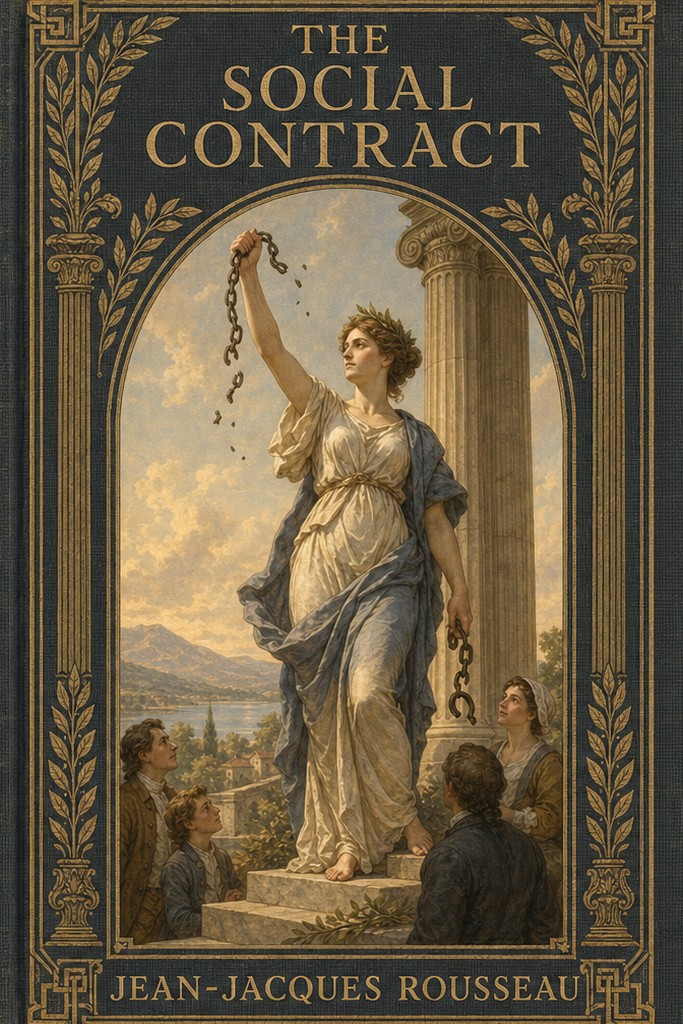
The Social Contract by Jean-Jacques Rousseau — Summary, Key Ideas & Full Text
148 pages50 chapters2h 58m read2h 6m speed read✦ 7-min Big ideas★ 4.0 (6)Free · no account
Rate it
The Social Contract reveals how true freedom and legitimacy in governance stem from the collective will of the people
Jean-Jacques Rousseau’s 'The Social Contract' is a profound exploration of the relationship between individuals and the state, arguing that legitimate political authority arises from a social contract agreed upon by free citizens. This work challenges the traditional notions of power and authority, positing that true freedom is found not in the absence of constraints, but in the collective agreement to form a society governed by the general will. Rousseau articulates the fundamental principles of sovereignty, the nature of laws, and the importance of civic duty, providing a framework for understanding democracy and governance that has influenced political thought for centuries. By delving into the nature of human freedom and the dynamics of social order, Rousseau invites readers to reflect on the legitimacy of their own governments and the role of citizens in shaping their societies.
Rousseau's 'The Social Contract' is a pivotal text that challenges readers to reconsider the foundations of political authority and the nature of freedom. By advocating for a society built on the collective will, Rousseau lays the groundwork for modern democratic thought, emphasizing the importance of civic engagement and the social contract. His insights into the balance between individual rights and collective responsibilities remain relevant today, prompting ongoing discussions about the legitimacy of governments and the role of citizens. Ultimately, Rousseau’s work inspires a vision of a just society where individuals are both free and bound by the commitments they make to one another, fostering a sense of unity and purpose in the pursuit of the common good.
“Man is born free; and everywhere he is in chains.”
“The social order is a sacred right which is the basis of all other rights.”
“Sovereignty, being nothing less than the exercise of the general will, can never be alienated.”

Jean-Jacques Rousseau has 2 works free to read on Lumina, including The Confessions of Jean Jacques Rousseau — Complete
All 2 books by Jean-Jacques Rousseau →