

Organized crime · Crimes against · Fiction
The Big Clock by Kenneth Fearing — Summary, Key Ideas & Quotes
1946175 pages✦ 3-min Big ideas★ 4.0 (1)
Rate it
George Stroud is a hard-drinking, tough-talking, none-too-scrupulous writer for a New York media conglomerate that bears a striking resemblance to Time, Inc. in the heyday of Henry Luce. One day, before heading home to his wife in the suburbs, Stroud has a drink with Pauline, the beautiful girlfriend of his boss, Earl Janoth. Things happen. The next day Stroud escorts Pauline home, leaving her off at the corner just as Janoth returns from a trip. The day after that, Pauline is found murdered in her apartment. Janoth knows there was one witness to his entry into Pauline’s apartment on the night of the murder; he knows that man must have been the man Pauline was with before he got back; but he doesn’t know who he was. Janoth badly wants to get his hands on that man, and he picks one of his most trusted employees to track him down: George Stroud, who else?
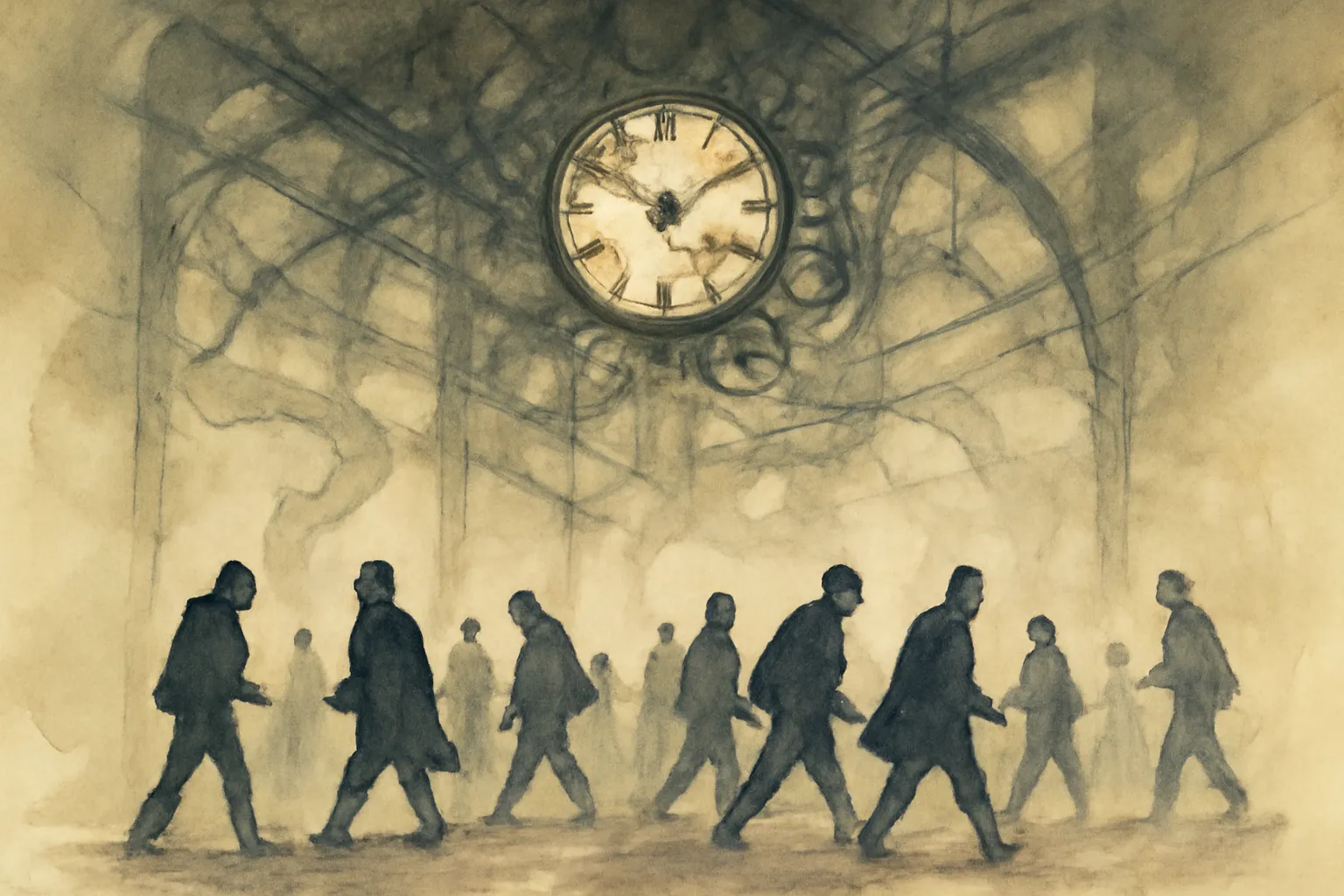
Fearing’s novel uses the monolithic media company as a metaphor for the dehumanizing force of modern institutions. The organization is depicted as a vast, impersonal machine—'the big clock'—that grinds up individuality and morality in service of its own survival. Employees, including protagonist George Stroud, are cogs in this relentless system, trapped by the very structure that employs them. The company’s ability to marshal its resources against a single individual, even one of its own, underscores the terrifying reach of corporate power.
The central irony of The Big Clock is that Stroud is tasked with tracking down himself. This creates a suffocating atmosphere of paranoia and existential anxiety, as Stroud must outwit not only his colleagues but also the surveillance apparatus he helped build. The tension arises from the knowledge that the system is ruthlessly efficient—and that Stroud, as both hunter and hunted, is uniquely qualified to understand its methods and limitations. Fearing uses this setup to explore the psychological toll of constant scrutiny and the fear of exposure.
“The big clock ticked on the wall, measuring off the seconds of my life.”