
Origin · Human beings · Fossil hominids
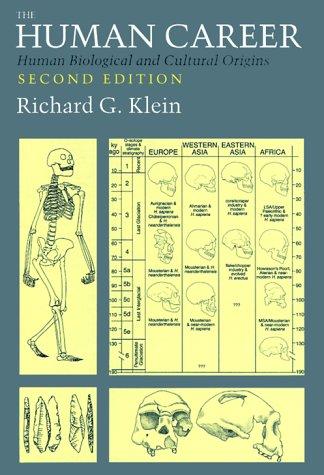
The Human Career by Richard G. Klein — Summary, Key Ideas & Quotes
1989917 pages✦ 3-min Big ideas
Rate it
Described as "by far the best book of its kind" (Henry McHenry, Evolution) and "the best introduction to the problems and data of modern palaeoanthropology yet published" (R. A. Foley, Antiquity), The Human Career has proved to be an indispensable tool in teaching human origins since its publication in 1989. The Human Career chronicles the evolution of people from the earliest primates through the emergence of fully modern humans within the past 200,000 years. Its comprehensive treatment stresses recent advances in knowledge, including, for example, ever more abundant evidence that fully modern humans originated in Africa and spread from there, replacing the Neanderthals in Europe and equally archaic people in Asia. With its coverage of both the fossil record and the archeological record over the 2.5 million years for which both are available, Klein emphasizes that human morphology and behavior evolved together. Throughout the text, Klein presents evidence for alternative points of view, but also does not hesitate to take a position. In addition to outlining the broad pattern of human evolution, The Human Career details the kinds of data that support this pattern, including information on archeological sites, artifacts, fossils, and methods for establishing dates in geological time.
Klein’s approach stands out for its rigorous integration of fossil discoveries with archaeological data. Rather than treating bones and artifacts in isolation, he demonstrates how changes in physical form and behavior are interlinked, allowing readers to see how shifts in anatomy relate to new technologies, social patterns, and ecological adaptations. This holistic perspective provides a richer, more dynamic picture of human evolution than accounts focused solely on one type of evidence.
A central argument in The Human Career is the 'Recent African Origin' hypothesis, which posits that anatomically modern humans evolved in Africa before spreading across the globe and replacing other hominins like Neanderthals. Klein marshals genetic, fossil, and archaeological evidence to support this view, while also engaging with competing models such as multiregional evolution. His clear-eyed analysis helps readers understand why the African origin model has become dominant.