
Political psychology · Social psychology · Ethics
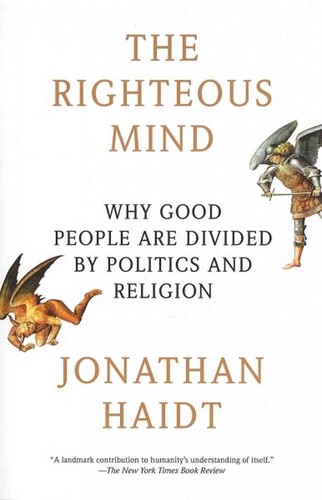
The Righteous Mind by Jonathan Haidt — Summary, Key Ideas & Quotes
2012493 pages✦ 3-min Big ideas★ 4.2 (6)
Rate it
A groundbreaking investigation into the origins of morality, which turns out to be the basis for religion and politics. The book explains the American culture wars and refutes the "New Atheists."

Haidt argues that moral judgments are primarily driven by intuitive, emotional responses rather than deliberate reasoning. We tend to form quick, gut-level reactions to moral issues, and then use reasoning to justify those reactions after the fact. This challenges the common belief that people arrive at their moral beliefs through careful, rational thought. Instead, reasoning often serves as a 'press secretary,' crafting arguments to defend positions we've already taken intuitively.
Central to the book is Haidt’s Moral Foundations Theory, which identifies six core moral values: care/harm, fairness/cheating, loyalty/betrayal, authority/subversion, sanctity/degradation, and liberty/oppression. Different cultures and political groups prioritize these foundations differently, explaining why people can see the same issue in such divergent moral terms. Liberals, for instance, tend to emphasize care and fairness, while conservatives draw more evenly from all six foundations.
“Morality binds and blinds.”
“Intuitions come first, strategic reasoning second.”
“If you think that moral reasoning is something we do to figure out the truth, you’ll be constantly frustrated by how foolish, biased, and illogical people become when they disagree with you.”
