Business Classics · Philosophy
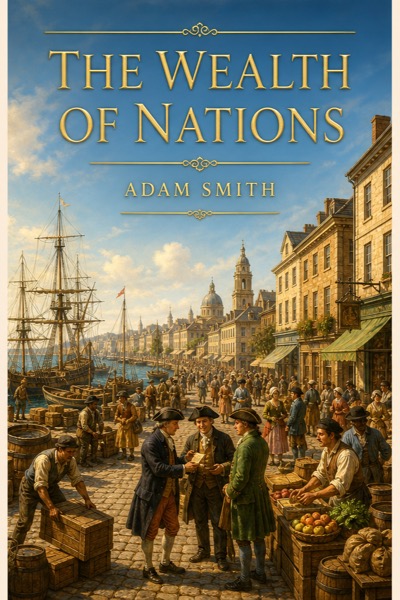
The Wealth of Nations by Adam Smith — Summary, Key Ideas & Full Text
1262 pages35 chapters25h 21m read18h speed read✦ 9-min Big ideas★ 4.1 (31)Free · no account
Rate it
The Wealth of Nations reveals the intricate mechanisms of economic growth through labor division, market dynamics, and the principles of trade
Adam Smith's seminal work, The Wealth of Nations, lays the foundation for modern economics by exploring how nations can generate wealth through the division of labor, the function of markets, and the principles governing trade. This book delves into the intricacies of economic interactions, emphasizing the importance of specialization and market size in enhancing productivity. Smith illustrates how the accumulation of capital and the effective employment of labor contribute to a nation's prosperity. By examining both historical contexts and theoretical frameworks, readers will gain insights into the mechanisms that drive economic systems and the role of government in facilitating or hindering growth. This exploration not only informs our understanding of the past but also provides valuable lessons for contemporary economic policy and practice.
The Wealth of Nations remains a foundational text in economics, providing profound insights into the mechanisms of wealth creation and the dynamics of market interactions. Adam Smith's exploration of labor division, market forces, and the role of government continues to resonate in contemporary economic discourse. By understanding these principles, readers can appreciate the historical context of economic policies and their implications for today's global economy. The book not only informs economic theory but also encourages a critical examination of the systems that govern our societies. Ultimately, Smith's work serves as a guide to fostering prosperity through cooperation, trade, and respect for individual initiative.
Read Adam Smith's work free on Lumina — the complete text plus an 8-minute summary and key ideas, no account needed