Astrophysics · Relativity (Physics) · Space and time
About Time by Paul Davies — Summary, Key Ideas & Quotes
1995316 pages✦ 3-min Big ideas★ 4.0 (1)
Rate it
The traditional association between time and creation is at the heart of science, cosmology, and religion. When scientists began to explore the implications of Einstein's time for the universe as a whole, they discovered that time is elastic, and can be warped by rapid motion or gravitation, that time cannot be meaningfully divided into past, present, and future, nor does time flow in the popular sense.
And they made one of the most important discoveries in the history of human thought: that time, and hence all of physical reality, must have had a definite origin in the past. There can be both a beginning and an end to time.
.
But important though Einstein's theory of time turned out to be, it still did not solve "the riddle of time," and the search for a deeper understanding of time and its relationship with the rest of the physical universe remains at the top of the scientific agenda. From black holes, where time stands still, to the bizarre world of quantum physics, where time vanishes completely, Professor Davies finds evidence that our current theories of time simply don't add up.
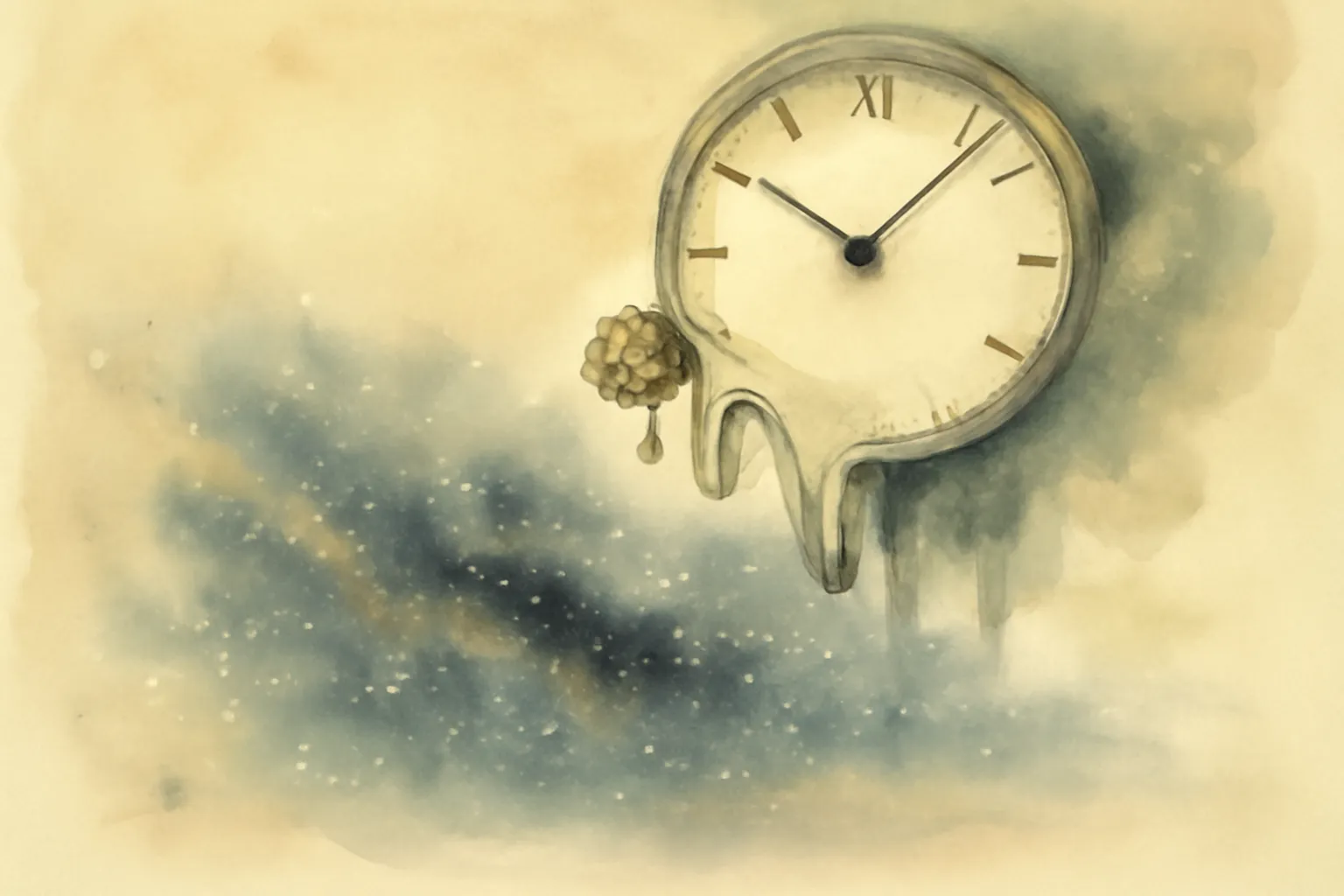
Davies explores how Einstein’s theories revolutionized our understanding of time, showing it is not an absolute backdrop but a flexible dimension intertwined with space. This means time can stretch, contract, and even stop under certain conditions, such as near black holes or at the speed of light. The book explains how these insights challenge our everyday intuition and force us to rethink the nature of reality itself.
A central theme is the idea that time—and thus the universe—had a definite origin, as suggested by the Big Bang. Davies discusses the scientific evidence for a cosmic beginning and the possibility of an end, addressing both the physics and the philosophical implications. He considers whether time could have existed 'before' the Big Bang and what it would mean for time to come to an end.
“The existence of time’s arrow is the greatest mystery in physical science.”