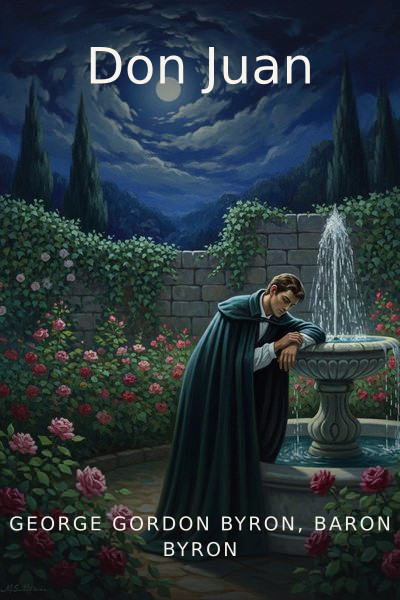

Don Juan is a satirical exploration of love, desire, and the human condition through the misadventures of a charming young rogue
Read full overviewShow less›
George Gordon Byron's epic poem 'Don Juan' presents a multifaceted portrayal of love and society through the eyes of its titular character. As Juan navigates various romantic entanglements and societal expectations, Byron critiques the moral hypocrisy and absurdities of his time. Readers will find themselves immersed in a rich tapestry of humor, philosophy, and social commentary that transcends the boundaries of the 19th century. The poem's playful tone and sharp wit offer a refreshing lens to examine the complexities of human relationships, making it a timeless piece that resonates even today. Through Juan's escapades, Byron reveals the often contradictory nature of desire, virtue, and the pursuit of happiness.
Byron's 'Don Juan' is a rich and complex work that transcends its time, offering insights into love, identity, and the human condition. The poem's playful narrative style and sharp satire invite readers to reflect on their own lives and societal norms. Through Juan's adventures, Byron reveals the contradictions inherent in desire and virtue, challenging us to confront the complexities of our own relationships and beliefs. The exploration of themes such as fate, freedom, and the absurdity of war resonates deeply, making 'Don Juan' a timeless reflection on the human experience. Ultimately, Byron's masterpiece encourages us to embrace the messiness of life while seeking understanding and connection in a world filled with contradictions.
Ratings at a glance
- 1The Nature of Love
- 2Satire and Social Critique
- 3The Quest for Identity
- 4The Role of Fate and Chance
- 5Gender Dynamics and Power
Notable quotes
“Bob Southey! You’re a poet, poet laureate, And representative of all the race.”
“O Love! how perfect is thy mystic art, Strengthening the weak, and trampling on the strong.”
“What is the end of Fame? ’tis but to fill A certain portion of uncertain paper.”
A glimpse inside

At its core, 'Don Juan' is an exploration of love in its many forms—romantic, platonic, and even tragic. Byron presents love as a powerful yet unpredictable force that ca… Read moreAt its core, 'Don Juan' is an exploration of love in its many forms—romantic, platonic, and even tragic. Byron presents love as a powerful yet unpredictable force that can elevate or destroy individuals. Through Juan's experiences, the poem showcases how love can be both enchanting and perilous, demonstrating that passion often leads to unforeseen consequences. For instance, Juan's innocent charm attracts various women, but it also incites jealousy and rage among men, illustrating love's inherent complexity. Byron's treatment of love is not just romantic; it examines the societal expectations that accompany it, revealing how these pressures can distort genuine feelings. The character of Julia embodies this complexity; her seduction of Juan leads to guilt and societal judgment, showcasing the battle between personal desires and societal norms. Ultimately, love in 'Don Juan' is a double-edged sword, capable of both profound joy and deep sorrow, reflecting the tumultuous nature of human emotions. Show less
Byron employs satire as a tool to critique the moral and social norms of his time. The poem's humor often exposes the hypocrisy of societal standards, particularly regard… Read moreByron employs satire as a tool to critique the moral and social norms of his time. The poem's humor often exposes the hypocrisy of societal standards, particularly regarding gender roles and sexual morality. Characters like Don Alfonso, who embodies possessive masculinity and jealousy, serve as foils to Juan's more carefree and innocent nature. Through their interactions, Byron highlights the absurdity of societal expectations placed on both men and women. The poem's tone oscillates between lightheartedness and sharp criticism, inviting readers to reflect on the contradictions within society. Byron's wit is particularly evident in his depiction of poets and literary figures, where he questions the authenticity of their art and the motives behind their works. This satirical lens allows Byron to dissect the pretensions of the literary elite, suggesting that much of what is deemed noble is often tainted by self-interest and hypocrisy. The reader is left to ponder the authentic nature of their own desires and the societal constructs that shape them. Show less
Read the full text — free
About the author
Read George Gordon Byron, Baron Byron's work free on Lumina — the complete text plus an 8-minute summary and key ideas, no account needed