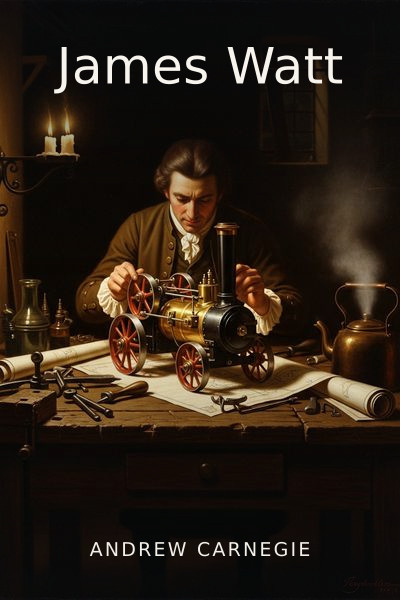

James Watt's innovations in steam technology ignited the Industrial Revolution and redefined the future of engineering
Read full overviewShow less›
Andrew Carnegie paints a vivid portrait of James Watt, whose groundbreaking work in steam technology transformed industries and propelled society into the Industrial Revolution. Born into a family that valued education and intellectual pursuits, Watt's journey from humble origins in Scotland to becoming a revolutionary inventor is filled with trials, triumphs, and relentless curiosity. Through his partnerships and innovative spirit, Watt not only developed the steam engine but also shaped the modern world. This exploration reveals how Watt's life, characterized by resilience and collaboration, was instrumental in ushering in a new era of efficiency and technological advancement.
James Watt's life and work exemplify the transformative power of innovation and the importance of perseverance in the face of adversity. His contributions to steam technology not only revolutionized industry but also propelled society into a new era of efficiency and productivity. Watt's legacy extends beyond his inventions; it encompasses his character and the values he espoused, reminding us that true progress is achieved through collaboration, integrity, and a relentless pursuit of knowledge. As we reflect on Watt's journey, we are inspired to embrace curiosity and resilience in our own endeavors, recognizing that each challenge can lead to groundbreaking change.
- 1Foundation of a Legacy
- 2The Catalyst for Change
- 3A Passion for Steam
- 4Navigating Challenges
- 5A Fortuitous Partnership
Notable quotes
“If you wish to make a friend, be one.”
“The darkest hour comes before the dawn.”
“I have tried a model of one of my old plans of rotative engines, revived and executed by Mr. Murdoch, which merits being included in the specification as a fifth method.”
A glimpse inside

James Watt was born on January 19, 1736, in Greenock, Scotland, into a family deeply rooted in a culture of education and resilience. Read moreJames Watt was born on January 19, 1736, in Greenock, Scotland, into a family deeply rooted in a culture of education and resilience. His great-grandfather was a Covenanter who faced persecution, and his grandfather founded a mathematics school, teaching navigation and mathematics to local fishermen. This familial commitment to education established a strong foundation for Watt's intellectual development. Growing up in a household that valued learning, Watt was encouraged to embrace knowledge and inquiry from a young age. His grandfather's refusal to conform to religious tests and his subsequent rise to prominence in the community exemplified the kind of determination that would also characterize Watt's life. The lessons learned in his childhood, particularly the importance of education and virtue, would shape his approach to invention and discovery throughout his life. The emphasis on learning created an environment that nurtured Watt’s curiosity and innovative spirit, leading him to explore the mechanics of the world around him. Show less
Watt's pursuit of knowledge took a significant turn when he moved to Glasgow for higher education. Under the guidance of Professor Muirhead, a family acquaintance, he was… Read moreWatt's pursuit of knowledge took a significant turn when he moved to Glasgow for higher education. Under the guidance of Professor Muirhead, a family acquaintance, he was introduced to various influential figures at the university, igniting his interest in the sciences. Muirhead's encouragement led Watt to seek better educational opportunities in London, a city where the exchange of ideas was vibrant. The journey from Glasgow to London was not just a physical transition; it symbolized Watt's commitment to personal and intellectual growth. Traveling on horseback for twelve days, Watt demonstrated his determination to harness every opportunity available. In London, Watt immersed himself in scientific discourse, which further fueled his curiosity and deepened his understanding of the principles of mechanics. This period of exploration and learning was critical, as it provided the context and resources for his future innovations in steam technology. The connections he made in London opened doors, allowing him to build relationships with influential scientists and engineers who would later play vital roles in his career. Show less
Read the full text — free
About the author
Read Andrew Carnegie's work free on Lumina — the complete text plus an 8-minute summary and key ideas, no account needed