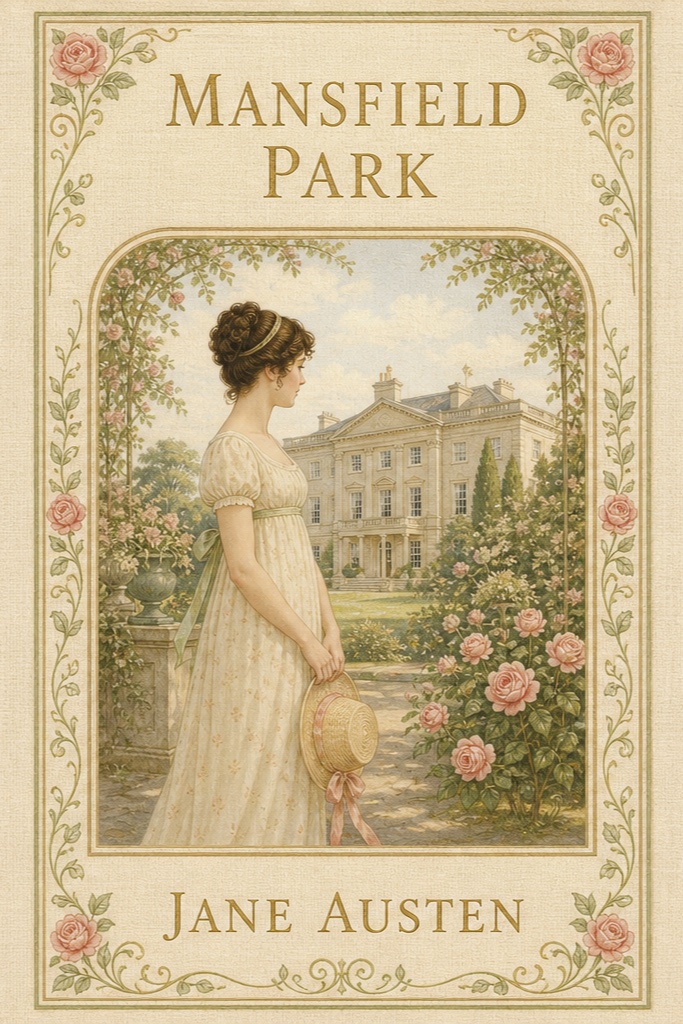

Timid, poor Fanny Price is raised among her wealthy relations and quietly holds to her principles as romance and scandal upend the household — Austen’s most searching novel of conscience and class.
Read full overviewShow less›
Set against the backdrop of early 19th-century England, 'Mansfield Park' by Jane Austen delves into the complex social hierarchies and moral dilemmas of its time. At its heart is Fanny Price, a poor relation raised among the privileged Bertram family, whose journey of self-discovery and moral integrity unfolds amidst the contrasting values of her relatives and friends. Readers will experience the tension between societal expectations and personal convictions, as well as the nuances of love, friendship, and familial duty. Through Fanny’s eyes, Austen masterfully critiques social norms and explores the importance of personal integrity, making this novel a timeless reflection on the human condition.
In 'Mansfield Park', Jane Austen intricately explores themes of class, morality, and personal growth through the life of Fanny Price. The novel serves as a critique of societal norms and the constraints placed on women, while emphasizing the importance of integrity and resilience in the face of adversity. Fanny's journey from a timid cousin to a morally self-assured woman highlights the necessity of personal conviction and the courage to choose one’s own path. Ultimately, Austen's work remains relevant today, urging readers to reflect on the balance between societal expectations and personal values, and the enduring quest for authenticity in an often superficial world.
- 1Class and Social Mobility
- 2Fanny Price: The Quiet Heroine
- 3The Influence of Environment on Morality
- 4Romantic Ideals vs. Reality
- 5The Role of Women in Society
Notable quotes
“‘I blush for you, Tom,’ said he, in his most dignified manner; ‘I blush for the expedient which I am driven on, and I trust I may pity your feelings as a brother on the occasion.’”
“‘Oh, for shame!’ cried Mrs. Norris. ‘A prison indeed? Sotherton Court is the noblest old place in the world.’”
“‘I like your Miss Bertrams exceedingly, sister,’ said he, as he returned from attending them to their carriage after the said dinner visit; ‘they are very elegant, agreeable girls.’”
A glimpse inside

The novel begins with the marriage of Miss Maria Ward to Sir Thomas Bertram, establishing a world where wealth and social standing dictate relationships and opportunities… Read moreThe novel begins with the marriage of Miss Maria Ward to Sir Thomas Bertram, establishing a world where wealth and social standing dictate relationships and opportunities. Austen illustrates the limited social mobility of women, as exemplified by Maria's sisters, who struggle to find equal matches due to their lack of fortune. Fanny Price, the impoverished cousin, serves as a lens through which the reader examines the rigid class structures of the time. Her lowly status both complicates her acceptance into the Bertram family and influences her self-perception. The stark contrast between Fanny's modest upbringing and the opulence of Mansfield Park highlights the pervasive nature of class distinctions, questioning the fairness of a society that values wealth over character. This theme of class is further explored through Fanny's relationships, particularly with the Crawfords, who embody a different set of moral values and social expectations, ultimately challenging Fanny’s understanding of her own worth. Show less
Fanny Price is characterized by her moral fortitude and quiet strength, setting her apart from the more flamboyant and socially adept characters around her. Read moreFanny Price is characterized by her moral fortitude and quiet strength, setting her apart from the more flamboyant and socially adept characters around her. Initially perceived as timid and shy, Fanny's true resilience emerges as she navigates the complexities of her relationships with her cousins, particularly Maria and Julia Bertram. Unlike her cousins, who are often swayed by societal pressures and romantic entanglements, Fanny remains steadfast in her principles, valuing integrity over popularity. Her discomfort in social settings and her reluctance to engage in the frivolities of her relatives showcase her depth and introspection. Throughout the novel, Fanny's character development is significant; she evolves from a passive observer to a central figure who ultimately asserts her own desires and beliefs. Austen's portrayal of Fanny challenges the notion of traditional femininity, suggesting that strength can manifest in subtle, yet powerful ways. Show less
Read the full text — free
About the author
Jane Austen has 8 works free to read on Lumina, including Emma, Northanger Abbey, Persuasion.
All 8 books by Jane Austen →Frequently asked
Worlds to get lost in
Take Lumina everywhere
Read offline, listen to AI summaries, speed-read, and sync your progress across devices — free on iPhone.
Download for iPhone